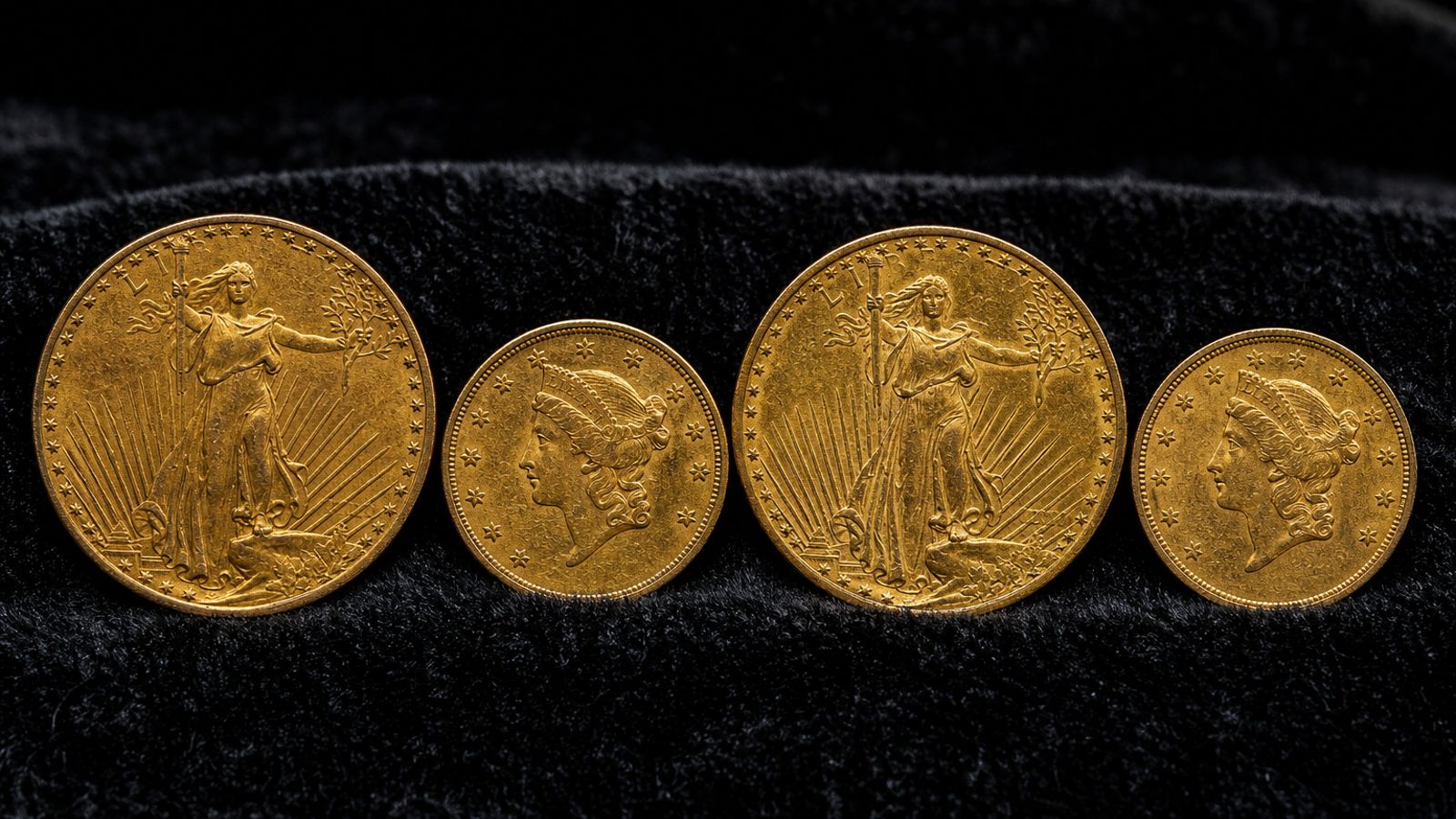
Pre-1933 U.S. gold coins are more than just precious metals—they’re pieces of American history. Once part of the nation’s currency system, these coins offer investors a unique combination of tangible gold value and historical scarcity. Today, premiums on these coins are at their lowest levels in two decades, creating a rare window of opportunity for collectors and stackers alike.
At PeerMetals, where community meets commerce, we believe it’s important to understand why these coins matter and how to make the most of this market cycle.
For investors accustomed to the straightforward world of modern bullion, a first encounter with Pre-1933 U.S. gold coins can be a baffling experience. You know that a $20 "Double Eagle" coin contains just under one troy ounce of gold, yet its price is significantly higher—sometimes thousands of dollars higher—than a modern one-ounce American Gold Eagle.
This price difference is known as the premium, and it is not arbitrary. It is the price of history, rarity, and survival.
Pre-1933 U.S. gold coins are not just bullion; they are historical artifacts from a bygone era of American finance. Their value is a fascinating blend of their intrinsic metal content and their powerful numismatic story. This guide from PeerMetals will unpack the key reasons why these coins command such a significant and durable premium, empowering you to invest in them with knowledge and confidence.
The Two Halves of Value - Intrinsic vs. Numismatic
To understand the price of a Pre-1933 gold coin, you must first recognize that it has two distinct components of value.
-
Intrinsic Value (The "Melt" Value): This is the base value of the gold content within the coin. A $20 Double Eagle, for example, contains 0.9675 troy ounces of pure gold. Its intrinsic value provides a solid "floor" price below which the coin will never fall, as it will always be worth its weight in gold.
-
Numismatic Premium (The "Collector" Value): This is the additional value above the gold content. This premium is driven by factors like rarity, condition, demand, and historical significance. For pre-1933 gold, this numismatic premium is almost always the largest and most important driver of its price.
Understanding this dual nature is the key to seeing these coins not as expensive ounces of gold, but as rare historical assets that also happen to contain gold.
PeerMetals Insight:
"The dual value of Pre-1933 gold is its greatest strength. It offers investors the safety net of a physical gold holding combined with the appreciation potential of a rare collectible. At PeerMetals, we encourage investors to see this not as a cost, but as a feature. You are acquiring two distinct assets—one historical, one metallic—in a single, beautiful coin."
The Catalyst of Rarity - Executive Order 6102
The single most important event that shaped the value of Pre-1933 gold occurred on April 5, 1933. On that day, President Franklin D. Roosevelt signed Executive Order 6102.
This order forbade the "hoarding" of gold coins, bullion, and certificates by U.S. citizens, effectively making private ownership illegal. Citizens were ordered to turn in their gold to the Federal Reserve in exchange for paper currency at the prevailing rate of $20.67 per ounce.
The Consequences:
-
Mass Melting: The vast majority of the U.S. gold coins in circulation were turned in and subsequently melted down by the government into large gold bars to be held at Fort Knox.
-
The Creation of Scarcity: This government action instantly transformed the surviving coins from common currency into rare artifacts. Millions of coins, representing the bulk of the nation's gold money supply, were permanently removed from circulation. The supply was decimated, ensuring the coins that survived—whether hidden away in private hands or held in foreign banks—would become exceptionally scarce.
This historical event is the bedrock upon which the entire market for Pre-1933 gold is built.
PeerMetals Insight:
"Executive Order 6102 is the origin story of the Pre-1933 gold premium. The U.S. government itself is responsible for creating the rarity we see today. Each surviving coin is, in essence, a refugee from a financial policy that ended the era of gold as circulating money in America. That story of survival is precisely what you are paying for in the premium."
The Key Drivers of the Numismatic Premium
Beyond the foundational rarity created by the 1933 recall, several key factors determine the specific premium on any given coin.
-
Rarity and Mintage: Even before the recall, some coins were scarcer than others. Coins from mints with low production runs (like Carson City or New Orleans) or specific "key date" years with low mintages are far rarer and command higher premiums than common-date coins from Philadelphia.
-
Condition (Grade): The state of preservation is paramount. A pristine, uncirculated coin that looks as it did the day it left the mint (graded MS-65 or higher by services like PCGS or NGC) is exponentially more valuable than a coin that is heavily worn from its time in circulation (graded VF or XF). Two coins from the same year can have a value difference of tens of thousands of dollars based on condition alone.
-
Design and Aesthetics: These are not just discs of metal; they are works of art. The $20 Saint-Gaudens Double Eagle, designed by famed sculptor Augustus Saint-Gaudens, is often called the most beautiful coin ever produced by the U.S. Mint. The classic, stoic design of the $20 Liberty Head has its own passionate following. This artistic appeal creates strong and sustained collector demand.
-
Historical Significance: Certain mints evoke a powerful sense of history. The "CC" mint mark of the Carson City Mint instantly transports a collector to the era of the Wild West and the Comstock Lode silver rush, adding a layer of romanticism and historical appeal that drives up its premium.
PeerMetals Insight:
"The premium on a Pre-1933 gold coin is a rich cocktail blended from these four ingredients. It requires an investor to think like a historian, an art critic, and a statistician all at once. At PeerMetals, our platform thrives on this specialized knowledge, connecting discerning collectors who understand that every scratch, every mint mark, and every design element contributes to a coin's unique value."
Bullion vs. Pre-1933 Gold: A Strategic Comparison
| Feature | Modern Gold Bullion (e.g., Gold Eagle) | Pre-1933 U.S. Gold (e.g., $20 Saint-Gaudens) |
| Primary Value Driver | Intrinsic metal content (the spot price of gold). | Numismatic factors (rarity, grade, demand). |
| Price Basis | Spot Price + a small, fixed premium. | A high and variable premium over the spot price. |
| Volatility | Moves in lockstep with the global gold market. | Can be influenced by collector market trends, independent of spot price. |
| Purpose | A direct hedge against inflation and currency risk. | A collectible historical asset with wealth appreciation potential. |
| Knowledge Required | Minimal; focus on spot price and reputable dealers. | Extensive; requires knowledge of grading, mintage figures, and history. |
PeerMetals Final Thoughts: Acquiring a Piece of American History
The premium on a Pre-1933 U.S. gold coin is not a barrier to entry; it is the price of admission to an exclusive club of historical asset owners. When you purchase one of these coins, you are not simply buying an ounce of gold. You are acquiring a tangible piece of American financial history—an artifact that survived a government recall, circulated during a pivotal era of growth and turmoil, and carries the artistic vision of its time.
These coins cannot be made again. Their rarity is sealed by history. Understanding the factors that create their value transforms an investor from a simple price-watcher into a sophisticated collector.
At PeerMetals, we provide a marketplace built on this understanding. We celebrate the unique, dual nature of these coins and connect knowledgeable buyers with trusted sellers, ensuring that these incredible pieces of history continue to be preserved and cherished by the next generation of collectors.
Ready to own a tangible piece of America's financial legacy? Explore our marketplace to find a curated selection of graded Pre-1933 U.S. gold coins from trusted sellers today!