Copyright © PeerMetals 2026
Browse silver goldbacks listed direct by collectors and independent dealers. Every card shows its price per ounce, so you can compare the price per troy ounce against the live silver spot price shown below, make an offer, or bid where a seller runs an auction.
Ending soonest in Silver bullion
Goldbacks are polymer notes with a measured layer of gold sealed inside, issued by US state series in denominations from 1/1000 oz upward. They trade on both gold content and collector demand.
Generic rounds and bars carry the tightest premiums because there is no sovereign mint or collector demand priced in. They are the efficient way to accumulate ounces.
Government-minted coins cost more per ounce but are recognised on sight, which makes them far simpler to sell on than a private-mint piece a buyer has to research.
Minting costs are near-fixed per piece, so the smaller the item the more you pay per ounce. Fractional pieces carry the widest premium of all.
Gold content is fixed by denomination and identical across every state series. Melt value is the gold spot price times that content; the price a Goldback actually trades at sits above it.
| Denomination | Pure gold | Melt value at $66.07/oz |
|---|---|---|
| 1/4 Goldback | 1/4000 oz | $0.02 |
| 1/2 Goldback | 1/2000 oz | $0.03 |
| 1 Goldback | 1/1000 oz | $0.07 |
| 2 Goldback | 1/500 oz | $0.13 |
| 5 Goldback | 1/200 oz | $0.33 |
| 10 Goldback | 1/100 oz | $0.66 |
| 25 Goldback | 1/40 oz | $1.65 |
| 50 Goldback | 1/20 oz | $3.30 |
| 100 Goldback | 1/10 oz | $6.61 |
Utah launched the first series in 2019 and a new state has followed most years. Each series has its own designs across every denomination, and collectors buy by state as well as by denomination.
A Goldback is a small polymer note with a measured layer of 24 karat gold sealed inside it, made by Valaurum using a vacuum-deposition process. One Goldback contains 1/1000 of a troy ounce of gold, and every larger denomination is an exact multiple. The gold is real and recoverable, which is what separates a Goldback from a gold-foil novelty note. Each note carries a state series design, a denomination and anti-counterfeit features, and newer print runs are marked "Alpha".
The gold in a 1 Goldback is worth only a few dollars, but printing, security features and distribution cost about the same per note whatever the denomination, so small notes carry the biggest premium. Goldbacks typically trade at roughly double their melt value, and that premium has held for years because the notes are used as spendable money and collected by series. Larger denominations carry a smaller premium per ounce, and sealed packs and full sets carry a premium of their own.
No government issues them and they are not United States legal tender. They are a voluntary private currency: businesses that choose to accept them post a daily exchange rate, and Utah, Nevada, New Hampshire, Wyoming and South Dakota have the most participating merchants. For most buyers on this page they are simply a way to hold gold in tiny, divisible units that can also be spent in the right places.
Confirm the series and denomination in the title match the photographs, since a 1/2 and a 1 Goldback look similar at thumbnail size. Uncirculated notes sell for more than handled ones, and PMG-graded 70 and star notes carry a collector premium well above an ungraded note. Compare the price per Goldback across sellers rather than the pack price, and check the live melt value in the table above so you know how much of the price is gold and how much is premium.
Pricing, payment, shipping and disputes
One Goldback holds 1/1000 of a troy ounce of 24 karat gold. A 5 Goldback holds 1/200 oz, a 50 holds 1/20 oz and a 100 holds 1/10 oz. The fractional 1/2 and 1/4 notes hold 1/2000 and 1/4000 oz. The table on this page shows the live melt value of each.
As gold, no: you pay roughly twice the metal value, so a 1 oz coin or bar is a far cheaper way to hold gold. As a spendable, divisible gold currency and a collectable series they have held their premium for years. Buy them for what they are, not as a substitute for bullion.
At businesses that voluntarily accept them, concentrated in Utah, Nevada, New Hampshire, Wyoming and South Dakota, at an exchange rate the Goldback company publishes daily. Outside those areas they are held or resold rather than spent.
Early Utah notes, especially first-year issues and complete sets, and limited editions such as the Washington DC note carry the largest collector premiums. PMG-graded 70 and star notes command more still. Common circulated notes from any series trade close to the standard exchange rate.
Sellers set their own prices. Many price directly off the live silver spot price with a fixed premium or discount, so their listings move with the market; others set a flat price. The live spot price used across the site is shown at the top of this page.
The premium covers minting, distribution and the seller's margin, so it widens as the piece gets smaller: bars and generic rounds sit tightest, sovereign coins cost more, and fractional pieces carry the most per ounce. Compare the same item across sellers before buying.
Yes, on any listing where the seller has enabled offers. Send your offer from the listing page and the seller can accept, decline or counter. Some sellers also run auctions, where you bid instead.
Every order is covered by PeerMetals buyer protection, and funds are only released to the seller after delivery. Each seller shows Metal Points and a rating built from their completed order history, so you can see their track record before you buy.
How to buy and what moves the price
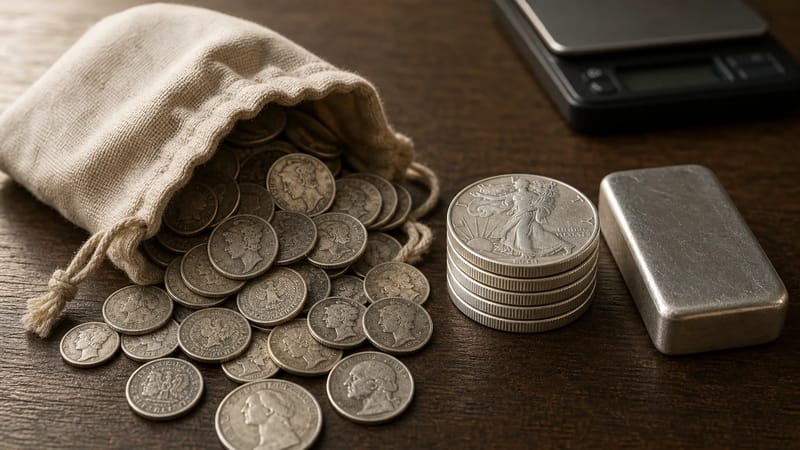
Dealer buybacks, pawn shops, coin shops, eBay and a peer-to-peer marketplace, compared with dated quotes and a worked example selling $500 face of junk silver and 20 Silver Eagles.
23 min read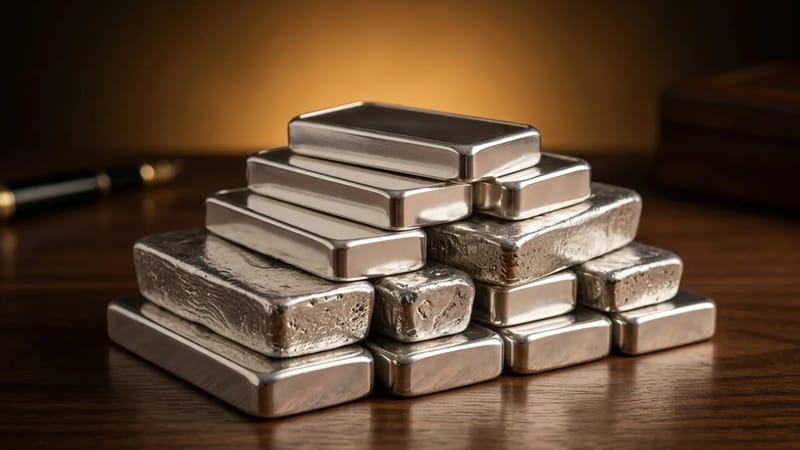
A "best silver bars" list is stale the day it's published -- premiums move daily. Here's the actual framework: how to check any bar's premium yourself, why size trades off against resale flexibility, what "recognized refiner" really means, and why a sealed assay card matters.
7 min read
A stack of gold has no beneficiary form and no recorded deed -- it passes by possession, not paperwork. The real estate-planning basics for physical metal: the step-up in basis, why an inventory matters more than a safe, and will vs. trust trade-offs.
7 min read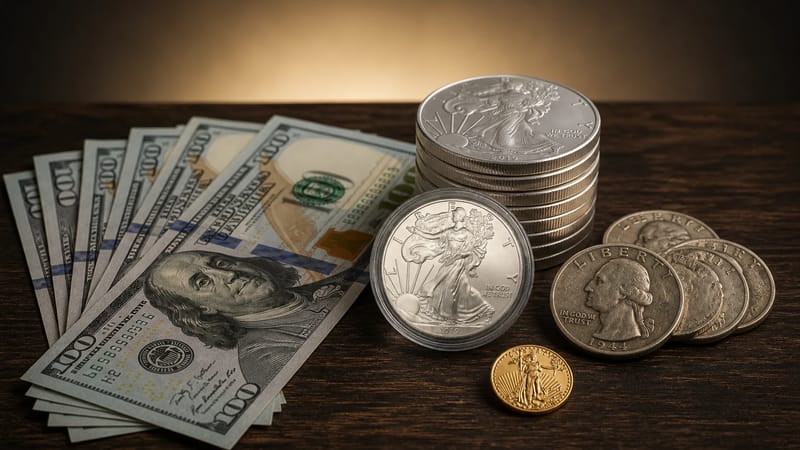
The first $1,000 decides more than any purchase after it — it sets the premium habits, the product mix, and the standard for every buy that follows. Here are three field-tested splits (weight-first, balanced, and metals-mixed), the four product types they draw from, and the five terms to know first.
8 min readList it alongside these results and reach buyers already searching for it. Free to list, and you set your own price — flat or tracking the live spot price.
Trusted by thousands of verified buyers and sellers
“Great seller great communication would buy from them again”
Francis Scialabba
“Everything was as described and packeged well. Good seller have bought from him a couple times now.”

Marc Gardner
“AWSOME THANKS AGAIN”

Melvin A Hendricks Jr.
“Absolutely beautiful silver. Awesome seller!”

Michigan Stacker
“Very nice coin, fast shipping, as described. Will buy again from this seller.”

Mike Bletz
“Great experience with the seller. I would definitely buy from them again ”
Chris Mcdermott
“Thanks Mike, for another great deal.”

Raul Gatchalian
“Different purchase, same great quality of products and service.”

Scott W
“Great product and fast shipping ”
recruitingsargent
“Excellent condition, great seller!!”

Brandon
“I'm very happy with the Morgan received from this seller and would gladly purchase from him again!”

BullionX, LLC
“Featured seller!!! Highly recommended!!! 💯”

Denny Flores