How Much Silver and Gold Should You Own? Prerequisites, Percentages, and the Age-in-Ounces Rule

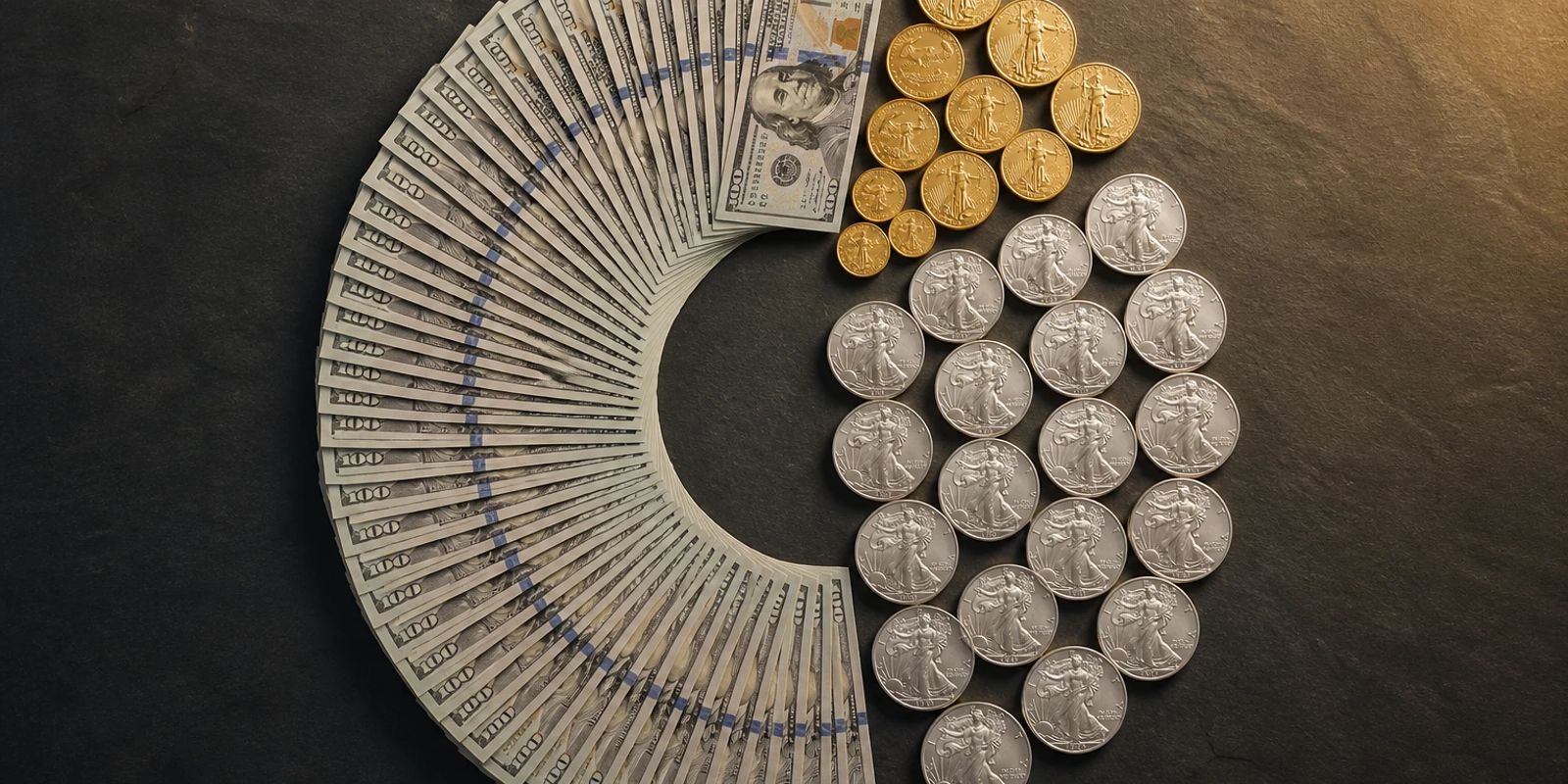
"How much silver should I own?" is the most-asked question in stacking, and anyone who answers with an exact number is guessing. What actually exists is a framework: prerequisites that come before the first ounce, a sensible ceiling on how much of your wealth lives in metal, and a handful of yardsticks the community uses to pace itself. This guide lays out all three — including the expensive lessons from people who skipped the ceiling.
Before the first ounce: the prerequisites
- High-interest debt goes first. Credit cards charge ~20%; silver doesn't reliably grow 20% a year. Carrying a $5,000 balance at 20% burns about $1,000 a year — a dozen ounces incinerated as interest. Silver protects money you have; it doesn't fix money you owe.
- Six months of cash comes second. Silver is not your emergency fund. Without a cash buffer, the first crisis forces you to sell metal — probably at the bottom, because crises correlate with bottoms. Cash protects the stack.
- Never finance metal. Ever. Borrowing at 15% to hold an asset with no yield inverts the entire premise, and debt turns every dip into a forced-selling risk. If you can't buy it with cash today, wait. The stack should reduce stress, not create it.

The ceiling: why 10–15% exists
Metals hedge a portfolio; they shouldn't be the portfolio. The cautionary tale is fresh: stackers who went all-in near silver's $121 January 2026 peak watched their entire savings drop ~40% within months. Diversification is what makes that survivable — silver crashes and your other assets hold; stocks crash and your metal holds. The 10–15% guideline isn't anti-silver; it's what lets you hold silver through exactly the drawdowns described in silver's crash history without ever being a forced seller.
Within that envelope, the silver-gold split and the product mix are their own decisions — covered in stack allocation and the ratio guide.
The yardsticks: pacing without pretending
"How much by age 30?" has no real answer — some stackers hold 50 ounces at 30, some hold 500, and both are fine because the habit matters more than the count. But yardsticks help pacing:
| Yardstick | How it works | Best for |
|---|---|---|
| Age in ounces | Own your age in ounces; +1 every birthday | A floor you can't rationalize away |
| 3% of income | Monthly allocation you barely feel | Starting without budget pain |
| $150/week plan | Coins first, bars as it grows, junk for change | Structured mid-level accumulation |
| Savings-account parity | Stack value ≈ cash savings as a milestone | The psychological tipping point |
| The 25-year horizon | 1 oz/week = 1,300 oz — a six-figure position | Seeing what patience actually builds |
You don't need money to start — you need a system. The entry price of stacking is one generic round near spot, or literally a junk-silver dime. Broke beginners become heavy stackers through small consistent buys, not windfalls. If the number feels too big, the number is wrong, not the goal — shrink the buy, keep the cadence. (Then follow the ladder in milestones.)

A worked example
Household with $6,000/month income, $60,000 in investable assets, no card debt, emergency fund done. The framework says: metals envelope of $6,000–9,000 total (10–15%); a 3% income flow ($180/month) filling it over three to four years; split perhaps 70/30 silver-gold by value; product mix per the first-$1,000 splits early on, graduating to 10 oz bars as weight grows. Every number scales linearly with your situation — the shape is the framework.
Frequently asked questions
Does home equity count in the 10–15%?
Most people apply the guideline to investable assets (cash, brokerage, retirement), excluding the house. Stricter and looser versions exist; the point is having a ceiling you set while calm.
Is more than 15% crazy?
It's a conviction bet, and conviction bets are fine when they're conscious — the failure mode is drifting all-in during a rally without deciding. If you exceed the guideline, do it in writing, with the drawdown math in front of you.
Cash buffer in the bank or in metal?
Bank. The buffer's entire job is being spendable on the worst day without selling anything — the day silver is most likely to also be down. Metal is the layer above the buffer, never the buffer.
Debt gone, cash buffered, ceiling set, system running — that's the full answer to "how much." The exact ounce count takes care of itself.