Timing Silver: Seasonal Patterns, Spikes, and the Real Cost of Waiting


Let's be precise about what this guide is: not a conversion to market timing — the community's verdict on that is settled (consistency wins; see stacking systems) — but an honest look at the timing textures silver actually has. Because it does have them: seasonal tendencies, spike-and-reset rhythms, and a brutally documented cost of hesitation. Stackers who know the textures buy the same amount with slightly better averages. Stackers who mistake them for a crystal ball stop buying entirely.
The seasonal tendency
Silver's calendar has a documented historical lean: summer months — June through September — have averaged soft (drifts of a few percent down), while January through April has historically leaned strong (gains averaging mid-single digits). The stacker application is mild, not dramatic: stack heavier into summer weakness, lighter into spring strength. Front-load the year's dip budget into the historically weak window; let the schedule run as normal otherwise.
The honest caveats: seasonality is a tendency, not a contract — geopolitics and Fed meetings overrule the calendar without notice (2026's January peak and spring crash inverted the script entirely), and a pattern known to everyone is partially priced by everyone. Treat it as a thumb on the scale, never the scale.
Spikes: don't chase, don't flinch
Silver's short-term rhythm is spike-pause-reset. A 6% day — like the jump to $77 that convinces everyone they "missed it" — is not a launch; fast vertical moves overwhelmingly pause and partially retrace, because they're liquidations and short-covers, not demand regime changes. The stacker rule: never chase a green candle. Wait for the cool-down, then resume the schedule. The mirror-image rule for red spikes lives in buying dips: a 9–10% weekly drop is where experienced stackers add, not exit.
What makes both rules work is the same fact: the fundamentals move slowly (deficits, demand — see the supply story), while the price moves violently around them. Headlines flip daily — ceasefire on, ceasefire off, oil up, Fed hawkish — and the metal whipsaws $65→$70→$65 without a single ounce of the thesis changing. Confusion stops most people. It shouldn't stop a schedule.

The cost of waiting, quantified
The market's recent record is a museum of hesitation costs. Silver sat below $58 for days while buyers "decided" — then printed $62 within a week ($4/oz, or $2,000 on a 500 oz plan). It dipped under $65 on war headlines and reclaimed $70 in days on a peace deal — nearly 10%, captured only by people already buying. Zoom out and the exhibit gets bigger: five years of "waiting for a better entry" in gold missed ~160%; 2025 alone handed silver holders +148% while spectators watched. And the 25-year version — one ounce a week, no timing at all — compounds to roughly 1,300 oz, a six-figure position built entirely out of not waiting.
Hesitation is a position. Waiting feels neutral — you haven't "done anything." But at zero ounces, you're fully positioned for exactly one outcome: prices never running again. Experienced stackers treat cash-on-the-sidelines as the riskiest allocation on the menu, because it's the only one with no metal in any scenario.
What the quiet money does
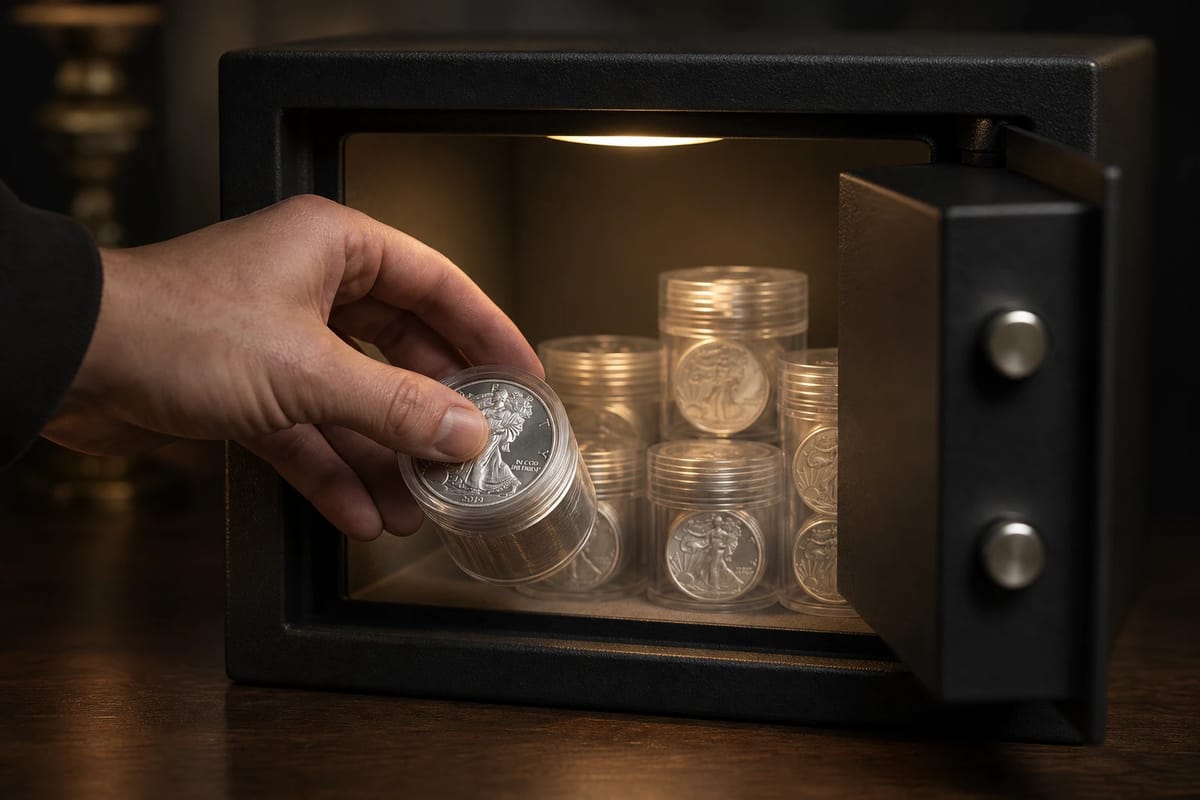
The most useful timing signal isn't on a chart — it's behavioral. Big stackers get quieter before runs: they accumulate when silver is boring, premiums are stable, and supply is easy, precisely because once momentum arrives, inventory tightens and premiums spike (the physical market's surge pricing — see premiums). By the time timing looks obvious, the good entries are gone. Preparation before momentum, never during it — that's the only market timing the community fully endorses.
| Timing move | Verdict | How stackers use it |
|---|---|---|
| Seasonal lean (summer-heavy buys) | Mild edge | Front-load the dip budget June–Sept |
| Chasing spikes | Reliably bad | Wait for the pause; resume schedule |
| Buying red weeks | Good with rules | Pre-set dip bonus, never the emergency fund |
| Waiting for the perfect entry | The most expensive move in stacking | Don't — the schedule is the entry |
| Buying when it's boring | The pro move | Quiet markets, stable premiums, easy supply |
Frequently asked questions
Should I pause buys in the strong season?
Most don't — they keep the base schedule year-round and only flex the bonus budget seasonally. Skipped months are how stacks stall (see the no-miss rules in systems).
The ratio moved 20% in a month without me doing anything — is that timing?
That's holding. Owning both metals means relative moves happen to you, favorably, with zero execution — the laziest and most reliable timing there is (the ratio guide).
What about buying before a big scheduled event (Fed, elections)?
Event-driven silver moves are coin flips with premiums attached. The schedule already owns metal in both outcomes; that's the whole advantage of not playing.
Use the calendar for a small edge, respect the spike rhythm, and let the schedule do the heavy lifting — because in silver, the expensive mistake has never been buying a little early. It's been waiting.