Who's Stacking Silver Now: Gen Z, Millennials, and the Quiet New Wave


The stereotype of the precious-metals buyer — older, wary, a little apocalyptic — is a decade out of date. The most striking shift in the market isn't the price; it's who's showing up. Recent surveys put physical ownership around 10.8% of Americans for gold and 11.6% for silver, and one 2,000-adult national survey found 38.6% of Americans aged 35–64 bought gold or silver in the past twelve months — with millennials buying more than any other age group, and 61% choosing physical coins and bars over ETFs.
Meanwhile the gap remains enormous: trillions in household cash and equities, and only about one in ten holding any physical metal. That combination — rapid adoption against a tiny base — is the story of the modern stacking wave.

Why the young are stacking
Gen Z and millennial stackers tell a remarkably consistent story. They watched inflation spike, housing run out of reach, and money printed at scales that made saving cash feel like a leak. Their response wasn't the stock market their parents defaulted to — it was hard assets, and silver in particular, because silver is reachable. One ounce costs less than a night out. You can start small, hold it in your hand, and owe nothing to a platform, a password, or a counterparty.
There's also a time-horizon advantage the older cohort can't buy back: a 25-year-old stacking a few ounces a month for fifteen years builds quietly what a 40-year-old starting late has to buy in expensive chunks. The habit compounds harder than the metal. (That math is the heart of the milestones guide.) And the culture spreads natively online — stack updates, dip memes, and the community's in-jokes travel through the same shorts and feeds that used to sell sneakers.

The five stacker archetypes
| Type | Signature behavior | Strength / risk |
|---|---|---|
| The beginner | Small buys, still calibrating | Everything ahead of them / premium mistakes |
| The consistent buyer | Same buy, every week or month | The compounding engine / none, honestly |
| The dip buyer | Waits for red days | Great entries / freezes when dips arrive |
| The premium lover | Fancy coins, proofs, designs | Joy of collecting / fewer ounces per dollar |
| The silent builder | No posts, no talk, just weight | Discretion / nobody knows to leave them the good deals |
Cutting across all five is the one divide that actually predicts outcomes: casual vs. serious. Casual stackers buy when excited, chase designs, and stop after rallies. Serious stackers buy on schedule, chase ounces, and keep stacking through boring markets. The difference isn't money — it's habits. Another honest split: blue-collar stackers skew toward generics and junk silver (maximum weight), white-collar toward Eagles and Maples (maximum recognition). Both stacks work; they're optimizing different constraints.
The market is splitting into two hobbies
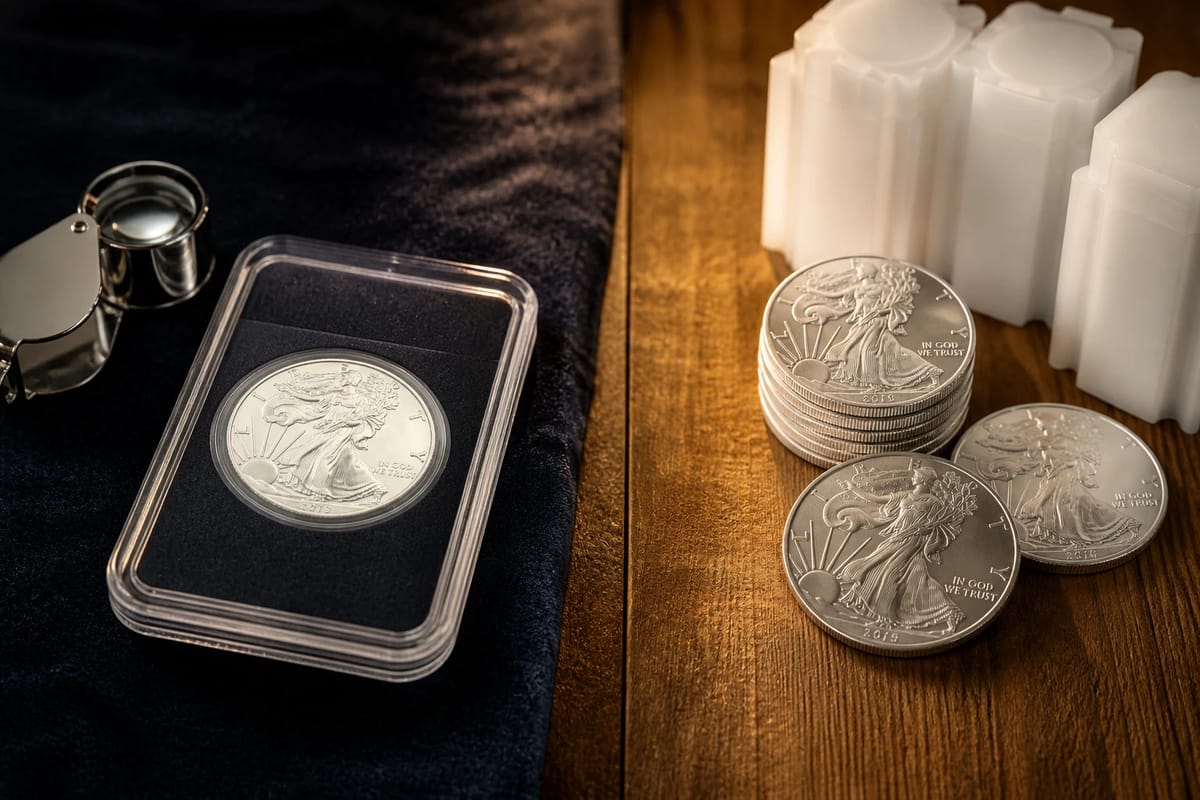
Dealers and show regulars report the same scene: at coin shows, bullion sits quietly at spot while collectible coins change hands briskly — and back home, online marketplaces add new weight-focused buyers every day. The old unified "coin hobby" is separating into collectors (chasing history, rarity, and stories — see grading basics) and stackers (building wealth in ounces, quietly, every month). Neither is wrong; they're different games sharing a metal. Knowing which game you're playing — and pricing accordingly — is half of buying well (bullion vs. numismatics covers the line).
Why the shift matters to you: the survey's non-buyers named one obstacle more than any other — not doubt about the metal, but dealer markups. That friction is exactly what peer-to-peer buying removes: stackers selling to stackers, priced against live spot instead of a retail spread. The new wave isn't just buying more metal; it's routing around the old toll booths.
Frequently asked questions
Is silver stacking still a niche?
By ownership, yes — roughly one in ten Americans holds physical silver, which is precisely the opportunity: the buying wave is large and the owner base is still small. Markets reprice when niches stop being niches.
I'm starting at 40+. Am I too late?
You have less runway and usually more capital — a different equation, not a worse one. Bigger consistent buys and an earlier gold allocation close the gap. Start with your first $1,000 and the first-timer checklist.
Which archetype should I be?
The consistent buyer, with a dip rule bolted on. Every other archetype works best as a flavoring, not the recipe — details in stacking systems.
The new wave of stackers isn't waiting for permission or a perfect price — they're building small, weekly, and quietly. Whichever generation you belong to, that's the part worth copying.