Silver Stacking Systems That Work: DCA, the 52-Week Challenge, and the No-Miss Rule

Ask a heavy stacker how they built their position and you'll almost never hear a story about a brilliant entry. You'll hear about a schedule. The uncomfortable truth of silver stacking is that the metal was never the hard part — showing up every week or every month was. The stackers who build something real aren't the most knowledgeable; they're the most consistent.
That's why the community has evolved a whole toolbox of buying systems: rules that remove the decision from every purchase. This guide collects the ones that actually survive contact with real life — and the math behind why boring beats brilliant.
Dollar-cost averaging: the default that wins
The simplest system is the strongest: buy the same dollar amount on the same schedule, regardless of price. $200 a month buys more ounces when silver is cheap and fewer when it's expensive — over a year, your average cost smooths itself out with zero forecasting. Compare the four buyer types the community jokes about: the weekly buyer, the monthly buyer, the dip-waiter, and the random buyer. The dip-waiter sounds smartest and usually freezes when the dip actually arrives; the random buyer skips more months than planned. Weekly and monthly win every time — not because they're clever, but because they never miss.
If you prefer thinking in metal instead of dollars, the ounce-based version is the 52-week challenge: one ounce every week for a year. Thirteen weeks in you're holding real weight; fifty-two weeks in you've built a stack most people never will — and, more importantly, the buying became automatic somewhere around month three.

Percentage rules: size the habit to your income
- The 3% rule. Allocate 3% of monthly income to silver — small enough that you don't feel it, consistent enough to matter. $5,000 a month becomes $150 in silver, every month, without a budget fight.
- Pay-silver-first (10%). The aggressive version: 10% of every paycheck goes to metal before bills and fun, treating ounces like a bill you owe your future self.
- The age-in-ounces yardstick. Own your age in ounces, then add at least one per birthday. It's not magic — it's a measuring stick you can't lie to.

The momentum rules: protecting the streak
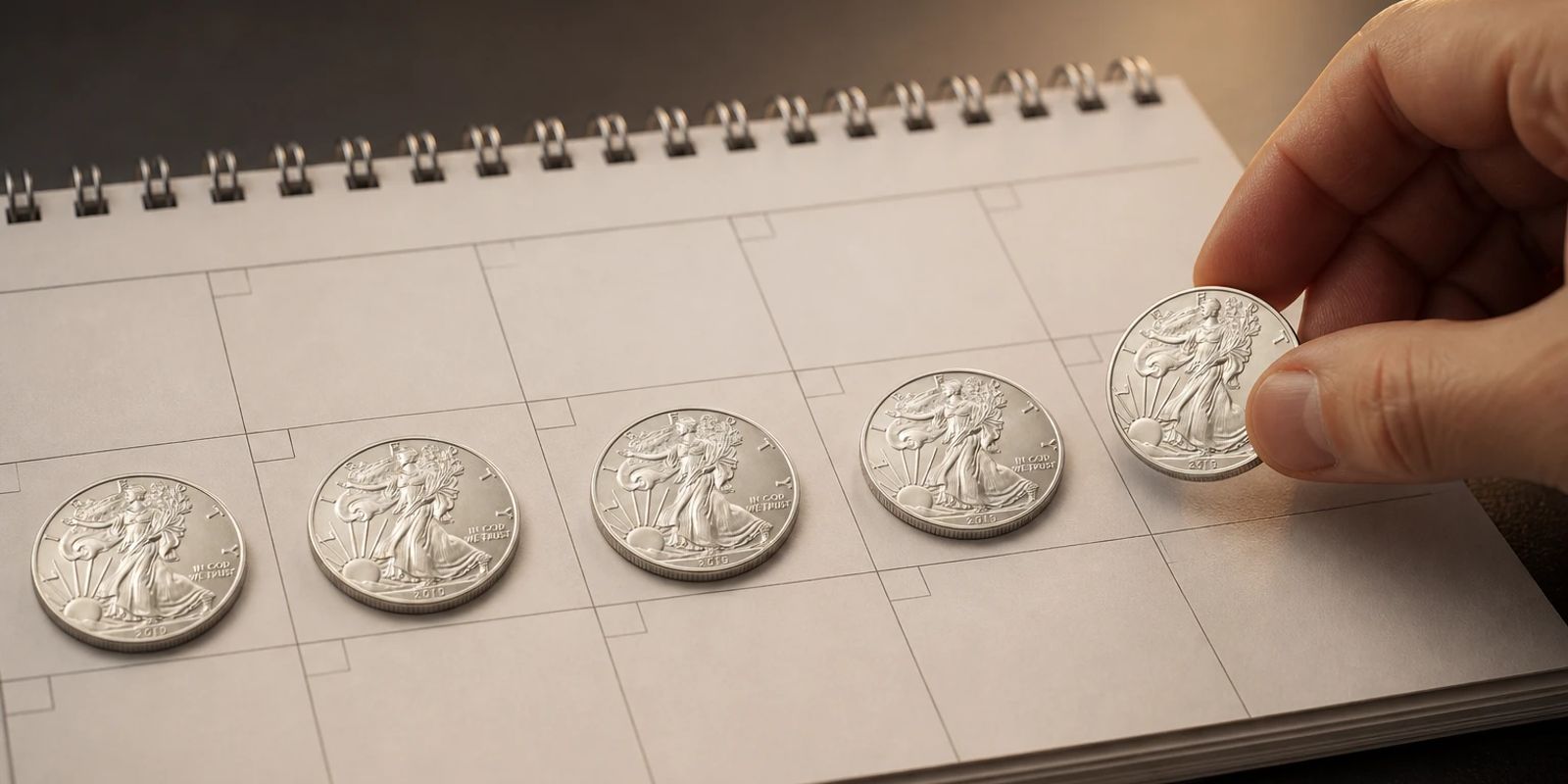
Every system dies the same death: a skipped buy that becomes two, then six. The community's guardrails are blunt for a reason. The no-miss-month rule: stack something — even one ounce — every single month, no matter the price or the news. The never-miss-two rule is the weekly version: missing one week is life; missing two in a row is how the habit breaks and "I'll buy later" begins.
Some stackers anchor the habit to payday: first Friday of every month, paycheck clears Thursday, buying happens Friday. Price high, buy anyway; price low, buy anyway. Twelve months, twelve buys, done. The point of an anchor day is that the decision was made once, in advance — which is exactly what makes it survive volatile weeks.
Add a dip bonus without breaking the system. The dip allocation rule keeps your fixed buy untouched but adds 20–30% extra when silver drops meaningfully — $100 becomes $120 on red weeks. You lower your average cost without draining cash or turning into a market timer. Dips stop being scary when they're part of the plan.
Choosing your system
| System | Cadence | Best for |
|---|---|---|
| Fixed-dollar DCA | Weekly or monthly | Almost everyone — the default |
| 52-week challenge | 1 oz weekly | Beginners building the habit |
| 3% of income | Monthly | Budget-sensitive starters |
| Pay-silver-first 10% | Every paycheck | Aggressive accumulators |
| First-Friday anchor | Monthly | People who skip without a fixed day |
| DCA + 20% dip bonus | Weekly + on drops | Stackers who can't resist red days |
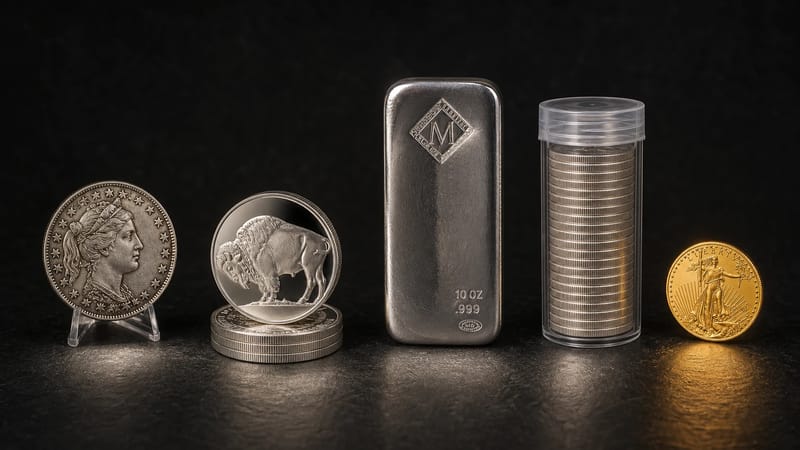
Whichever you pick, pair it with low premiums — a system that overpays 20% over spot compounds the wrong number. Our premium playbook covers the ceilings, and the milestones guide shows what the system builds toward. When the buying becomes automatic, what you buy matters more than when — that's covered in coins vs. bars vs. rounds.
Frequently asked questions
Is DCA really better than buying dips?
For most people, yes — not mathematically in every backtest, but behaviorally in every real life. Dip-waiting requires you to act on the scariest days; DCA requires nothing but a calendar. The system you'll actually follow beats the system that's optimal on paper.
What if I genuinely can't afford an ounce some months?
Buy smaller — a few junk-silver dimes count. The streak matters more than the size; consistency is the asset you're really building. See how much you should own for the prerequisites.
When do I stop?
Most stackers never formally stop — they graduate. The buys continue but shift toward larger bars, then gold. That evolution is its own story: the five phases every stacker goes through.
Pick a number, pick a day, protect the streak. Everything else in stacking is downstream of that.