



Copyright © PeerMetals 2026
Europe's best-selling silver bullion coin, launched in 2008 as the silver companion to the gold Philharmonic (first struck in 1989, itself once the world's best-selling gold coin). Named for the Vienna Philharmonic, one of the world's most respected orchestras, both coins share the same music-themed design.


Austrian Silver Philharmonic melt value tracks silver spot price directly — this chart is the same live silver price used to calculate the melt value above, so you can see the trend behind today's number.
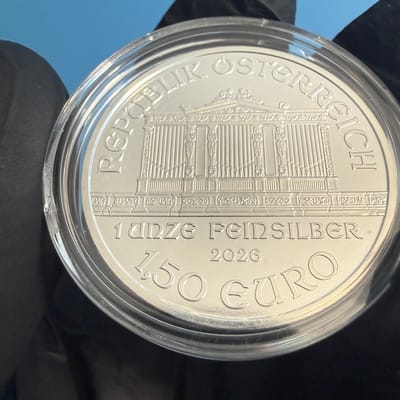
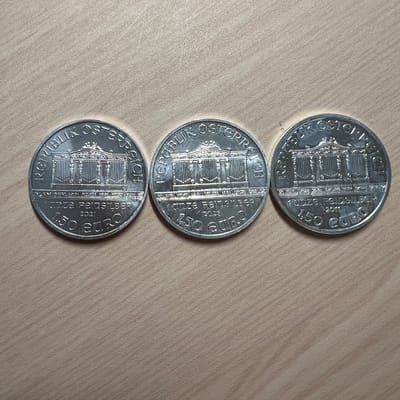
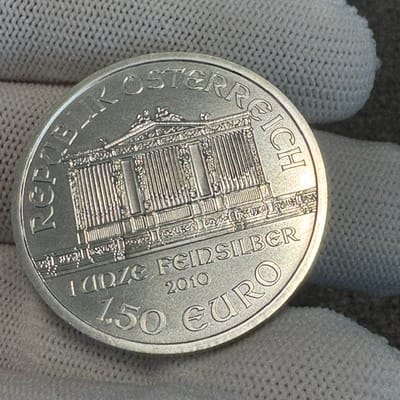
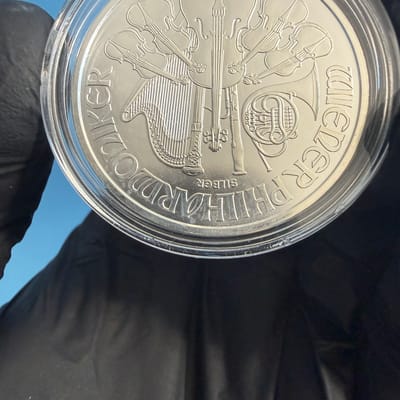
The Great Organ of the Vienna Musikverein concert hall, home of the Vienna Philharmonic orchestra — the same design used on the gold Philharmonic since 1989.
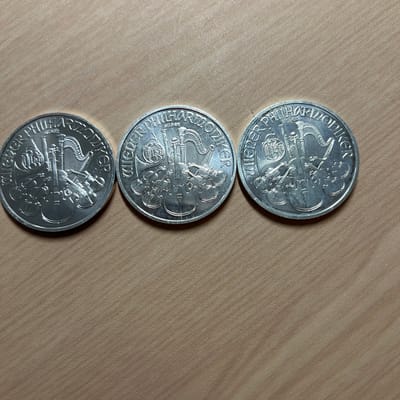
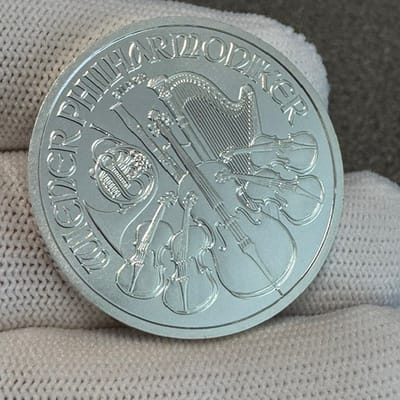
A grouping of orchestral instruments: a Vienna horn, bassoon, harp, and four violins, arranged around the coin's face value.
The Austrian Mint introduced the gold Philharmonic in 1989, and it became the world's top-selling gold bullion coin for several years running through the 1990s and 2000s. The silver version followed in 2008, adopting the same Musikverein organ and orchestral-instrument design so the two coins would visually match as a pair despite being separate bullion products.
Vienna's musical history runs deep — the city was home to Mozart, Beethoven, and Brahms, and the Vienna Philharmonic remains one of the most recorded orchestras in the world. The Austrian Mint leaned directly into that identity rather than using a national emblem or historical figure, making the Philharmonic one of the only major bullion coins built entirely around a cultural institution.
Unlike coins denominated in old pre-decimal units, the Philharmonic carries a face value in euros (€1.50 for the 1 oz silver version) — straightforward, but worth knowing since it looks unusual next to dollar- or pound-denominated bullion coins from other countries.
About the Austrian Silver Philharmonic
At the current silver spot price of $68.97/oz, the melt value of a Austrian Silver Philharmonic (1 troy oz, .999 fine silver) is approximately $68.97. This updates continuously with the spot price above — sellers on the marketplace typically price above melt value, since the premium covers minting, distribution, and dealer margin.
Melt value is the raw metal content only — what you'd get scrapping the coin. The premium above it pays for minting, distribution, and dealer margin, and on this marketplace specifically, it's set by each individual seller rather than one company's price list, so it's worth comparing a few listings rather than buying the first one you see.
Like any commodity, silver trades on global supply and demand — mine output and recycling on the supply side, industrial use, jewelry, and investment buying on the demand side. Short-term moves are usually driven by macro factors: interest rates, currency strength, and how much uncertainty investors are pricing into markets generally.
Government-minted bullion coins like this one are legal tender, widely recognized, and easy to resell — that recognition is usually worth the modest premium over generic rounds or bars of the same weight. For buyers who want to add to a physical position gradually, one-ounce coins are also just a convenient, liquid unit size.
This page shows melt value — spot price times pure metal content, recalculated on every page load. Individual seller listings add their own premium on top, and that premium (not the melt value) is what actually varies between sellers, so it's normal for listing prices below to sit above the number at the top of this page.