Silver Monster Box Guide: Price, Weight, Premiums and Resale


A sealed monster box of 500 American Silver Eagles cost between $35,710 and $40,830 from major U.S. dealers on 2 September 2026, at a silver spot price of about $65.44/oz on 3 September 2026. The silver inside is worth $32,720 at that spot, so the box carries a premium of roughly $6 to $16 per coin depending on the dealer and the year on the coins. This guide covers what a monster box is, how much it weighs, how the U.S. Mint distributes them, what other mints' boxes cost, how to check that a sealed box is genuine, and what dealers actually pay when you sell one. You can pull the live spot figure at any time from our live silver price page or the silver melt value calculator.
Silver monster box at a glance
| Item | American Silver Eagle monster box |
|---|---|
| Coins per box | 500 x 1 troy oz .999 fine Silver Eagles |
| Tube layout | 25 green plastic tubes of 20 coins |
| Silver content | 500 troy oz (15.55 kg, about 34.3 lb) |
| Gross weight | About 40 lb with box and tubes |
| Box dimensions | 14.75 x 8.5 x 4.5 in (CoinValues) to about 15 x 9 x 5 in (Blanchard) |
| Melt value at $65.44 spot | $32,720 |
| Cheapest sealed 2026 box, 2 Sept 2026 | $35,709.67 (Hero Bullion via FindBullionPrices) |
| Most expensive of 8 dealers tracked | $40,830.00 (APMEX) |
| Random-year sealed box | $34,389.05 best price (FindBullionPrices) |
| What the Mint charges its distributors | LBMA silver price plus $3.05 per coin |
What a monster box is
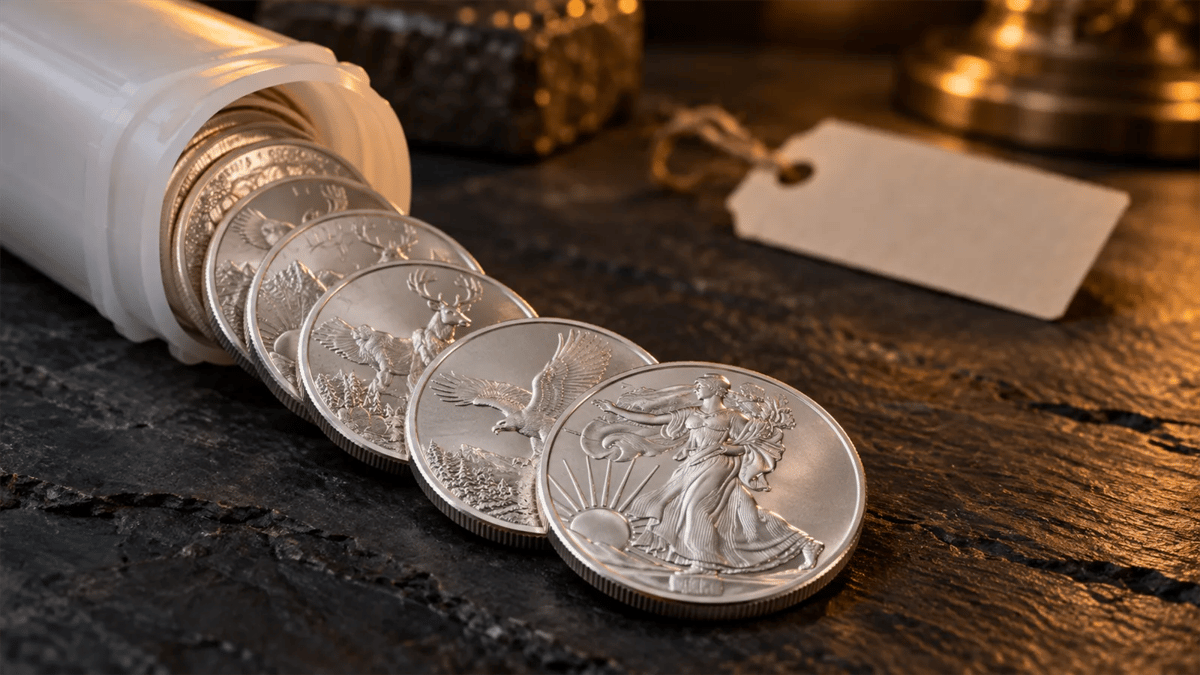
A monster box is the U.S. Mint's bulk shipping case for American Silver Eagle bullion coins. It holds 500 one-ounce coins in 25 hard plastic tubes of 20, inside a heavy green plastic case with the words UNITED STATES MINT and the Mint seal molded into the lid. The Mint has used the format since the Silver Eagle launched in 1986, and dealers nicknamed it the "Green Monster" for its color and its weight. CMI Gold and Silver notes the nickname probably owes something to Fenway Park's Green Monster wall.
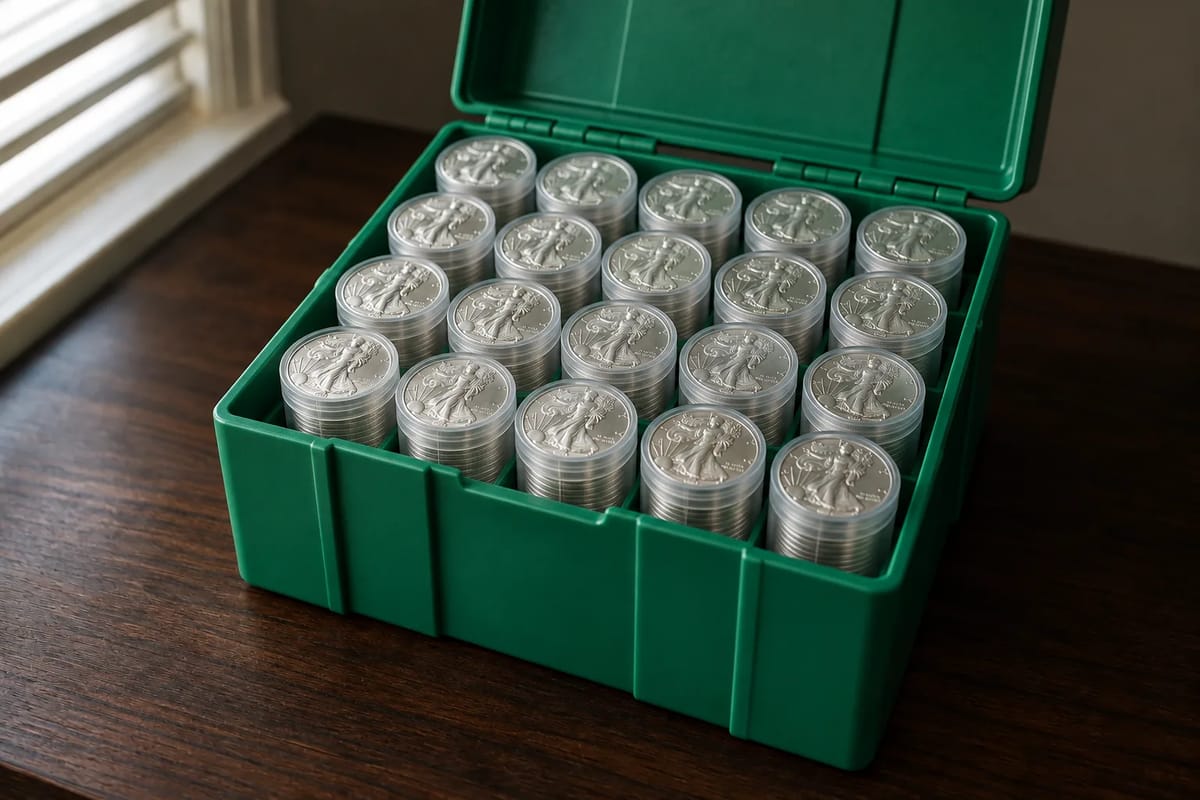
Three details matter for buyers. First, boxes leave the Mint sealed with straps or tape across the opening, and the seal is the only proof the contents have not been touched since they left the distribution system. Blanchard's guide describes official Mint tape; JM Bullion describes security straps or tape; Pinehurst Coins warns that older or back-dated boxes may not carry tamper-evident seals at all. Second, there is no certificate of authenticity. CoinValues puts it plainly: the sealed box with Mint tape is the authentication, and it stops being one the moment you cut the tape. Third, a box shipped from the Mint contains coins of a single production year, while dealer-held inventory may be mixed, so "random year" and "varied year" boxes should be checked for what they actually contain.
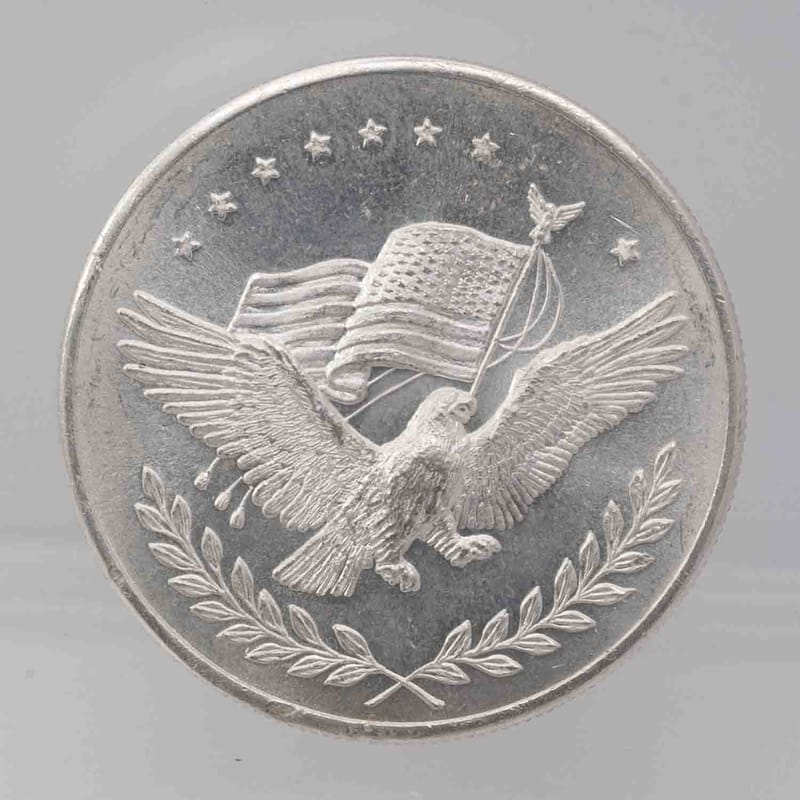
Each coin inside is a standard bullion Silver Eagle: 31.103 g of .999 fine silver, 40.6 mm across and 2.98 mm thick, with a $1 face value, per the specifications APMEX and U.S. Money Reserve publish. Bullion strikes carry no mint mark. Most are struck at West Point, but the Mint has run supplemental production at San Francisco and Philadelphia, and dealers such as SD Bullion sell those boxes separately as "(S)" and "(P)" boxes at higher prices. The reverse design changed in mid-2021 from John Mercanti's heraldic eagle to Emily Damstra's landing eagle, so 2021 boxes exist as Type 1 and Type 2, and everything from 2022 onward is Type 2 with the notched reeded edge the Mint added as an anti-counterfeiting feature.
Monster boxes from other mints
The U.S. Mint only sells one silver coin in a monster box, but every major sovereign mint now uses the format. The boxes are not interchangeable: tube counts, coin purity, box color and price all differ. Prices below are the best dealer price FindBullionPrices tracked on 2 September 2026 at $65.42 spot, with Texas Precious Metals' "as low as" bank-payment price as a second quote where available.
| Box | Mint | Purity | Layout | Box color | Best price 2 Sept 2026 | Premium over spot |
|---|---|---|---|---|---|---|
| American Silver Eagle (2026, sealed) | U.S. Mint | .999 | 25 tubes x 20 | Green | $35,709.67 (TPM: $39,076.18) | 9.2% |
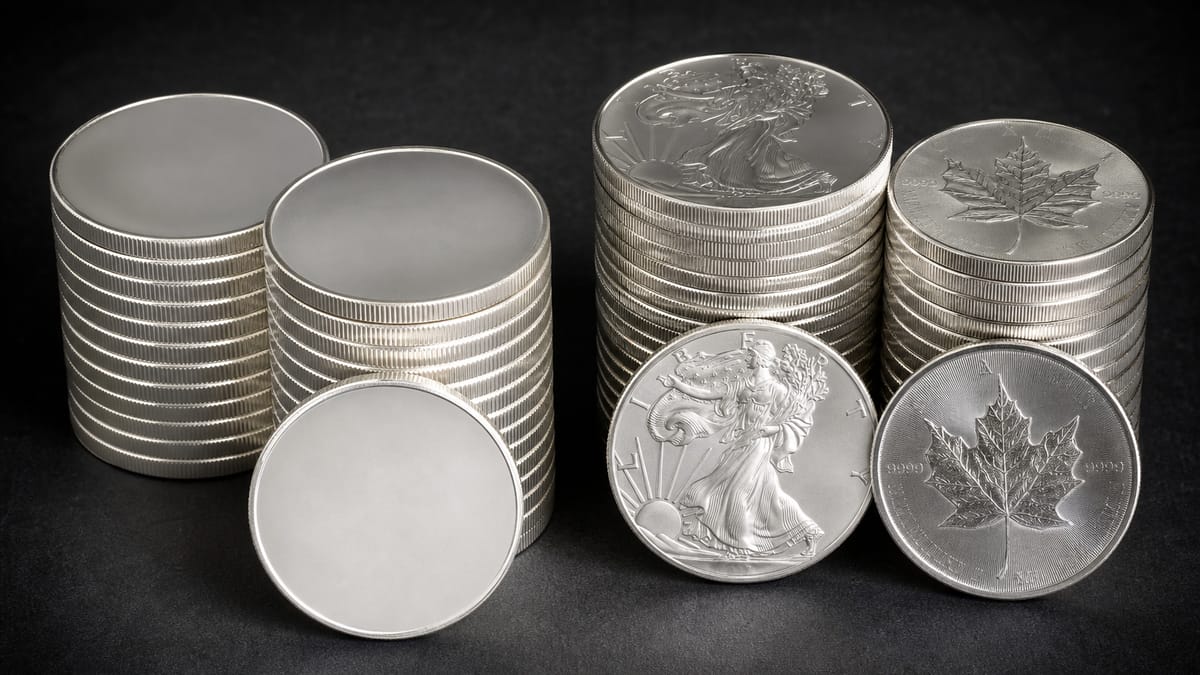
| Canadian Silver Maple Leaf (2026) | Royal Canadian Mint | .9999 | 20 tubes x 25 | Yellow | $33,996.32 (JM Bullion: $38,070.00) | 3.9% |
| Silver Britannia (2026) | The Royal Mint | .999 | 20 tubes x 25 | Varies | $34,535.00 (TPM: $36,576.18) | 5.6% |
| Silver Krugerrand (2026) | South African Mint | .999 | 500 coins | Varies | $34,685.00 | 6.0% |
| Silver Philharmonic (2026) | Austrian Mint | .999 | 500 coins | Red | $34,835.00 (TPM any year: $36,101.18) | 6.5% |
| Silver Kangaroo mini box | Perth Mint | .9999 | 250 coins | Blue and white | $17,733.81 (TPM 2026: $18,675.59) | 8.4% |
| 500 oz generic silver bar box | Various | .999 | 500 oz | Varies | $33,895.00 | 3.6% |
Two points where sources disagree. FindBullionPrices says the Philharmonic box uses 25 tubes of 20 like the Eagle, while APMEX's learning guide says 20 tubes of 25, so check the listing. Gold Stock Canada describes the Maple Leaf box as 25 tubes of 20 in a green case, while APMEX, FindBullionPrices and CMI all describe a yellow box of 20 tubes holding 25 coins; the yellow 20 x 25 layout is what U.S. dealers photograph. APMEX also notes that Britannias and Kangaroos ship in 250-coin boxes as well as the 500-coin format listed above.
The pattern in the price column is consistent across every dealer we checked: the Eagle box carries the highest premium of the sovereign boxes, and the Maple Leaf carries the lowest while offering higher purity. Blanchard, Coins Online and Gold Stock Canada all make the same point. The Eagle's edge is domestic recognition and liquidity, which shows up again when you sell.
Exact weight and dimensions
The silver alone is 500 troy ounces. Bullion Exchanges converts that to about 34.3 lb (15.6 kg), and Gold Stock Canada gives 15.55 kg for 500 coins at 31.1035 g each. Add the case and 25 tubes and the gross weight lands at "approximately 40 pounds" (Blanchard, Bullion Exchanges), "just over 40 pounds" (U.S. Money Reserve) and "40 pounds on a bathroom scale" (CMI). Blanchard's own storage section quotes 37 lb, and Coins Online says "over 35 pounds," so expect 37 to 40 lb depending on the packaging year.
For the box itself, CoinValues measures 14.75 x 8.5 x 4.5 inches; Blanchard gives roughly 15 x 9 x 5 inches with minor variation by production year. Either way, a box is about the size of a large shoebox and heavier than a bag of concrete mix. That footprint matters when you size a safe, since a stack of four boxes is 160 lb on one shelf.
How the Mint distributes monster boxes
The U.S. Mint does not sell bullion coins to the public. Its own page on becoming an Authorized Purchaser explains that coins move through a network of official distributors who "create a two-way market buying and selling to wholesalers, financial institutions, and other secondary retailers." The terms are public. Authorized Purchasers of American Eagle silver bullion pay the LBMA Silver Price plus $3.05 per coin, with a minimum order of 25,000 ounces, which is 50 monster boxes at a time. At $65.44 spot that minimum order is about $1.64 million of silver before the premium.
The Mint's current list of Authorized Purchasers for silver includes A-Mark Precious Metals, APMEX, Coins and Things (CNT), Dillon Gage, Fidelitrade, The Gold Center, Jack Hunt Coin Broker, Manfra Tordella and Brookes (MTB), StoneX Bullion and, in Europe, Bayerische Landesbank. SD Bullion, Upstate Coin and Gold and U.S. Gold Bureau are listed for gold only. The Mint also states that American Eagle silver bullion "remains on allocation" and that applications for new silver Authorized Purchasers are suspended, which is why dealers sometimes run short of current-year boxes and why premiums spike during heavy demand.
This chain explains the sealed-box premium. A box that goes from the Mint to an AP to a dealer to you has been handled by three parties, but if the straps are intact, nobody has opened it. Blanchard calls a sealed box a "recognized unit of trade," and APMEX notes that dealers and collectors prefer sealed boxes because the coins are guaranteed Brilliant Uncirculated and have a better chance at high grades. Once opened, the coins are still worth their metal, but the box is no longer a wholesale unit, and CoinValues notes that unsealed boxes are simply "worth less."
What a monster box costs: dealer prices on 2 September 2026
Start with melt. At today's spot, 500 ounces is worth $26,960.00; at the $65.44/oz price used in the tables below it was $32,720. Everything above that is premium. On 2 September 2026 FindBullionPrices tracked nine offers for a sealed 2026 Silver Eagle monster box and calculated an average price of $39,121.95. The dealer quotes, all at $65.42 spot:
| Dealer | Price (ACH/wire) | Per coin | Premium per coin | Premium over spot |
|---|---|---|---|---|
| Hero Bullion | $35,709.67 | $71.42 | $6.00 | 9.17% |
| Austin Rare Coins | $37,971.35 | $75.94 | $10.52 | 16.08% |
| SD Bullion | $38,474.03 | $76.95 | $11.53 | 17.62% |
| Summit Metals | $39,793.55 | $79.59 | $14.17 | 21.66% |
| JM Bullion | $40,805.00 | $81.61 | $16.19 | 24.75% |
| Silver.com | $40,805.00 | $81.61 | $16.19 | 24.75% |
| APMEX | $40,830.00 | $81.66 | $16.24 | 24.82% |
We checked two of those dealers' own pages the same evening. SD Bullion listed its 2026 sealed box at $38,528.25 for check or wire with silver at $66.07, and JM Bullion listed its 2026 box at $40,570.00 with silver at $66.15. Texas Precious Metals listed a 2026 sealed box at $40,775.28, or $39,076.18 "as low as" for bank payment. U.S. Money Reserve quoted $39,955.00 for a varied-year box. Card payments add about 4% at every dealer tracked; FindBullionPrices shows Hero Bullion's credit price at $37,138.06 against $35,709.67 for bank transfer.
The spread between the cheapest and most expensive dealer is $5,120 on identical government coins. That is the single biggest lever a buyer controls, bigger than the sealed-versus-opened question and bigger than a normal week of spot movement. Compare at least three quotes on the same day and price the box against the live spot on our silver price page before you wire funds.
Premium per coin: sealed, random-year, unsealed and partial
Premiums stack in a predictable order. Current-year sealed boxes cost the most, sealed random-year boxes cost less, and opened or mixed-date boxes cost the least, with single coins and mini boxes above all three on a per-coin basis. Quotes below are from 2 September 2026, and the premium column uses the $65.44 spot from our live price page.
| Format | Quote | Per coin | Premium per coin at $65.44 |
|---|---|---|---|
| 2026 sealed box, cheapest dealer | $35,709.67 (Hero Bullion) | $71.42 | $5.98 |
| 2026 sealed box, typical large dealer | $40,570.00 (JM Bullion) | $81.14 | $15.70 |
| Random-year sealed box, cheapest | $34,389.05 (FindBullionPrices best) | $68.78 | $3.34 |
| Random-year sealed box, Golden Eagle Coins | $36,940.00 | $73.88 | $8.44 |
| Any-year sealed box, Texas Precious Metals | $38,701.18 | $77.40 | $11.96 |
| Unsealed, various dates, Coins Online | $35,198.80 | $70.40 | $4.96 |
| 100-coin "mini monster box", 2026, JM Bullion | $8,294.00 | $82.94 | $17.50 |
| Single 2026 coin, U.S. Money Reserve | $79.91 | $79.91 | $14.47 |
Two things stand out. Golden Eagle Coins explains why random-year boxes are cheaper: they come from overstock inventory, the box is still Mint-sealed, and "no date is guaranteed." SD Bullion argues the opposite case for buying current-year boxes, that back-dated Eagles tend to gain premium as they age, and its own listings show it: on 2 September 2026 SD Bullion priced a sealed 2017 box at $45,028.25, a 2013 San Francisco box at $46,033.25 and a 2011-S box at $47,028.25 against $38,528.25 for 2026. CMI Gold and Silver is skeptical of that strategy, noting that only genuinely short-mintage years such as 1994 and 1996 held their premiums once a grading promotion ended. Treat back-dated box premiums as collector demand, not silver value.
How to verify a genuine sealed box
Run these checks before you pay for or accept a sealed box.
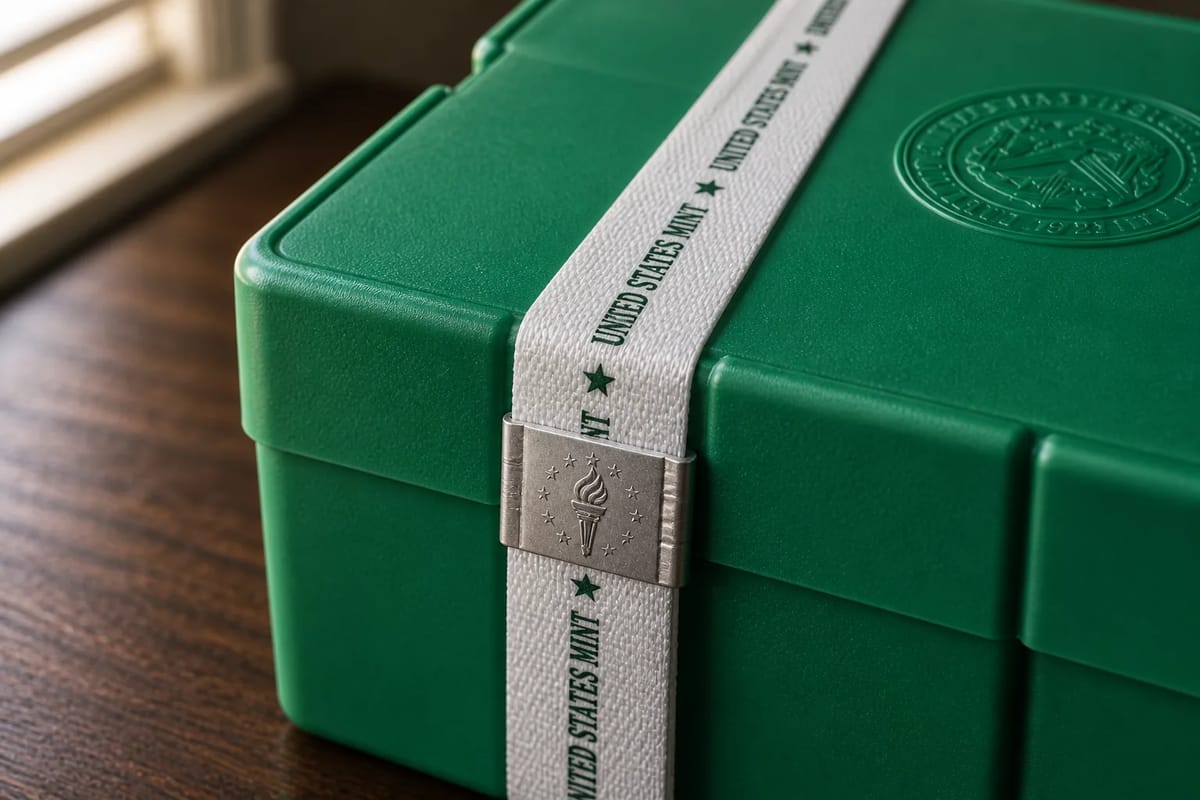
- Straps and tape. A box from the Mint arrives with security straps or official tape across the opening (JM Bullion, Blanchard). Look for cuts, re-taping or straps that have been slid off and back on. Pinehurst notes older boxes may never have had tamper-evident seals, so a strapless 2008 box is not automatically suspect, but a strapless 2026 box is.
- The lid. The Mint seal and UNITED STATES MINT are molded into the lid, not printed on a sticker (Scottsdale Bullion and Coin, JM Bullion, FindBullionPrices). Boxes from other mints carry their own raised seal.
- The label. The exterior carries production labeling and, for supplemental-facility boxes, the (S) or (P) designation dealers use in their listings. There is no certificate of authenticity inside, so a "COA" offered with a sealed box is a red flag rather than a bonus.
- Weight. Put it on a bathroom scale. CMI says a genuine box reads 40 lb; the silver alone is 34.3 lb. A box that is two or three pounds light is short tubes or wrong coins.
- Count and tubes. If the box is open, count 25 green tubes of 20. Coins from 2021 Type 2 onward should show the notched reeded edge (FindBullionPrices). Check a sample coin against 40.6 mm and 31.1 g.
- The seller. Sealed boxes only enter the market through Authorized Purchasers. A retailer who cannot say which AP supplied the box, or who is pricing thousands of dollars below the cheapest tracked dealer, is the problem, not the box.
CMI reports it knows of no one who has opened a genuine Green Monster Box and found anything other than Silver Eagles, and that most buyers stop opening boxes after their first one or two. The risk is not the Mint's box, it is a resealed box or a counterfeit case, and the six checks above catch both.
Storage, insurance and shipping
A monster box is dense. Blanchard's storage section makes three points that no other guide covers. First, a safe needs a weight rating and a floor that can carry it; four boxes are 160 lb before the safe's own weight. Second, standard homeowner policies usually exclude precious metals or cap coverage well below one box's value, so home storage needs a rider or a standalone policy backed by invoices and photographs. Third, allocated vault storage typically includes insurance in the fee, but pulling coins out of a sealed box permanently ends its sealed status, so decide before you vault it whether you will ever sell partial.
Shipping a 40 lb, $36,000 parcel is not a normal delivery. Dealers ship insured, and the free-shipping thresholds FindBullionPrices lists ($149 at Hero Bullion, $199 at SD Bullion and JM Bullion, $999 at Austin Rare Coins) are all cleared by a box. When you ship one out to sell, expect to pay for insured, signature-required carriage yourself, and confirm the buyer's maximum insured value per parcel before you pack. Keep the box in a cool, dry place away from humidity swings; the tubes and case protect the coins from contact damage, not from a damp basement.
Monster box vs 100 oz bars vs junk silver
Take the cheapest sealed 2026 box, $35,709.67, and ask what else that money buys on the same day.
| Option | Price 2 Sept 2026 | Silver bought with $35,710 | Cost per oz | Notes |
|---|---|---|---|---|
| Sealed 2026 Silver Eagle monster box | $35,709.67 for 500 oz | 500 oz | $71.42 | Most liquid U.S. product; highest premium |
| Five generic 100 oz bars | $6,468.97 each (FindBullionPrices best) | about 552 oz | $64.69 | Lowest premium; Johnson Matthey and Engelhard at $6,577 to $6,584 (0.6% to 0.7% over spot) |
| 90% junk silver by the $1,000 face bag | $44,612.60 per 715 oz bag | about 572 oz | $62.40 | Flagged "below spot" by FindBullionPrices; divisible to the dime |
The bars and the bag each put about 10% to 14% more silver in your hand than the Eagle box for the same money. The Eagle box buys recognition instead of ounces: Coins Online and Blanchard both note that dealers pay more, and ask fewer questions, for sealed sovereign boxes than for generic bars, and the buyback numbers in the next section show how much of that premium you get back. Junk silver has the opposite profile. It is the cheapest silver per ounce on the day, it divides into $1 face increments, and it never needs a seal, but no dealer treats a $1,000 face bag as a wholesale unit the way it treats a sealed box. Our junk silver guide explains the 715 oz convention and the junk silver calculator prices any face value against live spot. For the coin-versus-round trade-off in general, see rounds vs coins.
How to sell a monster box and what the spread looks like
Selling is where the sealed premium proves its worth or does not. The U.S. Mint's AP network is a two-way market, and every large retailer posts a sell-to-us price. Live quotes from 2 September 2026:
| Buyer | What they buy | Buy price | Per coin | Versus $65.44 spot | Same dealer's sell price | Round-trip spread |
|---|---|---|---|---|---|---|
| Golden Eagle Coins | Sealed random-year 500-coin box | $32,355.00 | $64.71 | $0.73 under spot | $36,940.00 | $4,585 (12.4%) |
| JM Bullion | 2026 Silver Eagle, per coin | $67.59 | $67.59 | $2.15 over spot | $40,570.00 per box | $6,775 (16.7%) on 500 coins |
| JM Bullion | Random-year Silver Eagle, per coin | $61.34 | $61.34 | $4.10 under spot | n/a | $30,670 for 500 loose coins |
| JM Bullion | Cull Silver Eagle, per coin | $58.34 | $58.34 | $7.10 under spot | n/a | Damaged or milk-spotted coins |
Read those rows together and the sealed-box premium looks different from the buy side. JM Bullion's buyback for a current-year Eagle is $67.59 a coin, so a sealed 2026 box sells back for about $33,795 against a purchase price of $40,570 at the same dealer. Buy the same box from the cheapest dealer at $35,709.67 and the round trip shrinks to about $1,900, or 5.4%. Random-year loose coins fetch $4.10 under spot at JM Bullion, while Golden Eagle Coins pays $0.73 under spot for the same coins if they are still in a sealed box. That gap, roughly $1,700 per box, is what the seal is worth on the day you sell.
Practical steps, drawn from APMEX's selling guide and the dealer pages: get quotes from at least two AP-level dealers and one local shop, since coin shops "often offer lower prices to cover their overheads"; lock the quote before you ship, because bullion buyback prices move with spot by the minute; ship insured with a signature; and keep the invoice, because APMEX notes long-term gains on bullion coins are taxed at the 28% collectibles rate and losses can offset other gains. Selling coin by coin to collectors or on a marketplace usually beats dealer buyback per coin, but a 500-coin box sold that way is 500 transactions. On PeerMetals, sellers list tubes and full boxes against live spot, and listings show the seller's price next to the current spot figure, so buyers on the marketplace can see the premium before they click, and sellers can list a box without waiting for a dealer's quote window.
Do partial boxes make sense?
Sometimes. The per-coin math from 2 September 2026 shows the cost of buying small. JM Bullion's 100-coin 2026 "mini monster box" in a Pelican case is $8,294, or $82.94 a coin, against $81.14 a coin for the full 500-coin box, a $1.80 per coin surcharge for the smaller case. Gold Stock Canada quotes a half box of 250 Maple Leafs at roughly the same per-coin rate as a full box in Canadian dollars. Perth Mint's standard Kangaroo box is 250 coins and, at $17,733.81 on FindBullionPrices, carries an 8.4% premium, slightly below the 9.2% on a full Eagle box.
The real trade-off is on the way out. A full sealed box is a single wholesale unit that Golden Eagle Coins will buy near spot without opening. Split it into tubes and each tube is priced as loose coins. If you expect to sell in pieces, a sealed box was never the right purchase; buy tubes of 20, accept the slightly higher premium per coin, and keep the option to sell one tube at a time. If you plan to hold the whole position for years, buy the sealed box from the cheapest quote you can find, put the receipt with the box, and leave the straps alone.
Frequently asked questions
How much does a monster box of silver cost right now?
On 2 September 2026, with silver at about $65.44, a sealed 2026 Silver Eagle monster box ranged from $35,709.67 (Hero Bullion) to $40,830.00 (APMEX) across the dealers FindBullionPrices tracks, and random-year sealed boxes started at $34,389.05. The silver inside is worth $32,720 at that spot. Multiply the live spot from our silver price page by 500 and add $3,000 to $8,000 for a current estimate.
How many coins are in a monster box?
A Silver Eagle monster box holds 500 one-ounce coins in 25 tubes of 20. Maple Leaf and Britannia boxes also hold 500 coins but in 20 tubes of 25. Perth Mint's Kangaroo box holds 250 coins, and dealers such as JM Bullion sell 100-coin "mini monster boxes" in their own cases, which are not Mint packaging.
How much does a silver monster box weigh?
The 500 troy ounces of silver weigh about 34.3 lb (15.55 kg). With the case and tubes the box weighs 37 to 40 lb, and most dealers round to 40 lb. It measures roughly 14.75 x 8.5 x 4.5 inches.
Should I open a sealed monster box?
Not if you plan to sell it as a box. Golden Eagle Coins pays $0.73 under spot per coin for a sealed random-year box while JM Bullion pays $4.10 under spot for loose random-year coins, so the seal is worth roughly $1,700 on a 500-coin box at those quotes. Open it only if you intend to sell coin by coin or tube by tube.
Can I buy a monster box directly from the U.S. Mint?
No. The Mint sells silver bullion only to Authorized Purchasers, who pay the LBMA silver price plus $3.05 per coin with a 25,000-ounce minimum order. The Mint's own page says silver Eagle bullion "remains on allocation" and it is not accepting new AP applications. Retail buyers purchase from dealers who buy from those APs.
Is a monster box cheaper per ounce than buying single coins?
Usually, but the gap depends on the dealer more than the format. U.S. Money Reserve priced single 2026 Eagles at $79.91 and its box at $39,955, which is $79.91 a coin, no discount at all, while Hero Bullion's box worked out to $71.42 a coin. Compare the box price divided by 500 against the same dealer's single-coin price, and against other dealers' box prices, before assuming bulk is cheaper.
What is the cheapest way to hold 500 ounces of silver?
On 2 September 2026, five generic 100 oz bars cost about $32,345 and a $1,000 face bag of 90% junk silver (715 oz) cost $44,612.60, both below the per-ounce cost of the cheapest Eagle box at $71.42. Bars have the lowest premium, junk silver is the most divisible, and the Eagle box has the strongest resale. Use the silver melt value calculator to compare any of the three against live spot.