Understanding Platinum's Durability: Tarnish vs. Patina

Platinum Does Not Tarnish
Platinum is one of the noblest metals known, which means it strongly resists corrosion, oxidation, and tarnish even at high temperatures. Unlike silver, it never reacts with the sulfur compounds in air to form a dark film, so a platinum piece will not develop the chemical tarnish that plagues other jewelry metals. What platinum does develop over years of wear is a soft, satiny "patina," but that is a physical surface effect, not corrosion, and it can always be polished away.
Why Platinum Resists Tarnish
Tarnish is fundamentally a chemical reaction. A reactive metal at the surface combines with something in its environment, typically oxygen or sulfur compounds, to form a new compound that looks dull, dark, or discolored. Whether a metal tarnishes comes down to how chemically reactive it is.
Platinum sits among the noble metals, a small group prized precisely because they are among the least reactive elements on the periodic table. A noble metal resists giving up its electrons to oxygen, sulfur, and most acids, so the chemical reactions that drive tarnish simply do not get started. Platinum holds onto its bright, white-gray luster across decades, and it stays stable even when heated, which is one reason it is used in laboratory crucibles and industrial catalysts.
Tarnish Is a Chemical Change; Wear Is Not
It helps to separate two completely different things that can change how a metal looks. The first is a chemical change, where the metal itself is converted into a different compound at the surface. The second is a physical change, where the metal is still the same metal but its surface texture has been altered by abrasion. Platinum is essentially immune to the first and, like every metal, subject to the second. Confusing the two is the root of most misunderstandings about platinum's so-called tarnish.
PeerMetals Insight
When someone says their platinum ring "tarnished," they almost always mean it lost its mirror shine and went hazy. That is patina from wear, not a chemical reaction, and a quick polish restores the original gleam.
Tarnish vs. Patina: The Key Difference
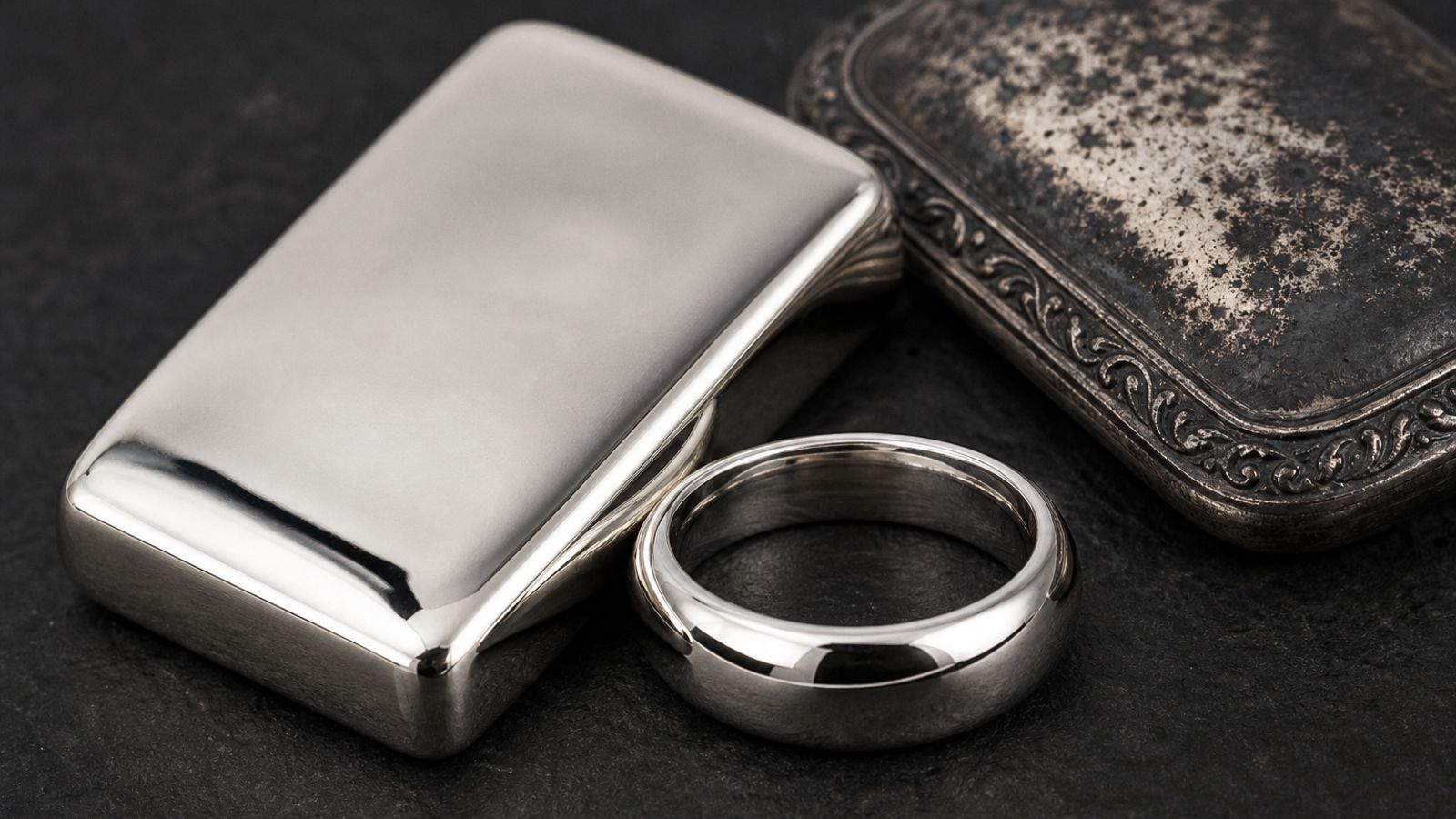
Because the words get used loosely, it is worth pinning down exactly how tarnish and patina differ. Tarnish is a corrosion product. The classic example is silver reacting with sulfur or hydrogen sulfide in the air to form black silver sulfide (Ag2S), the dark film that coats neglected silverware and silver jewelry. The metal at the surface has chemically become something else.
Patina on platinum is the opposite kind of phenomenon. It is a satiny matte finish built up from countless fine micro-scratches that accumulate through everyday handling. No new compound forms; the surface simply scatters light differently than a freshly polished mirror would. Many owners and jewelers actually prize this hazy, broken-in look, and it can always be polished back to a high mirror shine whenever the owner prefers.
| Property | Tarnish | Patina (on platinum) |
|---|---|---|
| Cause | Chemical reaction with sulfur or oxygen compounds in the air | Physical micro-scratches from everyday wear |
| What changes | The surface metal becomes a new compound (for example, silver sulfide) | Only the surface texture changes; the metal stays the same |
| Appearance | Dark, dull, or discolored film | Soft, satiny, matte sheen |
| Reversible? | Yes, by chemical cleaning or polishing | Yes, by polishing back to a mirror shine |
| Metals most affected | Silver, copper, and lower-karat gold alloys | Platinum (and many other worn metals) |
What Platinum Patina Looks Like and How to Manage It
Platinum patina shows up first on the high points of a piece, the curve of a band or the shoulders of a setting, where contact with surfaces is most frequent. Instead of a dark stain, you see a gentle softening of the shine, almost like the difference between a polished and a brushed metal finish. The color does not change; only the way light bounces off the surface does.
Embrace It or Polish It
How you handle patina is purely a matter of taste, because it does no harm to the metal.
- Embrace it. Let the satiny finish develop naturally for a warm, broken-in look that many people associate with a well-loved heirloom.
- Polish it. Have a jeweler buff the surface, or use an appropriate polishing cloth, to bring back the original high-gloss mirror finish.
There is one detail that makes platinum especially forgiving here. When platinum is scratched, almost no metal is actually lost; it is merely displaced, pushed aside rather than worn away. That is why a platinum band keeps its mass over decades even as it accumulates patina.
PeerMetals Insight
Because scratches displace rather than remove platinum, a band can be polished many times over a lifetime without meaningfully thinning, which is part of why platinum is favored for heirloom pieces.
Platinum vs. Gold vs. Silver: A Durability Comparison
Comparing platinum to the two other classic precious metals clarifies why it behaves the way it does. The behavior of each comes down to two things: how noble (unreactive) it is, and its physical properties.
Reactivity and Tarnish
- Platinum is a noble metal and does not tarnish. It resists corrosion and oxidation thoroughly, in any common alloy used for jewelry.
- Gold is also a noble metal, and pure gold does not tarnish either. However, lower-karat gold alloys contain larger proportions of more reactive metals such as copper and silver, and those alloying metals can tarnish or discolor over time.
- Silver is not a noble metal. It tarnishes readily, reacting with sulfur compounds in the air to form the dark silver sulfide film familiar to anyone who owns silverware.
Density and Physical Properties
Platinum is also remarkably dense and heavy. Its density is 21.45 g/cm3, making it denser than gold at 19.32 g/cm3 and roughly twice as dense as silver at 10.49 g/cm3. That heft is part of what gives platinum jewelry its substantial, quality feel in the hand. Platinum also has a very high melting point of 1768.3 C (3215 F), which contributes to its stability and durability under heat.
It is worth noting the purity differences too. Jewelry platinum is typically 95 percent pure and stamped PT950 or 950 Plat, while bullion platinum is refined to .9995 fine. The high purity of jewelry-grade platinum means there is very little reactive alloying metal present to cause discoloration in the first place, reinforcing its tarnish resistance.
Caring for Platinum
Caring for platinum is refreshingly simple, precisely because you never have to fight tarnish. The goal is only to keep it clean and to decide how you feel about patina.
- Routine cleaning. Soak the piece in warm water with a little mild dish soap, gently work it with a soft brush, then rinse and dry. This removes the oils and grime that dull any jewelry.
- Patina, your choice. Leave the satiny finish for a broken-in look, or have it polished to restore the mirror shine; neither choice harms the metal.
- Professional polishing. For a full restoration, a jeweler can buff out accumulated micro-scratches. Because platinum is displaced rather than lost, this can be repeated over many years.
- Sensible storage. Store pieces separately so harder gemstones and other items do not needlessly scratch the surface between wears.
The practical takeaway is straightforward: platinum does not tarnish, and the soft patina it develops over time is a harmless, reversible matter of personal taste rather than a flaw. Whether you let that satiny finish tell the story of years worn or polish it back to a bright mirror, the metal underneath stays essentially unchanged, which is exactly why platinum endures as a favorite for heirloom-quality pieces. If you are ready to start your own collection, you can explore platinum jewelry and bullion from trusted sellers on the PeerMetals marketplace.