Star Note Value Guide: What Your Star Note Is Worth in 2026


Most star notes are worth face value to a few dollars over it. US Currency Auctions' star note price guide lists a circulated Series 2013 or 2017 $1 star note at $1.25 to $2 and a crisp uncirculated one at about $3 (retrieved Sept 2026). The same guide puts a circulated modern $100 star note at $105 to $120 and an uncirculated one at $120 to $130.
The exceptions are what make star notes worth checking. Notes from print runs of 640,000 or fewer, notes from districts that only got one small run, and the Series 2013 $1 New York duplicates can be worth $60 to over $1,000 for a single note. A matched pair of the 2013 duplicates has sold for $7,200 at Stack's Bowers in 2021 and $25,000 on eBay in 2022, according to Coin World. This guide covers how to identify a star note, how to look up its run size, what each denomination is worth by condition, and how to grade, store, and sell one.
Star note value at a glance (Series 2009 to 2021)
The figures below come from US Currency Auctions' price guide for the common Federal Reserve Note versions of each series (retrieved Sept 2026). "Circulated" in that guide means Fine-12 through Extremely Fine-40 on the 70-point paper money scale. "Uncirculated" means a note with no folds, roughly 60 and above. Scarce-district notes from the same series are covered in a separate table further down.
| Denomination | Series | Circulated (F-12 to EF-40) | Uncirculated (60+) |
|---|---|---|---|
| $1 | 2013, 2017 | $1.25 to $2 | $3 and up |
| $1 | 2017A | $1.20 to $3 | $5 and up |
| $1 | 2021 | $1.25 | $3 |
| $2 | 2013 | $2.50 to $4.25 | $5 and up |
| $2 | 2017A | $2.35 to $4 | $5 and up |
| $5 | 2013 | $7 to $9 | $12 and up |
| $5 | 2017, 2017A, 2021 | $6 to $9 | $10 to $11 |
| $10 | 2013 | $14 to $25 | $30 and up |
| $10 | 2017, 2017A | $12 to $18 | $20 and up |
| $20 | 2009, 2013 | $24 to $30 | $35 and up |
| $20 | 2017, 2017A, 2021 | $21 to $26 | $28 to $30 |
| $50 | 2009 | $50 to $75 | $90 and up |
| $50 | 2013, 2017A, 2021 | $52 to $65 | $60 to $70 |
| $100 | 2009, 2009A | $110 to $125 | $130 and up |
| $100 | 2013, 2017A, 2021 | $105 to $120 | $120 to $130 |
Two things stand out. The premium is largest in percentage terms on the $1 and $2, where a crisp note fetches two to three times face. On $50 and $100 notes the premium is often under 20 percent, and SerialWorth's staff give the same range for a common-run 2009 $100 star, $105 to $115 circulated and $120 to $130 crisp. That is why serious star note collectors concentrate on the low denominations.
What a star note is and why the BEP prints them
A star note is a replacement note. The Bureau of Engraving and Printing (BEP) explains it this way on its serial numbers page: when an imperfect sheet is detected during manufacturing after the serial numbers have been overprinted, it must be replaced with a new sheet, and "a star sheet is used to replace the imperfect sheet." The BEP adds that reusing an exact serial number to replace an imperfect note "is costly and time consuming," so the replacement gets its own serial number with a star in place of the suffix letter.
The U.S. Currency Education Program (uscurrency.gov) states the same rule in one line: a star suffix "is used to identify notes that serve as replacements during the production process." The star note is not an error. It is the fix for an error, and it spends exactly like any other note of the same denomination.
Two facts about the accounting matter for value. First, every note of a given denomination and series is supposed to carry a unique serial number, which is why the BEP cannot simply reprint the spoiled one. Second, the BEP publishes what it prints. JM Bullion notes that the BEP's monthly production reports, which go back to 2003, itemize the star notes produced each month by denomination, series, district, and serial range. That public record is what every star note lookup tool is built on.
MyCurrencyCollection describes two kinds of star notes that look identical. Sheet star notes replace damaged sheets before cutting and are typically printed in runs of 640,000 notes or fewer. Regular star notes replace damaged 100-note packs after cutting and come in much larger runs, typically 1.28 million up to the maximum run size of 3.2 million. As that site puts it, "nothing visible will indicate which is which," so the only way to tell is to look up the serial number against the production tables.
How to identify a star note
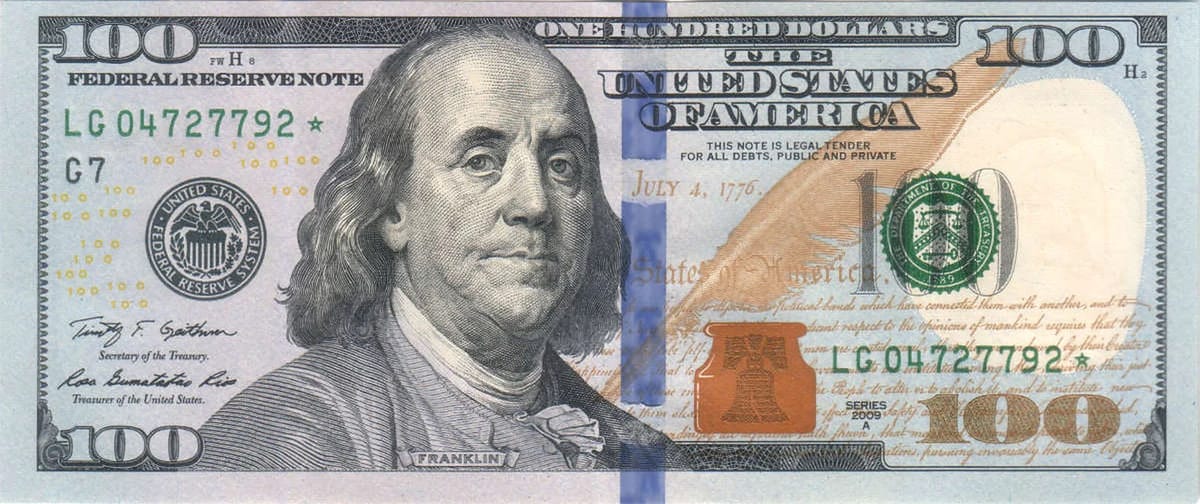
On every Federal Reserve Note printed since 1928, the star sits at the end of the serial number, replacing the suffix letter. The serial number is printed twice on the face, and both copies should end in a star. JM Bullion points out that the serial numbers usually sit in the upper left and lower right, except on the $1, where they sit in the lower left and upper right.
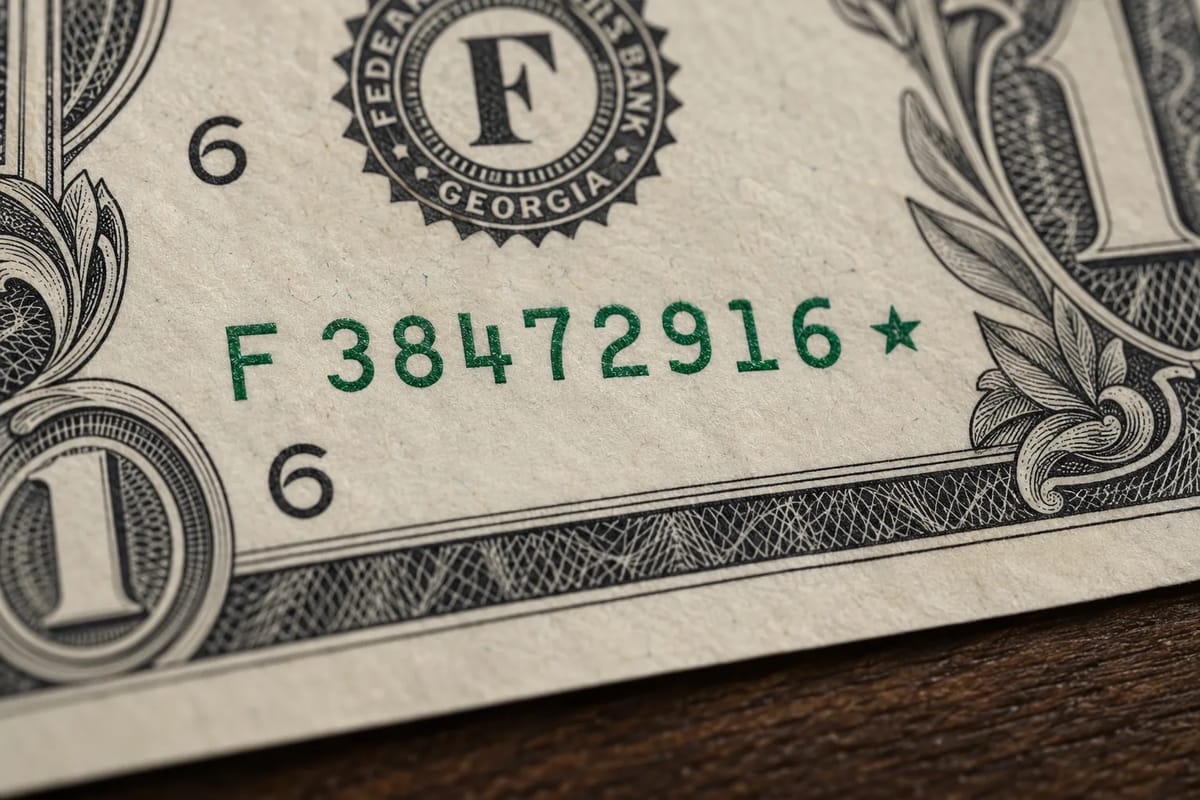
Older note types put the star at the front. JM Bullion says Silver Certificates, United States Notes, and Gold Certificates all place the star before the serial rather than after it, and that National Bank Notes never used star notes at all. US Currency Auctions gives both formats as examples, *75681423A and A32741568*, and calls the trailing star "the norm for modern day star notes." APMEX also notes the ink color follows the note: red stars on Legal Tender Notes, green stars on Federal Reserve Notes, and that a star printed as an outline only, rather than fully inked, may itself be an error note.
Reading the rest of the serial number
To look up a star note you need three things: denomination, series year, and Federal Reserve district. The series year is near the signatures. JM Bullion says it sits at the bottom left on the redesigned $5 through $100 and at the lower right on the $1. The district letter works differently by denomination, and the BEP's serial numbers page spells out the rule:
- $1 and $2 notes still use the old format of one letter, eight digits, and one letter (or a star). The first letter is the Federal Reserve Bank, A through L, and the same letter appears in the black seal to the left of the portrait.
- $5 and higher, Series 1996 onward have two prefix letters. The first letter identifies the series and the second identifies the district. The letter and number indicator on the face (for example L12) matches that second letter.
- The BEP does not use the letter O, because it looks like a zero, or the letter Z, which is reserved for test printings.
The series prefix letters on $5 and higher notes, per the BEP and uscurrency.gov, are: A for 1996, B for 1999, C for 2001, D for 2003, E for 2004, F for 2003A, G for 2004A, H and I for 2006, K for 2006A, J for 2009, L for 2009A, M for 2013, N for 2017, P for 2017A, and Q for 2021. So a $20 star note reading MB01234567* is Series 2013 from New York. The twelve districts are A Boston, B New York, C Philadelphia, D Cleveland, E Richmond, F Atlanta, G Chicago, H St. Louis, I Minneapolis, J Kansas City, K Dallas, and L San Francisco. Think of the district letter as the paper-money version of a coin mint mark: it tells you which of twelve possible populations your note belongs to.
One more identifier matters for the 2013 duplicates discussed below. According to uscurrency.gov, notes printed at the BEP's Fort Worth, Texas facility carry a small "FW" in front of the face plate number, while Washington, D.C. notes do not.
Why print-run size drives star note value
Star notes are printed in numbered batches called runs, and the run size is the single biggest factor in what a modern star note is worth. MyCurrencyCollection, which maintains the most widely used lookup tool, states that 3.2 million notes is the largest run size, that "640,000 is generally the threshold of run size when star notes start being considered more rare," that many small runs fall between 160,000 and 640,000 notes, and that some have been printed in quantities of 16,000 or less. GovMint repeats the 640,000 figure and adds that runs of 16,000 or fewer are "especially desirable."
The reason is set collecting. Many collectors try to obtain one note from every star run for a series and denomination, and MyCurrencyCollection gives the example of the $1 Series 2009, which has 20 separate star runs: a note from the runs of 1.28 million or more is easy to buy, while a note from the 32,000-note run "will be very difficult." Other collectors build one-note-per-district sets. When a district has three runs of 320,000, 640,000, and 3.2 million, the district collector can fill the slot with the cheap note, which drags down the value of the two small runs. But when a district has only one run and it is small, both kinds of collectors need it. MyCurrencyCollection's example is the Series 2003 $1 Cleveland (D) star, the district's only run at just 320,000 notes.
The rarity scale collectors use
LookupStarNote.com publishes a five-tier scale based on its analysis of more than 500 runs from 2009 to 2021. The percentages are that site's own estimate of how many runs fall in each tier and the premium column is its typical multiplier over face, so treat them as a rule of thumb rather than a price list.
| Tier | Run size | Share of runs | Typical premium over face |
|---|---|---|---|
| Common | 1,280,000 or more | 65% | Face plus about 10% |
| Uncommon | 640,001 to 1,280,000 | 20% | Face plus 25% to 50% |
| Rare | 320,001 to 640,000 | 10% | 2x to 5x face |
| Very rare | 160,001 to 320,000 | 4% | 5x to 10x face |
| Extremely rare | 160,000 or fewer | 1% | 10x to 50x face |
Not every tool draws the lines in the same place. SerialWorth's lookup labels runs of 320,000 or fewer "ultra rare," up to 1.28 million "very rare," up to 3.2 million "scarce," up to 9.6 million "common," and anything above that "abundant." The cutoffs differ but the two tools agree on the shape: 3.2 million is ordinary, 640,000 is where a premium begins, and 320,000 or fewer is where collectors compete. SerialWorth also notes that run sizes have grown over time, with pre-1990s runs often 640,000 or fewer, 1990s and 2000s runs typically 1.28 million, and modern runs often 3.2 million or more.
Two caveats on run size
First, run size matters far less for older series. MyCurrencyCollection explains that older star notes are usually collected by district rather than by run, and that many reference books do not break older star values down beyond the district letter. Second, a series still in production can change. If the BEP prints another star run for a district next month, a note that was the district's only run stops being one. MyCurrencyCollection also describes a "frenzy" for fresh star notes when a new run appears in the monthly reports, with prices running high for a few months before the notes reach circulation in quantity. LookupStarNote reports that a new signature series is slated to begin printing in mid-2026, which will start that cycle again.
Star note value by denomination and series
The tables below are drawn from US Currency Auctions' star note price guide (retrieved Sept 2026), which describes its figures as averages of realized auction prices and fixed-price retail sales. The circulated column is Fine-12 to Extremely Fine-40 and the uncirculated column is 60 and above. These are prices for the common district version of each series. The guide itself warns that a heavily worn or damaged modern star note "may not always be worth more than face value."
Older Federal Reserve Note star notes, Series 1963 to 2006
| Denomination | Series | Circulated (F-12 to EF-40) | Uncirculated (60+) |
|---|---|---|---|
| $1 | 1963 to 1969D | $2.50 to $9 | $7.50 to $11 |
| $1 | 1974 | $9 to $20 | $30 and up |
| $1 | 1977 to 1988 | $2.25 to $8 | $6 to $10 |
| $1 | 1988A to 2006 | $1.25 to $4 | $3 to $5 |
| $2 | 1963 United States Note (red seal) | $10 to $18 | $40 and up |
| $2 | 1963A United States Note (red seal) | $18 to $30 | $75 and up |
| $2 | 1976 | $4.50 to $6 | $8 and up |
| $2 | 1995 to 2009 | $2.25 to $7 | $4 to $11 |
| $5 | 1963 United States Note (red seal) | $18 to $35 | $75 and up |
| $5 | 1963 to 1977 | $8 to $55 | $20 to $80 |
| $5 | 1977A | $45 to $75 | $95 and up |
| $5 | 1981 to 1988 | $25 to $90 | $60 to $125 |
| $5 | 1988A to 2006 | $6 to $20 | $15 to $25 |
| $10 | 1963 to 1985 | $16 to $65 | $40 to $125 |
| $10 | 1988A | $45 to $60 | $80 and up |
| $10 | 1990 to 2006 | $11 to $25 | $18 to $45 |
| $20 | 1963 | $50 to $80 | $175 and up |
| $20 | 1963A to 1988A | $30 to $75 | $80 to $450 |
| $20 | 1990 to 2006 | $24 to $45 | $35 to $50 |
| $50 | 1963A to 1985 | $65 to $175 | $125 to $225 |
| $50 | 1988 to 2006 | $55 to $175 | $95 to $225 |
| $100 | 1963A to 1985 | $130 to $200 | $200 to $250 |
| $100 | 1966 and 1966A United States Note (red seal) | $300 to $900 | $1,800 to $2,000 |
| $100 | 1988 to 2006A | $120 to $145 | $150 to $160 |
The pattern matches APMEX's rule of thumb: star notes from before 1981 carry more value because fewer survive, but "numerous star notes issued before 1981 sell for less than $20." The standouts are the red-seal United States Notes, especially the 1966 and 1966A $100, which US Currency Auctions lists at $300 to $900 circulated and $1,800 to $2,000 uncirculated.
Scarce-district star notes worth far more than the common version
US Currency Auctions breaks out specific district and series combinations that it calls "scarce to rare" and "definitely worth looking for." These are the notes that turn a $3 star into a $500 star, and they show why the district letter matters.
| Denomination | Series and district | Circulated (F-12 to EF-40) | Uncirculated (60+) |
|---|---|---|---|
| $1 | 1969C San Francisco (L) | $45 to $75 | $150 and up |
| $1 | 1981A Dallas (K) | $200 to $325 | $500 and up |
| $1 | 1985 St. Louis (H) | $175 to $275 | $600 and up |
| $1 | 1988 Atlanta (F) | $175 to $350 | $1,000 and up |
| $1 | 1993 Philadelphia (C) | $40 to $65 | $125 and up |
| $1 | 2009 St. Louis (H) | $30 to $100 and up | $450 and up |
| $1 | 2013 Kansas City (J) | $10 to $25 | $60 and up |
| $1 | 2017 Minneapolis (I) | $15 to $35 | $70 and up |
| $2 | 1976 Kansas City (J) or Minneapolis (I) | $15 to $45 | $90 and up |
| $2 | 2003A Atlanta (F) | $20 to $40 | $100 and up |
| $5 | 1977A Richmond (E) | $135 to $175 | $285 and up |
| $5 | 1981 Minneapolis (I) | $125 to $400 | $1,000 and up |
| $5 | 1988A Minneapolis (I) | $400 to $600 | $1,000 and up |
| $10 | 1969B Richmond (E) or Kansas City (J) | $105 to $195 | $375 and up |
| $10 | 1981 Minneapolis (I) | $120 to $180 | $450 and up |
| $10 | 1981A New York (B) | $60 to $90 | $275 and up |
| $20 | 1969B Kansas City (J) or San Francisco (L) | $125 to $175 | $750 and up |
| $20 | 1981 Minneapolis (I) | $105 to $195 | $375 and up |
| $50 | 1969B Dallas (K) | $150 to $550 | $1,000 and up |
| $50 | 1963A Dallas (K) | $175 to $225 | $375 and up |
| $100 | 1981 Richmond (E) | $200 to $375 | $1,000 and up |
The 1988 $1 Atlanta star deserves its own line. PMG, in a 2021 auction preview, called it "the rarest $1 Federal Reserve Star Note" according to Robert Azpiazu's Guidebook of Modern Federal Reserve Notes, noted that only 640,000 were printed for the Atlanta district, and reported a Heritage estimate of $750 and up for a PMG 65 Gem Uncirculated EPQ example. That single note, a 640,000-run star, shows the threshold in action.
Circulated versus crisp uncirculated: what condition does to the price
Condition multiplies the run-size premium. LookupStarNote publishes a matrix of typical premiums over face by rarity tier and grade. For a common 3.2 million run, it shows face value through Very Fine, face plus 10 percent in Extremely Fine to About Uncirculated, face plus 50 percent in Crisp Uncirculated, and face plus 100 percent for a Gem 65 or better. For a rare 640,000 run the same columns read face plus 50 percent, 100 percent, 200 percent, 400 percent, and 800 percent. For an extremely rare run they read face plus 200, 400, 800, 1,500, and 3,000 percent. The site's summary is that "the difference between circulated and uncirculated can mean 2x-4x value for rare notes."
SerialWorth's worked examples put dollar figures on that. A 2021 $1 star from a 500,000-note run, crisp with no folds but pulled from circulation, was estimated at $5 to $15. A Series 2017A $2 New York star from the 3.2 million run was put at a "modest premium" circulated and $7 to $10 crisp uncirculated. A 2009 $100 star from a 3.2 million run went from $105 to $115 circulated to $120 to $130 crisp.
Paper money grading uses a 70-point scale, the same idea as the Sheldon scale for coins described in our guide to PCGS, NGC, and ANA grading standards. The key breakpoints from PMG's published scale are: 65 Gem Uncirculated may show "one or two minor distractions" from handling but no folds; 63 Choice Uncirculated has imperfect centering and no folds; 58 Choice About Uncirculated is "often a note with a single fold that crosses the design"; 50 About Uncirculated has two heavier folds; 40 Extremely Fine has three or more folds; 30 Very Fine is lightly circulated with seven to ten folds; 12 Fine shows rounded corners and margin splits. A single center fold is the difference between 63 and 58, and on a rare star that fold can halve the price.
PMG's EPQ (Exceptional Paper Quality) designation means the note is "completely original" and has not been "physically, chemically, or materially processed to give the appearance of a higher grade." PCGS Banknote uses PPQ (Premium Paper Quality) for the same idea. SerialWorth estimates that the designation adds 30 to 100 percent over the same numeric grade without it. Never wash, press, or iron a note. A pressed note loses the designation and, usually, the premium.
The most valuable modern star notes and recent auction results
LookupStarNote's top ten list for Series 2009 to 2021 is built from run size and recent sales. The ranges are that site's reported recent sale prices, not certified auction records.
| Rank | Note | District | Run size | Reported recent sale |
|---|---|---|---|---|
| 1 | $5 Series 2017A | B New York | 125,000 | $150 to $250 |
| 2 | $100 Series 2009A | E Richmond | 128,000 | $500 and up |
| 3 | $10 Series 2017A | G Chicago | 128,000 | $180 to $280 |
| 4 | $10 Series 2017 | F Atlanta | 128,000 | $180 to $280 |
| 5 | $50 Series 2017A | J Kansas City | 128,000 | $400 and up |
| 6 | $20 Series 2017 | D Cleveland | 160,000 | $200 to $300 |
| 7 | $100 Series 2017A | F Atlanta | 160,000 | $500 and up |
| 8 | $1 Series 2017 | I Minneapolis | 250,000 | $75 to $150 |
| 9 | $1 Series 2013 | J Kansas City | 250,000 | $75 to $150 |
| 10 | $5 Series 2013 | J Kansas City | 250,000 | $60 to $100 |
Compare rows 8 and 9 with US Currency Auctions' guide, which lists the 2017 Minneapolis $1 star at $15 to $35 circulated and $70 and up uncirculated, and the 2013 Kansas City $1 star at $10 to $25 circulated and $60 and up uncirculated. The two sources agree at the uncirculated end and diverge on circulated examples, which is typical: hobby lookup sites tend to quote the top of the eBay range while dealer guides quote what sells consistently.
Certified auction results give firmer numbers. Beyond the 1988 Atlanta $1 estimated at $750 and up, the same 2021 Heritage sale described by PMG included a 1935A Experimental "R" $1 Silver Certificate star, one of only 12,000 replacement notes printed for that test issue, estimated at $2,250 and up, and a 1977A $1 Richmond star on Natick test paper estimated at $1,500 and up. JM Bullion's list of famous star notes also names the 1928 $1,000 star, the 1950 $100, and the 1934 $5 Silver Certificate, though the sources reviewed here give no current prices for them.
The Series 2013 $1 duplicate star notes
This is the star note story that makes the news. According to Coin World, the BEP printed Series 2013 $1 star notes at Washington, D.C. for the New York (B) district in October and November 2014, with serial numbers running from B00000001* to B00250000* in the first month and B03200001* to B09600000* after that. Not quite two years later, BEP monthly production reports show the same serial ranges were printed again at the Fort Worth facility. The last of them came off the press in June 2017. The result, as Coin World and JM Bullion both put it, is roughly 6.65 million possible pairs of $1 notes sharing a serial number, distinguishable only by the FW mark on the Fort Worth note.
Coin World and GovMint both describe it as more of a bookkeeping error than a printing error, and the value lives entirely in the pair. Coin World reported that as of September 2021 only 11 confirmed matched pairs had been identified through the Project 2013B registry. Stack's Bowers sold the first pair publicly at its ANA auction on August 12, 2021 for $7,200 (PMG Choice Very Fine 35 and Gem Uncirculated 66). MyCurrencyCollection reports that same pair, serial B04436550*, resold on eBay for $9,300 in March 2022, while Coin World quotes the owner as saying he sold it for $9,000. A second pair, graded PMG Very Fine 30 and Gem Uncirculated 67, sold in a verified eBay transaction for $25,000 on October 9, 2022. LookupStarNote, citing the Project 2013B registry, says pairs have sold for roughly $600 to $25,000 depending on grade and that most 2024 to 2026 sales fell between $600 and $2,850.
A single note from the duplicate range is a different matter. MyCurrencyCollection is blunt: "Single notes from the duplicate serial number range are NOT considered print errors. They have the same rarity as regular star notes." Even so, it documents eBay sales of singles at $25 to $50 circulated and $100 or more uncirculated, and attributes the premium to speculation, with buyers treating the notes as lottery tickets. US Currency Auctions lists a matched set at $500 to $2,500 circulated and $10,000 and up uncirculated. If you hold one, check the serial against the two ranges above, note whether it has the FW mark, and register it with Project 2013B, because the only way to realize the big number is to find the note's twin from the other facility.
Fancy serial numbers on star notes
A star note with a fancy serial number carries two premiums at once, and SerialWorth notes that the effect "is often multiplicative rather than additive." MyCurrencyCollection's fancy serial guide gives these value ranges for regular notes, which apply to star notes as a floor:
- Low serial numbers: only serials starting with five or more zeros count. 00000XXX runs $30 to $75, 000000XX $100 to $300, and 0000000X $500 to $1,000. A serial like A04318603 is not low.
- High serial numbers: 99999XXX $50 to $75, 999999XX $100 to $300, 9999999X $500 and up.
- Solid (every digit the same, such as 88888888): $1,000 to $4,000.
- Ladder (each digit one higher or lower than the last): a true 12345678 runs $900 to $1,900, while partial ladders like 00234567 bring about $95.
- Radar (reads the same backward, such as 12533521) and repeater (first half equals second half, such as 74627462): repeaters run $25 to $50, super repeaters like 39393939 run $100 to $300.
- Binary (only two different digits): $20 to $75, and true binary (only 0 and 1) $40 to $150.
- Seven of a kind (77777771 or 77177777): $50 to $150.
- Birthday and trinary serials: sometimes more than face, usually not, unless a buyer wants that exact date.
SerialWorth's star-specific multipliers are steeper, quoting 50 to 1,000 times base value for a solid, 20 to 200 times for a ladder, 10 to 50 times for a radar, and 5 to 100 times for a low number. Those are ceilings for gem examples. The PMG-described Heritage sale gives a grounded example: a two-note lot of 1969C $20 radar serial notes graded PMG 65 EPQ carried an estimate of $250 and up, and those were not star notes.
How to look up a star note's run size
Every lookup tool draws on the same BEP monthly production reports, which the BEP posts as PDFs on its website, organized by fiscal year from 2003 through 2024 and by calendar year from 2024 onward. The tools save you from reading the PDFs. Here is the process.
- Write down the denomination, the full series year including any suffix letter (2017A is not 2017), and the complete serial number including the star. For $5 and higher notes the first letter is the series and the second is the district, so record both.
- Go to MyCurrencyCollection's Star Note Lookup and enter denomination, series, and serial number. The tool returns the production numbers for that run, and as of this writing it was last updated June 27, 2026 with the May 2026 BEP report. It also has production tables listing every run by series.
- Cross-check on a second tool. LookupStarNote.com covers Series 2009 through 2021 and shows the rarity tier. SerialWorth's tool covers Federal Reserve Notes only, from Series 1974 to 2021, and adds recent sale data. The two disagree on tier names, so read the run size itself, not the label.
- Note both the run size and the total number of star notes printed for that district and series. A 320,000 run that is the district's only run is worth more than a 320,000 run alongside a 3.2 million run.
- If the series is still in production, check the newest BEP monthly report before selling, since a new run for your district changes the picture.
- For a note older than the 2003 reports, the lookup tools may not have the run, and JM Bullion advises that 1970s and earlier notes usually need a dealer's opinion. The BEP does not appraise or authenticate currency.
Once you know the run size, compare it against the price guide tables above. If it is under 640,000, or the note is on the scarce-district list, it is worth photographing front and back, sleeving, and checking sold listings before you do anything else.
Grading a star note: when it pays and when it does not
Two services dominate: PMG (Paper Money Guaranty) and PCGS Banknote. Both encapsulate the note in a sealed holder with a numeric grade on the 70-point scale and a paper-quality designation (EPQ at PMG, PPQ at PCGS). SerialWorth recommends grading for valuable star notes, "especially those from small runs or with fancy serial numbers," because certification raises buyer confidence and resale value, and it advises buying notes in PCGS or PMG holders to avoid altered examples.
The math only works when the premium exceeds the fee. SerialWorth's staff told an owner of a common-run 2009 $100 star, "I would not spend money grading it unless it is in very high-grade condition," and gave the same advice on a 3.2 million run 2017A $2 star worth $7 to $10 crisp. A reasonable rule from the price tables: grade when the note is uncirculated and the guide value is above roughly $100, or when you hold a 2013 duplicate pair, a scarce-district note, or a star with a fancy serial. Do not grade folded notes from 3.2 million runs. Read the grade descriptions before you submit, because a note you think is uncirculated with one light center fold is a 58, not a 63, and a 58 on a common star is a face-value note in a holder that cost more than the note.
How to store and sell star notes
Storage
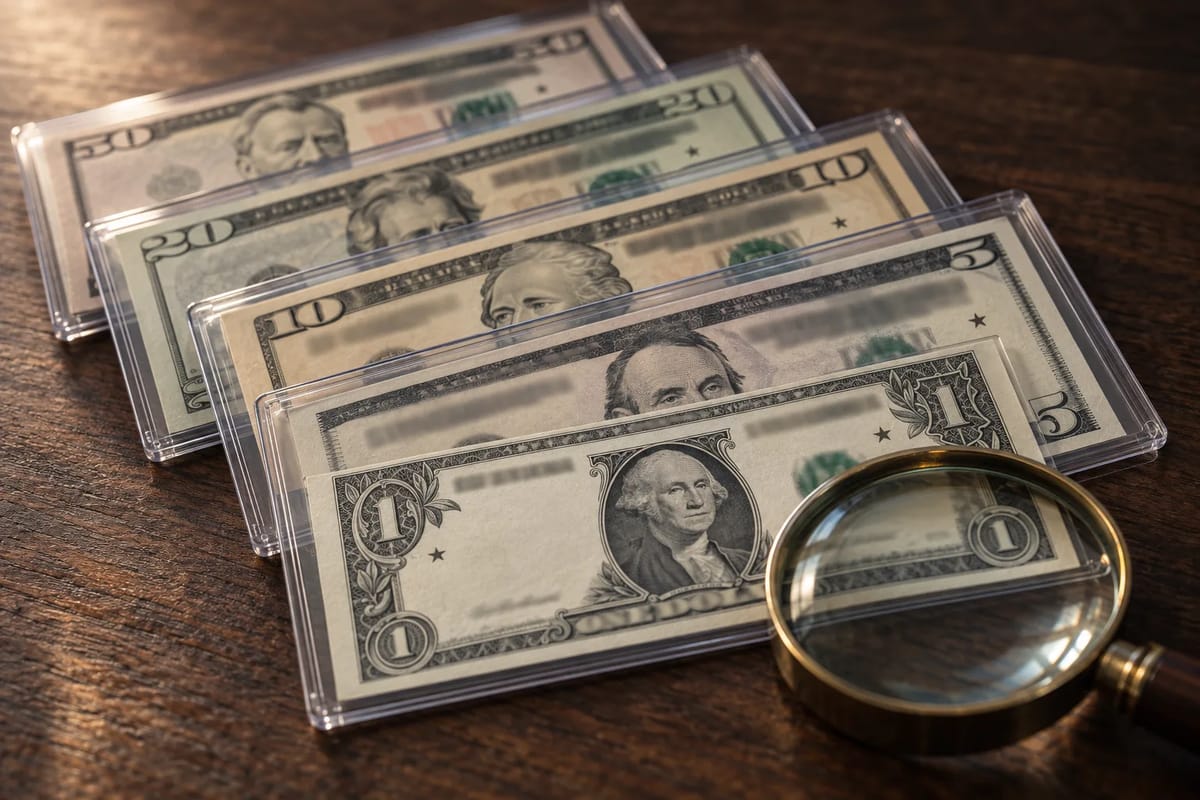
SerialWorth's preservation guidance is specific. Store notes in archival currency holders made of inert materials such as Mylar or polyethylene, never PVC sleeves, which damage paper over time. Handle by the edges, ideally with cotton gloves, since skin oils transfer to paper. Keep notes away from sunlight, extreme temperatures, and humidity, aiming for 65 to 70 degrees Fahrenheit and 40 to 50 percent relative humidity. Never tape, staple, clip, clean, press, or repair a note. LookupStarNote adds the practical version: sleeve any star from a run of 640,000 or fewer the moment you identify it, because "finger oils and folding destroy value rapidly." Consecutive runs are worth keeping together. MyCurrencyCollection notes that a full pack of 100 consecutive uncirculated $1 star notes typically sells for $125 to $200 depending on age.
Selling
LookupStarNote lays out the channels and the discounts. eBay is the most liquid market for common to rare stars, and the site stresses checking sold listings rather than asking prices. Heritage Auctions dominates the high end and, by that site's estimate, achieves 20 to 30 percent premiums over eBay for extremely rare or gem notes. Local coin shows pay cash immediately at about 60 to 70 percent of online prices. SerialWorth's table adds consignment auctions (Heritage, Stack's Bowers, GreatCollections) for valuable notes, collector forums for specialized notes, and dealer buy lists for quick sales at lower returns. For a $3 star, the sale price will not cover fees anywhere, which is why most collectors hold common stars, trade them, or sell them in bulk lots.
Because a star note's market value is set by run size and grade rather than by the paper itself, it has no melt value and the metal calculators on this site do not apply. The rest of the collecting logic is the same as coins: rarity, condition, and demand. If you also set aside coins from change, our coin values hub covers the same three variables for each major U.S. series. Collectors who buy and sell certified notes and coins peer-to-peer can browse the PeerMetals marketplace, where every listing shows the seller's price against live spot for metal items, or list their own through Sell With Us.
Frequently asked questions
Are all star notes valuable?
No. APMEX's rule of thumb is that modern star notes from 1981 onward are worth face value or a little more, and GovMint says most modern stars found in change are worth face. US Currency Auctions prices a circulated 2013 or 2017 $1 star at $1.25 to $2. The value is in the exceptions: runs of 640,000 or fewer, scarce districts, fancy serials, and the 2013 duplicates.
How do I know if my star note is from a rare run?
Look it up. Enter the denomination, full series year, and serial number into MyCurrencyCollection's Star Note Lookup or LookupStarNote.com. If the run is 640,000 notes or fewer it is scarce, and if it is 320,000 or fewer it is where collectors compete. Also check whether it is the only star run for that district and series, which adds to the value.
What is a 2013 $1 star note worth?
A common 2013 $1 star is worth $1.25 to $3 per US Currency Auctions. A New York (B) note whose serial falls in B00000001* to B00250000* or B03200001* to B09600000* is one half of a possible duplicate pair and trades at $25 to $50 circulated and $100 or more uncirculated on eBay, according to MyCurrencyCollection. A confirmed matched pair, one Washington and one Fort Worth, has sold for $7,200 to $25,000.
Is a $100 star note worth more than a $1 star note?
In dollars, yes; in premium, usually no. US Currency Auctions lists a modern $100 star at $105 to $130, a 5 to 30 percent premium, while a crisp $1 star at $3 is three times face. JM Bullion explains why: the $100 was roughly a quarter of the BEP's 2024 print order and the $1 about a third, while the $2 was under 4 percent, so low-denomination stars from small runs are proportionally scarcer and more collected.
Where is the star on older bills?
On Federal Reserve Notes, which cover everything printed since 1928, the star replaces the last letter of the serial number. On Silver Certificates, United States Notes, and Gold Certificates the star comes before the serial number, according to JM Bullion. National Bank Notes never used stars.
Should I get my star note graded?
Only if the guide value is well above the grading fee. SerialWorth recommends certification for small-run stars and fancy serials, and against it for common-run notes unless they are in very high grade. Uncirculated scarce-district notes, 2013 duplicate pairs, and anything the tables here put above about $100 are worth submitting to PMG or PCGS Banknote.
Can I still find rare star notes in circulation?
Yes. SerialWorth notes that some modern runs are as small as 320,000 notes and that new stars enter circulation regularly. LookupStarNote suggests fresh ATM withdrawals and bank straps of $1 notes as the best sources. Every star you find takes about a minute to check, and SerialWorth's staff valued a 2021 $1 star from a 500,000 run, pulled crisp from circulation, at $5 to $15.