War Nickel Value: Silver War Nickels by Date, Grade and Variety

A common circulated war nickel is worth about $3.03 for its silver alone at today's spot ($3.68 at the $65.39/oz price of 3 September 2026 used throughout this guide), which is roughly 74 times its five-cent face value. Dealers sell $1 face value (20 coins) for about $74 to $77 and buy it back for $44 to $56, uncirculated common dates run $9 to $13 in MS-60 and $28 to $40 in MS-65, and the four recognized varieties (1943/2-P overdate, 1943-P doubled eye, 1945-P doubled die reverse, and the 1942-P proof) bring $15 to several thousand dollars. You can get the live melt figure for any number of coins from the silver melt value calculator.
Everything below is priced against that $65.39 spot. Every guide value is attributed to the page it came from, with the retrieval date, because war nickel prices move with silver every day and the numismatic portion of the price guides is only revised a few times a year.
Quick answer: what a war nickel is worth
| What you have | Value at $65.39/oz silver | Source |
|---|---|---|
| One circulated war nickel, any common date | $3.68 melt (0.05626 troy oz silver) | PeerMetals spot, NGC and JM Bullion silver weight |
| $1 face value (20 coins, 1.125 troy oz) | $73.56 melt; dealers ask $73.69 to $77.19; dealers pay $44.11 to $55.94 | APMEX, Hero Bullion, Money Metals (retrieved 2026-09-03) |
| One roll (40 coins, $2 face) | $147.13 melt; $299.99 (AU) to $599.00 (BU, dated) at APMEX | APMEX |
| Common date, MS-60 | $9.13 to $13 | USA Coin Book |
| Common date, MS-65 | $28 to $40 | USA Coin Book |
| Common date, MS-65 Full Steps and up | $60 to $7,500 depending on date and grade | Greysheet CPG |
| 1943/2-P overdate | $28 (G-4) to $793 (MS-65); up to $6,000 at the top of the Greysheet range | USA Coin Book, Greysheet |
| 1943-P doubled eye | $25 (G-4) to $559 (MS-65); up to $7,800 in Full Steps | USA Coin Book, Greysheet |
| 1945-P doubled die reverse | $15 (G-4) to $501 (MS-65); up to $7,000 in Full Steps | USA Coin Book, Greysheet |
| 1942-P proof | $135 in PR-65; $28 to $1,920, cameo to $6,600 | USA Coin Book, Greysheet |
What a war nickel is
A war nickel is a Jefferson five-cent piece struck from late 1942 through 1945 in an emergency alloy of 56% copper, 35% silver, and 9% manganese instead of the standard 75% copper and 25% nickel. Nickel was a strategic metal for armor plate, and Public Law 507 of March 27, 1942 gave the Treasury authority to take it out of the coin; CoinWeek's summary of the same law (Title XII, section 642 of the Second War Powers Act) notes that Congress suggested a 50/50 silver and copper mix but let the Mint change the proportions. The changeover date was October 8, 1942, and the alloy ran through December 1945. In 1946 the Mint went back to copper-nickel.
The 9% manganese is the odd ingredient, and it explains a lot about how these coins behave. Coin-operated machines of the period tested a coin's electrical and magnetic signature, not just its weight and diameter, and a plain silver-copper blend failed that test. Manganese was added to restore the signature so vending machines kept working. It also hardened the alloy. The hobonickel.org write-up on carving these coins points out that the wartime metal was notoriously hard to strike, with poor mixing, oxidation, and inconsistent annealing, which is why so many war nickels have weak steps on Monticello and why they tone the way they do (more on both below).
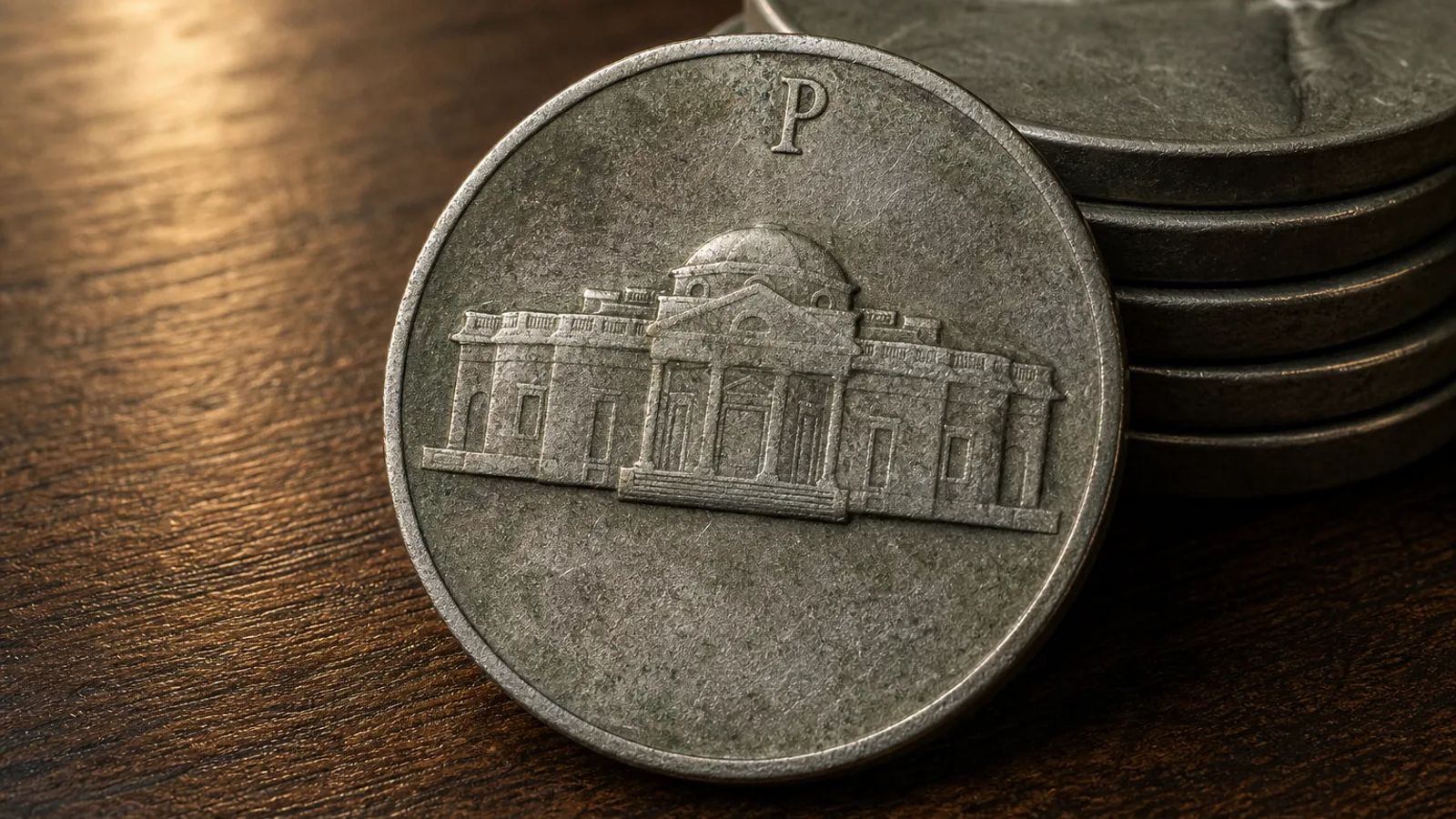
Because the Treasury expected to pull the silver coins back out of circulation after the war, it gave them an oversized mint mark, a large P, D, or S placed above the dome of Monticello on the reverse. Two firsts came out of that decision. It was the first time any U.S. coin carried a P mint mark for Philadelphia, and JM Bullion notes the P did not appear on U.S. coinage again until 1979. It was also, per Greysheet, the first proof coin from Philadelphia to carry a mint mark, the 1942-P Type 2 proof. War nickels were withdrawn in the mid-1960s once silver was worth more than face value, but a few still turn up in change.
There are exactly 11 date and mint combinations: 1942-P, 1942-S, 1943-P, 1943-D, 1943-S, 1944-P, 1944-D, 1944-S, 1945-P, 1945-D, and 1945-S. There is no 1942-D war nickel. Denver struck all of its 1942 nickels in the old alloy before the change, so a 1942-D is always copper-nickel and always has a small mint mark to the right of Monticello.
How to identify a war nickel
At a glance
Turn the coin over. On a war nickel the mint mark is large and sits directly above Monticello's dome. On every other Jefferson nickel from 1938 to 1964 the mint mark is small and sits to the right of the building, and Philadelphia coins have no mint mark at all. The mint mark did not move to the obverse until 1968, so there is no point checking the front of a 1940s nickel. If you are new to reading mint marks, the mint mark field guide shows where each series puts them.
The date alone is not enough. Every 1943, 1944, and 1945 nickel is silver, but 1942 comes both ways. A 1942 with a big P above the dome is a Type 2 war nickel worth $3.68 and up; a 1942 with no mint mark is a Type 1 copper-nickel coin that USA Coin Book prices at 18 cents in G-4. Same date, twenty-fold difference.
Two secondary tells help when the mint mark is worn. Circulated war nickels take on a dull, sometimes greenish-grey tone that copper-nickel coins never develop, and Gainesville Coins reports a slightly greasy feel from the manganese. Neither is proof on its own. The one counterfeit worth knowing is the Henning 1944 nickel, a well-known fake; CoinWeek notes the Henning pieces were caught precisely because they lacked the mint mark every genuine 1944 nickel must have.
By weight
A war nickel weighs 5.00 grams and measures 21.2 mm across, per the NGC and Coinflation specifications. Weigh $1 face value and a scale should read close to 100 g. A coin that is far off 5.0 g is not a genuine war nickel. Be aware of what the scale cannot tell you: a regular copper-nickel Jefferson also weighs 5.00 g, so weight confirms a coin is a real nickel, it does not prove it is silver. (Some dealer pages state that war nickels are lighter than a 5.67 g regular nickel; that figure is wrong, and both types weigh 5.00 g.) The mint mark is the identifier, the scale is the check. Specifications for the whole series are in the coin weight and purity lookup.
Silver content and melt value, with the math
Each war nickel is 35% of 5.00 g, which is 1.75 g of pure silver, or 0.05626 troy ounces (JM Bullion gives 0.05626 oz; NGC rounds it to 0.0563 oz). It takes about 18 war nickels to make one troy ounce of silver. Melt value is that weight times the spot price, and nothing else moves the number.
Worked example at a silver spot price of $65.39/oz on 3 September 2026:
- One coin: 0.05626 oz x $65.39 = $3.68
- $1 face value (20 coins, 1.125 oz): 1.125 x $65.39 = $73.56
- One roll (40 coins, 2.25 oz): 2.25 x $65.39 = $147.13
- $50 face value bag (1,000 coins, 56.25 oz): 56.25 x $65.39 = $3,678.19
The copper and manganese are worth almost nothing. Coinflation's full calculation on 2 September 2026 (at $65.47 silver) came to $3.6835 for the silver, $0.0405 for the 56% copper, and $0.0009 for the 9% manganese, for a total of $3.7249. Dealers ignore the base metals and price on silver, so treat $3.68 as the floor. For any other quantity or a different spot price, the silver melt value calculator does this sum against the live silver price.
War nickel value by date and mint
The table below is from USA Coin Book's Jefferson nickel price chart (numismatic portion updated February 2026, precious-metal portion live, retrieved 3 September 2026). The grade scale is the standard 70-point Sheldon scale: G-4, VG-8, F-12, VF-20, EF-40, AU-50, MS-60, MS-65. In every circulated grade the value is silver plus a few cents; the numbers only separate from melt once you reach mint state. Mintage figures are as printed on USA Coin Book and Coinflation, which agree on every issue except the 1942-P (see the note after the table). For what those grades mean in practice, see the grading standards guide.
| Date and mint | Mintage | G-4 | VG-8 | F-12 | VF-20 | EF-40 | AU-50 | MS-60 | MS-65 |
|---|---|---|---|---|---|---|---|---|---|
| 1942-P | 57,900,600 | $4.12 | $4.44 | $4.76 | $6.50 | $7.14 | $7.84 | $11.52 | $28 |
| 1942-S | 32,900,000 | $4.44 | $4.76 | $5.38 | $6.24 | $7.14 | $7.84 | $13 | $33 |
| 1943-P | 271,165,000 | $4.44 | $4.76 | $5.38 | $6.24 | $6.50 | $7.84 | $10.17 | $28 |
| 1943-D | 15,294,000 | $4.12 | $4.76 | $5.38 | $6.24 | $7.84 | $9.13 | $11.52 | $28 |
| 1943-S | 104,060,000 | $4.12 | $4.76 | $5.38 | $6.24 | $6.50 | $7.84 | $10.17 | $28 |
| 1944-P | 119,150,000 | $4.12 | $4.76 | $5.38 | $6.24 | $6.50 | $7.84 | $11.52 | $40 |
| 1944-D | 32,309,000 | $4.12 | $4.76 | $5.38 | $6.24 | $6.50 | $7.84 | $11.52 | $40 |
| 1944-S | 21,640,000 | $4.12 | $4.76 | $5.38 | $6.24 | $6.50 | $8.51 | $10.17 | $29 |
| 1945-P | 119,408,100 | $4.12 | $4.76 | $5.07 | $5.96 | $6.50 | $7.14 | $11.52 | $28 |
| 1945-D | 37,158,000 | $4.12 | $4.44 | $4.76 | $5.50 | $5.96 | $6.50 | $9.13 | $28 |
| 1945-S | 58,939,000 | $4.12 | $4.44 | $4.76 | $5.50 | $5.96 | $6.50 | $9.13 | $28 |
Three things stand out. First, the circulated columns are nearly identical across all 11 issues because every one of them is priced on 0.05626 oz of silver. Second, the 1943-D has by far the lowest mintage at 15.3 million, yet it is worth within a dollar or two of a 271-million-mintage 1943-P in every grade up to MS-65; war nickels were saved by the roll, so low mintage did not translate into scarcity. Third, the 1944-P and 1944-D carry the highest MS-65 value at $40 despite mid-range mintages, so the guide is pricing supply in gem condition, not the number struck.
On the 1942-P mintage: USA Coin Book prints 57,900,600 while Coinflation prints 57,873,000. The two figures differ by 27,600 coins, because USA Coin Book's total includes the 1942-P proofs and Coinflation's counts business strikes only. Both are correct for what they count.
Greysheet CPG ranges, September 2026
Greysheet's CPG retail values (retrieved 3 September 2026) give the full mint-state range for each issue, from the melt floor up to the finest graded examples, and a separate range for coins certified with Full Steps. The low end of every regular range is $3.65 or $3.66, which is Greysheet's melt figure on the day it was retrieved, confirming that anything short of choice mint state is a bullion coin.
| Date and mint | Regular strike (MS range) | Full Steps (MS range) |
|---|---|---|
| 1942-P | $3.66 to $100 | $18 to $2,000 |
| 1942-S | $3.66 to $93 | $20 to $3,200 |
| 1943-P | $3.66 to $1,350 (MS-68 listed at $1,700) | $11.90 to $7,500 |
| 1943-D | $3.65 to $1,200 | $7.90 to $4,500 |
| 1943-S | $3.66 to $2,500 | $6.20 to $6,000 |
| 1944-P | $3.66 to $1,200 | $15 to $380 |
| 1944-D | $3.66 to $1,200 | $23.90 to $4,800 |
| 1944-S | $3.66 to $1,200 | $75 to $5,000 |
| 1945-P | $3.66 to $3,250 | $30 to $6,500 |
| 1945-D | $3.66 to $1,800 | $14.90 to $2,800 |
| 1945-S | $3.65 to $1,600 | $60 to $2,000 |
For a sense of how a whole set trades, CoinWeek (writing in October 2020 with silver at $24) put a complete 11-coin set in roughly MS-63 at about $150, and APMEX currently lists an 11-coin BU set at $174.99 and an average-circulated set at $74.99. A single type coin, per the same CoinWeek piece, was $6 in MS-60, $25 in MS-65, and $70 in MS-67; USA Coin Book's 2026 figures for MS-60 and MS-65 have moved to $9 to $13 and $28 to $40, almost entirely because silver has nearly tripled since then.
The varieties that are worth real money
Four war nickels carry a premium that has nothing to do with silver. Check every coin in a bag for these before you sell it by weight, because each one is worth a minimum of several times melt even in worn condition. Values below are USA Coin Book (February 2026 numismatic update) unless stated, with Greysheet CPG ranges and CoinWeek's 2020 figures for comparison.
1943/2-P overdate
A 1943 date punched over a leftover 1942 die. Look for a shadow of the 2 behind the 3, most visible at the bottom of the numeral, and often a hooked-looking 3. USA Coin Book: $28 in G-4, $64 in VF-20, $126 in EF-40, $210 in AU-50, $347 in MS-60, $793 in MS-65. Greysheet's CPG range runs $35 to $6,000 for regular strikes and $400 to $4,800 with Full Steps. CoinWeek quoted $125 in XF up to $5,500 for an MS-67 Full Steps example in 2020, and estimated that somewhere between 100,000 and 200,000 were struck but only a couple of hundred survive in mint state. Every coin in this variety is worth certifying. The dedicated 1943/2 overdate guide has the full grade table.
1943-P doubled eye (doubled die obverse)
A doubled die on the obverse that shows most clearly as a second outline of Jefferson's eye just below the ridge of his nose, which is why collectors call it the doubled eye. USA Coin Book: $25 in G-4, $40 in VF-20, $64 in EF-40, $84 in AU-50, $157 in MS-60, $559 in MS-65. Greysheet lists the generic 1943-P doubled die obverse at $35 to $800, the attributed doubled eye (FS-106) at $285 to $850, and Full Steps examples of either at $260 to $7,800. CoinWeek's 2020 figures were $55 in XF, $300 in MS-60, and $7,500 in MS-67 Full Steps.
1945-P doubled die reverse
Doubling on the reverse lettering, strongest on the right side of MONTICELLO. USA Coin Book: $15 in G-4, $28 in VF-20, $40 in EF-40, $59 in AU-50, $106 in MS-60, $501 in MS-65. Greysheet: $20 to $1,140 for regular strikes and $800 to $7,000 with Full Steps. CoinWeek quoted $52 in XF, $275 in MS-60, and as much as $11,500 for an MS-66 Full Steps coin in 2020. Greysheet also lists 1945-P tripled die reverse varieties (FS-803 at $75 to $450 and FS-804 at $30 to $1,200) that are less well known and easy to miss.
1942-P proof
The only proof war nickel. Greysheet calls the 1942-P Type 2 proof the first Philadelphia proof to carry a mint mark, and notes that no proof nickels were made from 1943 through 1949, so it is a one-year type. USA Coin Book prices it at $135 in PR-65. Greysheet's ranges are $28 to $1,920 for ordinary proofs, $800 to $6,500 for cameo, and $5,600 to $6,600 for deep cameo. Proofs were sold to collectors and never released into circulation, so one will not turn up in a bag; if you have one it will have mirrored fields and sharp square rims.
Minor varieties
Greysheet also carries repunched mint marks that add a modest premium: the 1943-D/D (FS-501) at $50 to $216, the 1944-D/D at $100 to $180, the 1945-D/D at $60 to $150, and 1942-P/P and 1942-S/S at just over melt. CoinWeek also mentions transitional errors, 1943 nickels struck on leftover copper-nickel planchets and 1946 nickels struck on the wartime silver alloy, which are genuine rarities but far too scarce to plan around.
Full Steps: why two identical coins can differ 50-fold
Monticello has six steps across its base on the reverse. On a well-struck coin all six show as separate lines; on most war nickels, struck in that hard, poorly mixed alloy, the steps blur into a slope. PCGS and NGC add a Full Steps (FS) designation, and Greysheet's definition is five or six full steps across the bottom of Monticello with no breaks. CoinWeek estimates that about 20% of 1943-P nickels show five of six steps, and coins with all six are scarce.
The premium is large. Compare the two Greysheet columns above: a 1944-S tops out at $1,200 as a regular strike but $5,000 with Full Steps; a 1943-P goes from $1,350 to $7,500. CoinWeek noted that a top-grade MS-68 FS type coin was worth over $6,000 in 2020, and Greysheet's series notes say that for some dates no Full Steps coins are known above MS-65 at all. Full Steps only matters on uncirculated coins, because the steps are the first thing to wear, and it only pays on certified coins, because nobody will pay an FS premium on a raw coin. If you have a bright, sharply struck war nickel, tilt it under a lamp and count the steps before you decide it is a bullion coin.
Why war nickels tone dark, and whether that hurts
Almost every circulated war nickel is dull grey, and many are blotchy or faintly green. That is the manganese. The hobonickel.org piece is blunt about it: the manganese and silver alloy tones dark, dull, and blotchy on its own, far more than a standard nickel, and collectors who do not know the alloy sometimes mistake it for corrosion. Gainesville Coins describes the same greyish-green patina on worn examples and notes that war nickels develop toning or spotting more readily than pure silver coins, so it recommends low-humidity storage and individual holders for uncirculated pieces. CoinWeek adds that fresh war nickels had a dazzling, whiter finish than regular nickels, and that it was the finish that turned dull with time.
Whether the toning costs you money depends on which market the coin is in. For a circulated coin the answer is no: it trades at melt, and melt does not care about color. For an uncirculated coin, even natural toning is not a defect in itself, but heavy blotching hides the luster that MS-65 and Full Steps prices depend on, and a coin that has been dipped or polished to remove it is worth less than one left alone. Do not clean a war nickel. If it is uncirculated and dark, it is worth a look from a grading service before it is worth any chemistry.
What dealers actually pay versus the guide price
Guide values are retail asking prices for individual coins. A bag of war nickels sells in a different market, by face value, at a discount to melt. Here is what three dealers were quoting on 3 September 2026 for $1 face value (20 circulated coins, 1.125 oz, melt $73.56):
| Dealer | Sells $1 face for | Buys $1 face for | Buy price as a share of melt |
|---|---|---|---|
| APMEX | $74.49 (listed as $0.00 per oz over spot); $50 face bag $3,724.31; $200 face bag $14,897.25 | not quoted on the page | not available |
| Money Metals Exchange | $77.19 | $55.94 | 76% |
| Hero Bullion | $73.69 by check or wire ($70.00 at 200 or more), $76.64 by card | $44.11 (indicative, $1,000 minimum buyback) | 60% |
So the retail premium is small, roughly 0% to 5% over melt, but the buyback spread is wide. Gainesville Coins says dealers typically pay 10% to 20% below melt for common circulated silver nickels because of processing costs, which would be $59 to $66 per $1 face at today's spot; the two online quotes above are lower still, at 24% and 40% below melt. The spread exists because war nickels are a low-value coin that has to be counted, sorted, and checked for the varieties, and because the buyer has to move 20 coins to sell 1.125 oz of silver. A local coin shop with a customer for them will often beat an online buyback, and a private sale to another stacker will beat both.
For uncirculated coins and varieties, the guide value is the ceiling and a dealer offer will sit below it. USA Coin Book lists 13 to 206 examples of each date for sale on its own marketplace, and Greysheet's dealer-to-dealer wholesale prices, which are behind its paywall, run below the CPG retail figures quoted here. Expect an offer of well under guide for a raw coin and closer to guide for a certified one with the variety or Full Steps attributed on the label.
How to sell a bag of war nickels
- Pull the varieties first. Check every 1943-P for the overdate and doubled eye and every 1945-P for the doubled die reverse. Even in G-4 those three are worth $15 to $28 each against $3.68 for the rest of the bag, and a single 1943/2-P in EF-40 ($126) is worth 34 ordinary coins. Set aside anything bright and sharply struck for a Full Steps check.
- Count by face value and weigh it. Dealers quote per $1 face (20 coins). $1 face should weigh 100 g; a $50 bag should weigh 5 kg. A weight that is low means clad or copper-nickel contamination, and the buyer will find it.
- Work out melt before you ask for quotes. Face value x 1.125 oz x spot. For $50 face at $65.39 that is $3,678. The melt calculator gives you the live number.
- Get three quotes. Two online (the buyback prices above move daily) and one local. Ask each what percentage of melt they pay, not just the dollar figure, so you can compare them when silver moves before you ship.
- Or list it yourself. On PeerMetals, sellers list war nickels by the roll, by face value, or as individual dated coins, and every listing shows the seller's price against live spot, so a buyer can see at a glance whether $1 face at $75 is near melt or not. Sellers pay a flat 2.75% and no listing fee, which is a smaller cut than the 24% to 40% under melt an online buyback takes. Selling on PeerMetals also lets you sell the varieties and uncirculated rolls separately, at collector prices, rather than folding them into a bulk lot.
- Ship it right. Money Metals' buyback terms require USPS Registered Mail insured for full value and note that UPS and FedEx exclude precious metals from their insurance. A $50 face bag weighs 5 kg, so factor in postage.
War nickels versus 90% junk silver, per dollar spent
War nickels and pre-1965 dimes, quarters, and halves are both sold by face value, but the silver behind each dollar of face is very different. $1 face in war nickels holds 1.125 oz of silver. $1 face in 90% coin holds about 0.7234 oz by the Mint specification, or 0.715 oz by the dealer wear convention, as explained in the junk silver guide. That is why a dollar of war nickels sells for $74 and a dollar of 90% for about $48; you are buying 57% more silver.
What matters to a buyer is the price per ounce, and here the two are close. Using Hero Bullion's check-price quotes on 3 September 2026: $1 face of war nickels at $73.69 is $65.50 per oz of silver, about 0.2% over the $65.39 spot; $1 face of 90% coins at $48.39 is $66.89 per oz on 0.7234 oz, about 2.3% over spot. APMEX's $74.49 for war nickels works out to $66.21 per oz. So $100 spent on war nickels at Hero's price bought about 1.53 oz of silver and $100 spent on 90% bought about 1.49 oz. Hero states on its product page that war nickels typically trade at lower premiums per silver ounce than 90% coinage; Gainesville Coins says the opposite, that war nickel premiums are lower than Silver Eagles but higher than junk dimes and quarters. Both can be true on different days and at different dealers, which is the point: check the per-ounce figure, not the per-dollar one. The junk silver calculator handles the 90% side of the comparison.
Three practical differences tip the balance. War nickels are worse on the way out, because the buyback discount is deeper than on 90% coin. They are bulkier per ounce of silver, at 5 g of coin for every 1.75 g of silver, against 2.5 g of coin per 2.25 g of silver in a 90% dime. And they are harder to check quickly, because every coin has to be turned over to confirm the mint mark, whereas a 90% coin shows its silver on the edge. In their favor, they are the smallest silver unit in 20th-century U.S. coinage, at $3.68 apiece, they cannot be confused with clad once you know the mint mark, and a bag of them may hold a $500 variety, which a bag of 1964 quarters will not.
Frequently asked questions
How much is a 1943 nickel worth?
Every 1943 nickel is 35% silver, so the floor is $3.68 at $65.39 silver. USA Coin Book prices a circulated 1943-P, 1943-D, or 1943-S at $4.12 to $9.13 depending on grade, an MS-60 at $10.17 to $11.52, and an MS-65 at $28. The two exceptions are the 1943/2-P overdate ($28 to $793 by grade) and the 1943-P doubled eye ($25 to $559), so check the date and Jefferson's eye on every 1943-P before you sell it as bullion.
Are all 1942 nickels silver?
No. Philadelphia and Denver struck copper-nickel coins for most of 1942, and only the Philadelphia and San Francisco coins made after the October 1942 changeover are silver. A silver 1942 has a large P or S above Monticello's dome; a copper-nickel 1942 has a small D to the right of the building or no mint mark at all. USA Coin Book values the copper-nickel 1942 (no mint mark) at 18 cents in G-4 and the silver 1942-P at $4.12, so the mint mark is the whole difference.
How many war nickels make an ounce of silver?
About 18. Each coin holds 0.05626 troy oz, so 17.8 coins equal one ounce, which is why $1 face value (20 coins) contains 1.125 oz. A standard 40-coin roll holds 2.25 oz.
Should I get a war nickel graded?
Only for the varieties, the 1942-P proof, or a bright uncirculated coin with all six steps showing. A common circulated war nickel is worth $3.68 and a grading fee would cost more than the coin. A 1943/2-P in EF-40 is worth $126 raw and far more with the variety attributed on a PCGS or NGC label, and a Full Steps designation can turn a $28 MS-65 into a coin worth hundreds. The grading standards guide explains what the services look for.
Is a dark or green war nickel damaged?
Usually not. The 9% manganese in the alloy tones dull grey and often blotchy on its own, and collectors who do not know the alloy mistake it for corrosion. Dark toning does not change the silver content or the melt value. Do not clean it: a dipped or polished war nickel is worth less to a collector than an untouched dark one.
Can I still find war nickels in circulation?
Rarely. They were pulled from circulation in the mid-1960s when the silver was worth more than five cents, but CoinWeek notes they still turn up once in a while, and bank rolls of nickels are the usual hunting ground. Check the reverse of every 1942 to 1945 nickel for the large mint mark above Monticello.
Where is the best place to sell war nickels?
For a bulk bag, whoever pays the highest percentage of melt, which on 3 September 2026 meant a local shop or a private sale rather than the 60% to 76% of melt quoted by two online buybacks. For varieties and uncirculated coins, sell them individually to collectors. Listings on PeerMetals show the seller's price against live spot, so buyers can judge a bag against melt and a graded variety against the guide in the same place. The Jefferson nickel value hub covers the rest of the series.