Silver Certificate Value: What Every Series Is Worth in 2026

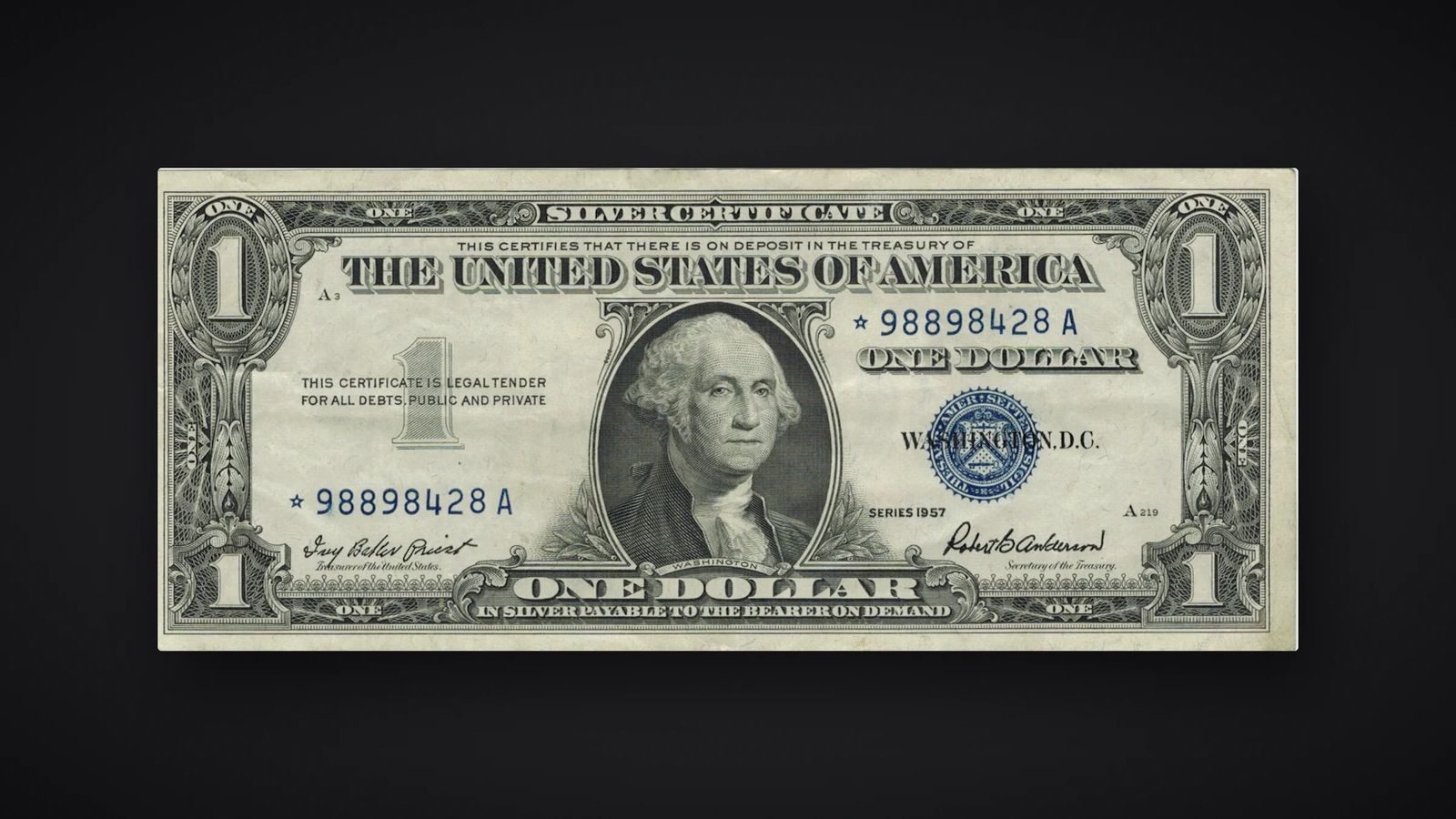
A common $1 silver certificate is worth about $1.50 to $3 in circulated condition and $5 to $15 crisp uncirculated. That covers the Series 1935 and 1957 blue-seal dollars that make up the vast majority of notes people find in drawers and old wallets. PCGS puts a well-worn, undamaged 1957 $1 at "around $1.50 to $2", and Greysheet's small-size price guide starts its 1935 and 1957 $1 entries at $1.50 (both retrieved September 2026).
The exceptions are real, though. Greysheet's same guide runs from $1.50 all the way to $100,000, and that top figure belongs to a small-size silver certificate too: the Series 1928D $1 star note. Large-size notes from 1896 and 1899, WWII emergency issues, the 1933 $10, and any star note from a scarce series can be worth tens to thousands of dollars. This guide covers how to tell which one you have, what each series is worth by condition, and what a dealer will actually pay versus what you see on eBay.
Quick answer: what a silver certificate is worth today
The table below uses the 1-to-70 paper money grading scale shared by PMG and PCGS Banknote: Very Good (VG-8), Fine (F-12), Very Fine (VF-20), Extremely Fine (XF-40), About Uncirculated (AU-50 to AU-58), Choice Uncirculated (CU-63/64) and Gem Uncirculated (65 and up). "Circulated" below means roughly VG to XF; "uncirculated" means no folds, CU-63 or better. Ranges combine Greysheet CPG values with Great American Coin Company's retail ranges, both retrieved September 2026.
| Note | Circulated (VG-8 to XF-40) | Uncirculated (CU-63 to Gem 65) | Top of Greysheet range |
|---|---|---|---|
| $1 Series 1957, 1957-A, 1957-B | $1.50 to $3 | $5 to $18 | $210 to $280 (superb gem) |
| $1 Series 1935 to 1935-H | $1.50 to $6 | $10 to $25 | $85 to $500 |
| $1 Series 1934 | $22 and up | $100 and up | $435 |
| $1 Series 1928 to 1928-B (Funnyback) | $20 to $35 | $56 to $120 | $1,000 to $1,400 |
| $1 Series 1928-C, D, E | $30 to $200 and up | $1,000 and up | $2,500 to $3,000 |
| $5 Series 1934 and 1953 | $7 to $20 | $50 to $150 (certified) | $140 to $2,000 |
| $10 Series 1934 and 1953 | $15 to $40 | $100 and up | $600 to $7,250 |
| $10 Series 1933 | $2,000 and up | $35,000 and up | $95,000 |
Every silver certificate is still legal tender at face value. If yours is torn, taped, written on, or stained, face value is usually what it is worth, no matter the series. If it is clean and crisp, keep reading before you spend it.
What a silver certificate was, and why it no longer buys silver
A silver certificate was a receipt for metal. The obligation printed on the face of a Series 1957 $1 reads: "This certifies that there is on deposit in the Treasury of the United States of America one dollar in silver payable to the bearer on demand." Congress authorized the notes in the Bland-Allison Act of February 28, 1878, and an act of August 4, 1886 added the $1, $2 and $5 denominations. Early issues, Series 1878, ran from $10 up to $1,000.
For most of their life you could walk into a bank with a silver certificate and get a silver dollar. PCGS notes that in the late 1950s that could mean handing over a 1957 $1 note and receiving a Morgan or Peace dollar, coins that were "still readily available for face value during that time." A Morgan or Peace dollar contains 0.7734 troy ounces of silver, which at a silver spot price of $65.44/oz on 3 September 2026 is about $50.61 of metal. You can check the live figure on our silver price page. That gap between $1 and $50 is exactly why the system ended.
The timeline that matters for value
- July 10, 1929: small-size notes replace the large "horse blanket" notes. Large-size silver certificates measured about 7.38 by 3.18 inches; small-size notes are about 6.14 by 2.61 inches, the same as a modern bill.
- Silver Purchase Act of 1934: the Treasury Secretary gets authority to issue silver certificates against bullion rather than only coined dollars. Series 1934 and 1935 follow.
- Around 1963: silver rises to the point where 90% silver dimes, quarters, halves and dollars are worth more as metal than as money. People hoard coins and a nationwide coin shortage follows (PCGS).
- June 4, 1963: Public Law 88-36 repeals the Silver Purchase Act and ends production of silver certificates. Greysheet calls this the date the notes were "officially made obsolete."
- March 1964: Treasury Secretary C. Douglas Dillon stops redeeming certificates for silver dollars. From this point holders receive raw silver granules or bullion instead.
- June 24, 1967 to June 24, 1968: the final one-year window for exchanging certificates for bullion. A Treasury press release of May 13, 1968 told holders to present notes in person at the Federal Reserve Bank of New York or San Francisco, or the U.S. Assay Office in either city, and warned that "if many holders wait until just before the June 24 deadline the exchange facilities may not be able to handle all requests."
- June 24, 1968: silver redemption ends. The same release states that after that date "silver certificates will continue to be usable as legal currency, but may not be redeemed for silver."
Since 1968 a silver certificate is worth exactly one thing at the bank: a Federal Reserve Note of the same face value. Everything above face is collector value, which is why condition and series matter so much. Wikipedia's featured article on the series adds a detail worth knowing: years after redemption ended, the Treasury found large quantities of silver dollars in its vaults that had been set aside specifically to back these notes.
How to identify a silver certificate
You can confirm a silver certificate in about ten seconds. Check these five points on the face of the note:
- Blue Treasury seal on the right side and blue serial numbers. Federal Reserve Notes use green; United States Notes (legal tender notes) use red; gold certificates use gold or orange.
- The words "SILVER CERTIFICATE" printed across the top of the note.
- The obligation text "payable to the bearer on demand" and, on later notes, "in silver."
- The series year to the right of the portrait, with or without a letter suffix. On a $1 note it reads "Series 1935 E" or "Series 1957 B", for example. The letter changed when either Treasury signature changed, not when the note was printed, so a "1935" note may have been printed years later.
- A star in place of a letter in the serial number, which marks a replacement note (more on star notes below).
Two WWII exceptions break the blue-seal rule. Series 1935A $1 notes overprinted "HAWAII" carry a brown seal and serial numbers, and 1935A notes issued to troops in North Africa and Europe carry a yellow seal. Both still say "Silver Certificate" at the top. Also note that the motto "In God We Trust" first appeared partway through the 1935G printing; a 1935G note can exist with or without it, and Greysheet prices the two varieties separately (Fr. 1616 without motto, Fr. 1617 with).
Denominations to expect: small-size silver certificates were only regularly issued as $1, $5 and $10. Large-size notes (1878 to 1923) ran from $1 to $1,000. If you have a small-size $20 or higher with a blue seal, look again; it is almost certainly a Federal Reserve Note or a different note type.
$1 silver certificate values by series and condition
The $1 is the note nearly everyone has. Values below use the PMG/PCGS 1-to-70 grade scale (VG-8, F-12, VF-20, XF-40, AU-50, CU-63, Gem 65). Greysheet's "range" is its lowest CPG value (typically VG or Fine) to its highest listed grade (usually Gem 65 or 66), retrieved September 2026. Recent sold-auction figures from Serial Worth are given where they help.
Series 1957, 1957-A and 1957-B (the most common)
PCGS reports that 5.3 billion $1 notes were printed with the Series 1957 date across all three signature combinations and their star notes, so "no standard Series 1957 $1 Silver Certificate is worth a tremendous amount of money, even in most Crisp Uncirculated grades." These were the last silver certificates printed, and Series 1957 was the first $1 series printed entirely with "In God We Trust" on the back; the motto first appeared partway through the 1935-G printing.
| Series and signatures | Heavily worn, undamaged | PCGS XF-40 | PCGS Choice CU-63 PPQ | Greysheet range |
|---|---|---|---|---|
| 1957 Priest-Anderson | $1.50 to $2 | $5 | $18 | $1.50 to $210 |
| 1957 star note | $2 and up | $12 | $20 | $2 to $160 |
| 1957-A Smith-Dillon | $1.50 to $2 | $5 | $12 | $1.50 to $280 |
| 1957-A star note | $2 and up | $10 | $21 | $2 to $135 |
| 1957-B Granahan-Dillon | $1.50 to $2 | $5 | $10 | $1.50 to $260 |
| 1957-B star note | $2 and up | $10 | $24 | $2 to $130 |
Sources: PCGS (XF-40 and CU-63 PPQ estimates, October 2020 article), Greysheet CPG ranges (September 2026). Serial Worth's sold-auction data for a plain 1957 $1 lines up: VF-20 about $4.25, XF-40 about $4.64, CU-63 about $10.25, Gem 65 about $16.44, Gem 67 about $39, and a superb Gem 69 at $278.75. The Greysheet top figures ($210 to $280) are for the very finest graded examples, not for a nice note out of a drawer. Heavily worn, discolored or written-on 1957 notes are worth face value according to PCGS.
Series 1935 through 1935-H
Great American Coin Company calls the Series 1935 $1 "the most commonly encountered silver certificate in existence," with billions printed across nine sub-series between the mid-1930s and 1953. Signatures identify each letter. Greysheet ranges are CPG values from lowest to highest listed grade.
| Series | Signatures | Greysheet range (regular) | Greysheet range (star) | Notes |
|---|---|---|---|---|
| 1935 | Julian-Morgenthau | $3 to $500 | $35 to $950 | Original issue; a 1935 mule star is listed at $4,375 |
| 1935-A | Julian-Morgenthau | $2 to $300 | $3 to $500 | Largest print run; also the base note for Hawaii, North Africa, R and S varieties |
| 1935-B | Julian-Vinson | $2 to $200 | $16 to $420 | Scarcer than 1935 and 1935-A |
| 1935-C | Julian-Snyder | $1.50 to $140 | $3 to $250 | Common |
| 1935-D | Clark-Snyder | $1.50 to $150 (narrow back) / $1.50 to $240 (wide back) | $3 to $750 (narrow) / $3 to $550 (wide) | Wide and narrow back varieties |
| 1935-E | Priest-Humphrey | $1.50 to $140 | $5 to $140 | Very common in circulated grades |
| 1935-F | Priest-Anderson | $1.50 to $260 | $6 to $285 | Slightly scarcer |
| 1935-G | Smith-Dillon | $2 to $120 (no motto) / $4 to $185 (with motto) | $2.50 to $185 / $9 to $400 | Motto added mid-series |
| 1935-H | Granahan-Dillon | $2 to $85 | $3 to $350 | Final 1935 sub-series |
For a typical 1935-series note in hand, Great American Coin Company's retail ranges are the practical guide: heavily circulated (Good to Fine) $1.50 to $3; Very Fine $3 to $6; Extremely Fine $6 to $12; ungraded uncirculated $10 to $25; certified Gem 65 or better $30 to $75 and up. The scarcer letters (1935-B, C, F, G, H) run roughly 1.5 to 3 times those figures in the same grade. Serial Worth's sold data for a 1935-E is consistent: VF-20 about $6.87, XF-40 about $8, CU-63 about $11.95, Gem 65 about $21, Gem 67 about $79.
Series 1928 to 1928-E (the Funnyback) and Series 1934
The first small-size $1 silver certificates, Series 1928 through 1928-E, are nicknamed Funnybacks. Wikipedia describes the reason as "the dramatically lighter green ink used on the reverse and unusually large font" for the word ONE. These are worth real money in any grade. Investopedia notes that 1928, 1928-A and 1928-B are "fairly common" while 1928-C, D and E are rare by comparison, with 1928-C and D reaching "up to a thousand dollars" in premium condition and 1928-E uncirculated notes earning "over $1,500", with the best examples over $4,000.
| Series | Greysheet range (regular) | Greysheet range (star) |
|---|---|---|
| 1928 $1 (Fr. 1600) | $21 to $1,200 | $50 to $1,900 |
| 1928-A $1 | $21 to $1,000 | $30 to $3,000 |
| 1928-B $1 | $20 to $1,400 | $65 to $4,000 |
| 1928-C $1 | $68 to $3,000 | $1,800 to $18,000 |
| 1928-D $1 | $30 to $2,500 | $1,000 to $100,000 |
| 1928-E $1 | $200 to $3,000 | $5,500 to $34,000 |
| 1934 $1 (Fr. 1606) | $22 to $435 | $50 to $2,900 |
Serial Worth's recent auction results for a plain 1928 Funnyback put circulated examples at $12.74 to $35, uncirculated at $56.48 to $119.99, and premium 65-and-up EPQ notes at $101.72 to $420. Star notes from the same series sold for $32 to $195.50 circulated and $780 to $1,380 in premium grades. The Series 1934 $1 is a one-year type between the Funnybacks and the 1935 series; Greysheet starts it at $22, so even a worn one is worth keeping.
$5 and $10 silver certificate values
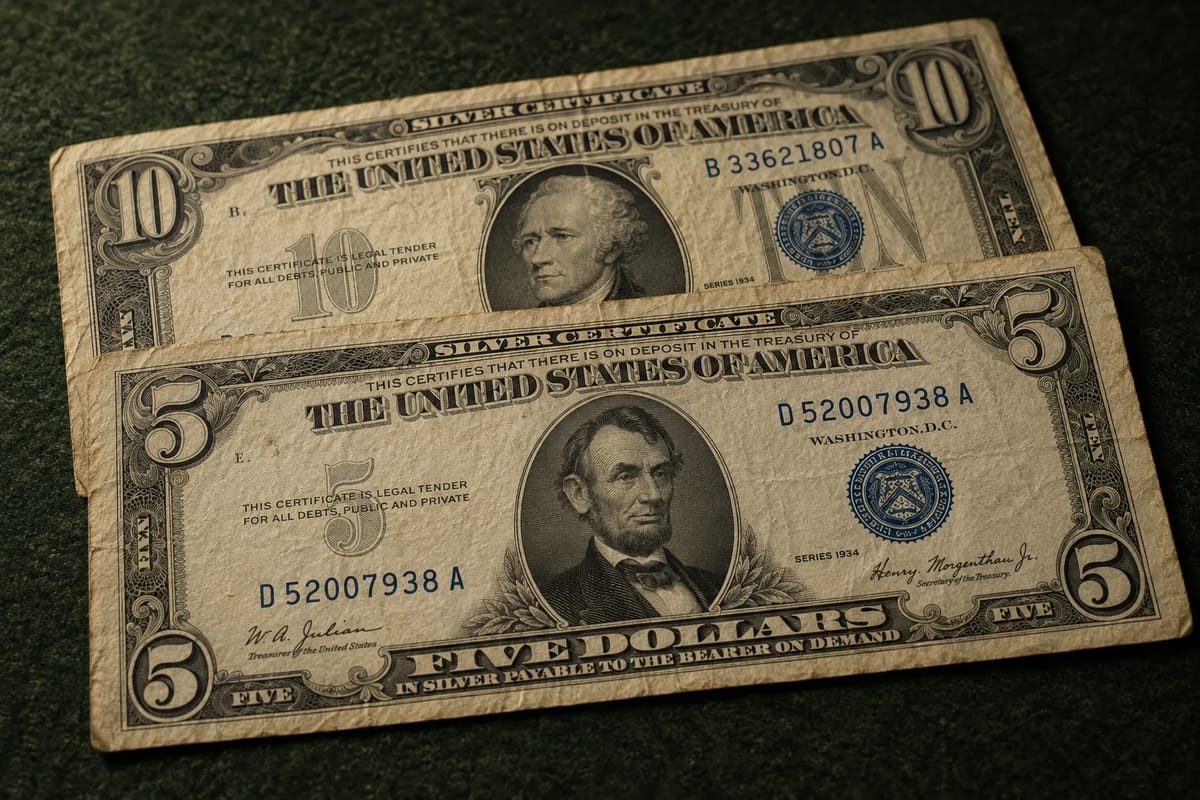
Small-size $5 silver certificates carry Lincoln and were issued as Series 1934 (with A through D sub-series) and Series 1953 (A and B). The $10 carries Hamilton and was issued as Series 1933 (one year only), 1934 (A through D) and 1953 (A and B). Grade scale: PMG/PCGS 1-to-70 as above.
| Note | Typical circulated (dealer retail) | Greysheet range (regular) | Greysheet range (star) |
|---|---|---|---|
| $5 Series 1934 | $7 (Antique Money); $8 to $20 (GACC) | $9.75 to $2,000 | $25 to $1,500 |
| $5 Series 1934-A | $7 to $20 | $8.75 to $210 | $15 to $1,400 |
| $5 Series 1934-B | $11 and up | $11 to $850 | $35 to $3,000 |
| $5 Series 1934-C | $7 to $20 | $8.75 to $350 | $20 to $750 |
| $5 Series 1934-D | $7 to $20 | $8.75 to $140 (wide) / $10 to $1,200 (narrow) | $15 to $750 (wide); narrow star $900 |
| $5 Series 1953 | $7 to $20 | $8 to $550 | $10 to $950 |
| $5 Series 1953-A | $7 to $20 | $8 to $265 | $10 to $800 |
| $5 Series 1953-B | $7 to $20 | $8 to $250 | $400 to $17,000 |
| $10 Series 1933 | Rare in any grade | $2,000 to $95,000 | Not listed |
| $10 Series 1934 | $15 (Antique Money); $15 to $30 (GACC) | $28 to $3,200 | $35 to $1,900 |
| $10 Series 1934-A | $15 to $30 | $26 to $600 | $40 to $1,900 |
| $10 Series 1934-B | $35 and up | $35 to $7,250 | $600 to $20,000 |
| $10 Series 1934-C | $15 to $30 | $26 to $775 | $35 to $2,500 |
| $10 Series 1934-D | $15 to $30 | $28 to $600 | $50 to $7,500 |
| $10 Series 1953 | $40 and up | $40 to $600 | $50 to $1,750 |
| $10 Series 1953-A | $40 and up | $40 to $700 | $50 to $2,600 |
| $10 Series 1953-B | $40 and up | $40 to $950 | No star notes listed |
Two rows deserve a second look. Antique Money flags the 1953-B $5 star and "some 1934 stars" as rare, and Greysheet agrees: the 1953-B $5 star starts at $400 and tops out at $17,000. The 1934-B $10 star starts at $600. Great American Coin Company adds that certified high-grade $5 notes reach $50 to $150, and that large-size $5 notes begin at $50 to $100 circulated. Antique Money puts a 1923 large-size $5 at "at least a few hundred dollars."
Star notes: what the premium really is
A star note is a replacement printed to take the place of a sheet that was damaged or misprinted during production. On silver certificates the star comes before the serial number (for example *12345678A), unlike Federal Reserve Notes, where it replaces the letter at the end. Print runs were a fraction of regular runs, so every star carries some premium, but the size of it depends entirely on the series.
- Common series (1935, 1957): Great American Coin Company puts the premium at "perhaps $5 to $20 over regular note prices." PCGS's estimates show a 1957 star at $12 in XF-40 versus $5 for a regular note, and $20 to $24 in CU-63 versus $10 to $18. Greysheet starts common stars at just $2 to $5.
- 1935-A stars: Serial Worth's sold data runs $16 to $21 circulated, $42 to $91 uncirculated, and $120 to $653 in premium grades.
- 1928 stars: Greysheet ranges start at $30 to $65 for 1928, A and B, then jump to $1,800 (1928-C), $1,000 (1928-D) and $5,500 (1928-E). The 1928-D star tops the entire small-size guide at $100,000.
- Large-size stars: Serial Worth records 1899 Black Eagle stars at $1,150 to $2,107 uncirculated and $3,840 to $12,013 in premium grades, and a 1923 star in VF-35 that sold for $7,475.
The rule for a beginner: any star note deserves a second look before it goes in the "common" pile, and any star on a 1928-C, D or E, a 1934-B $10, or a 1953-B $5 deserves a professional opinion.
The valuable silver certificates
These are the notes that make the headlines. Values below are from Greysheet, Serial Worth sold-auction data, Investopedia (as of June 2026) and Wikipedia, all retrieved September 2026. Grade scale is the PMG/PCGS 1-to-70 scale.
| Note | What to look for | Circulated (VF-20 to XF-40) | Uncirculated to Gem | Records |
|---|---|---|---|---|
| 1896 $1 Educational, "History Instructing Youth" | Large-size; allegorical figure of History pointing a youth toward Washington, D.C. | $362 (VF-20) to $828 (XF-40) | $1,308 (CU-60) to $5,669 (Gem 67) | $21,850, August 2010 |
| 1899 $1 Black Eagle | Large-size; eagle on a flag with Lincoln and Grant below; 13 signature varieties | $121 (VF-20) to $196 (XF-40) | $431 (CU-60) to $5,175 (Gem 68) | $90,000, May 2022, solid serial number |
| 1923 $1 Porthole | Last large-size $1; Washington in a round frame | $36 (VF-20) to $51 (XF-40); Antique Money says about $15 for a typical worn one | $94 (CU-60) to $2,100 (Gem 68) | $7,475 for a VF-35 star |
| 1928 $1 Funnyback | First small-size $1; pale green back with oversized ONE | $12.74 to $35 | $56 to $120; premium 65 EPQ and up $102 to $420 | Greysheet star ranges to $100,000 (1928-D) |
| 1935-A $1 Hawaii | Brown seal, HAWAII overprinted on both sides; 35,052,000 printed from June 25, 1942 | $22 to $74.50 | $80.50 to $220; premium about $250 to $306 | Westminster Mint cites about $90 for an uncirculated example |
| 1935-A $1 North Africa | Yellow seal, blue serial numbers | $36 to $99 | $100 to $299; premium about $294 | Scarcer than Hawaii |
| 1935-A $1 red R and S experimental | Small red R or S overprinted on the face; about 1.184 million R and 1.2 million S printed | $48 to $288 | $186 to $408; premium $540 to $2,220 | $17,272.50 for a Gem 65 R star, April 2017 |
| 1933 $10 | One-year type; Greysheet's rarest small-size entry | $6,900 (VF-25) to $8,872 (VF-35) | Greysheet range $2,000 to $95,000 | $50,400 for a Gem 66 with serial A00000088A, January 2022 |
Investopedia's June 2026 survey of asking prices for the 1896 $1 Educational runs from $94 to over $5,500 depending on grade, which matches the Serial Worth sold data in the table. Wikipedia gives the whole three-note Educational Series (the $1, $2 and $5) a range of $70 to $38,400. Westminster Mint notes that the 1896 $2 can reach about $3,000 and that sets of large-size "horse blanket" notes have approached $6,000 at auction.
The Hawaii and North Africa notes are common enough to buy but scarce enough to matter. The Hawaii overprint was issued after Pearl Harbor so that dollars captured in an invasion could be repudiated; use ended October 21, 1944 and recall began by April 1946. Great American Coin Company retails a Very Fine 1935-A Hawaii $1 at $99.95 and a Very Fine 1935 star note at $39.95, both useful reference points for what a dealer charges versus what one pays.
Paper money grading terms, and when to get a note certified
Paper money uses a 70-point scale like coins, but the criteria are folds, corners, soiling and paper originality rather than wear on relief. PMG's published scale runs from 4 (Good) to 70 (Gem Uncirculated). The grades you will see most in listings are:
- VG-8 Very Good: heavily circulated, limp paper, many folds, possibly small edge tears. Most drawer finds land here or lower.
- F-12 Fine: still limp with many folds, but complete and readable.
- VF-20 Very Fine: PMG's definition is "moderately circulated with numerous folds, mild soiling." Paper still has some body.
- XF-40 Extremely Fine: "three or more folds, one of which may be horizontal." Crisp, bright, light handling only.
- AU-50 to AU-58 About Uncirculated: AU-55 is "commonly assigned to a note that has one fold or two to three corner folds."
- CU-60 to CU-64 Uncirculated and Choice Uncirculated: no folds; 63 and 64 are "Choice." Centering and minor handling separate the numbers.
- Gem 65 to 70: 65 and 66 are Gem, 67 to 69 are Superb Gem, and 70 requires "no evidence of handling visible at 5x magnification."
PMG adds EPQ (Exceptional Paper Quality) when a note is "completely original" in the graders' opinion, meaning no washing, pressing or repairs. PCGS Banknote's equivalent designation is PPQ (Premium Paper Quality), which is why PCGS lists its 1957 values as "Choice UNC PPQ63." A note without EPQ or PPQ at a high numeric grade has usually been cleaned or pressed and sells for less. The general principles are the same as for coins; our guide to PCGS, NGC and ANA grading standards covers how third-party grading works and what a slab does and does not guarantee.
When is grading worth the fee? Great American Coin Company's rule is that PCGS Currency and PMG are "cost-effective primarily for scarce, uncirculated, or potentially premium notes rather than common circulated examples." In practice: grade a 1928-C, D or E, any large-size note, a Hawaii or North Africa note in AU or better, a 1933 $10, a scarce star, or any $1 that is truly flawless. Do not grade a folded 1957 $1; the fee exceeds the note's value.
Grading pitfalls that cost money
- Pressed notes. A folded note that has been ironed flat looks uncirculated to a beginner. Hold it at an angle to the light; a pressed fold still shows as a faint line and broken fibers. It grades as a circulated note with a "pressed" or no-EPQ designation.
- Corner folds count. PMG assigns AU-55 to a note with one fold or two to three corner folds, so a single soft corner fold moves a note out of the Uncirculated grades entirely, and on a scarce issue the price follows.
- Damage sets a floor at face value. Great American Coin Company lists tears, holes, missing corners, writing, stamps, tape, repairs, staining and water damage as defects that "substantially discount value regardless of series or denomination."
- Series letters are easy to misread. The letter is small and sits after the year. 1935-E and 1935-F are both common; 1928-D and 1928-E are not. Confirm the letter under magnification before pricing.
Why most silver certificates are worth $1 plus a small premium
Three facts explain the low prices. First, supply: PCGS counts 5.3 billion Series 1957 $1 notes, and Great American Coin Company says the 1935-A sub-series alone ran to several billion. Second, no metal: as Westminster Mint puts it, once redemption ended "the value of these commodities only reflects the demand of collectors" rather than a silver backing. Third, survival: because silver certificates were the last $1 note people remembered as "special," millions were tucked away in uncirculated or lightly circulated condition, so even the nice ones are not scarce.
The comparison with silver coins is stark. A 90% silver dollar from the same era is worth its metal, about $41.70 at today's spot, regardless of how worn it is; see our silver dollar value guide. The certificate that once claimed that dollar is worth $1.50. No melt calculator applies to paper. If you want the silver rather than the paper, the same money buys real ounces; our junk silver guide explains the cheapest way to do that.
How dealers price silver certificates versus eBay
Understanding the spread between what a dealer pays, what a dealer charges and what eBay listings ask will save you disappointment.
Dealer buy prices
A coin shop buying a common circulated 1935 or 1957 $1 has to resell it for the $1.50 to $3 that Great American Coin Company and PCGS quote, so its offer sits below that, which in practice means face value or a little above. Uncirculated common notes retail at $5 to $15, and the counter offer is a fraction of that. Great American Coin Company's statement that common circulated notes "might fetch $1.25 to $2.00" describes the retail side of that spread, not the buy side. For scarce notes the spread narrows: a dealer will pay a meaningful percentage of Greysheet CPG for a 1928-E, a Hawaii note in AU, or any large-size note, because those sell.
Dealer sell prices
Retail listings run above the wholesale CPG figures. Great American Coin Company's storefront prices show the pattern: $99.95 for a VF Hawaii $1 against Serial Worth's $22 to $74.50 sold range, and $1,299 for a bundle of 100 Extra Fine 1935 $1 notes, which is $12.99 each against a $6 to $12 guide value. Littleton Coin's catalog lists a 1957 $1 at $40.50 and a 1957 star at $24.95. Those are asking prices with packaging and marketing built in, not what your note is worth to a buyer.
eBay and auction sites
eBay is where most people first see silver certificate prices, and asking prices mislead. Serial Worth's sold-auction data puts a 1957 $1 at about $4 in VF-20 and about $16 in Gem 65, while dealer catalogs ask $14.95 for an uncirculated 1957 $1 (Collectors Alliance) and $40.50 (Littleton Coin) for the same note. Sold listings are the useful number. Great American Coin Company's advice is that "the most reliable way to assess value is to compare against recent sold listings on established currency marketplaces, or to have the note examined by a professional currency dealer." Serial Worth aggregates those sold results, which is why its grade-by-grade figures in this guide are lower than retail catalogs and closer to what you will actually receive. Remember to subtract fees and shipping: on a $4 note, eBay's fees and a stamped envelope eat most of the proceeds.
Where to sell
- Common $1 notes in bulk: a local coin shop or a currency dealer at a show. Expect face to $1.25 each circulated; do not spend time listing them individually.
- Uncirculated common notes: group them into lots of 5 to 20 for online sale, or sell to a dealer who stocks them for gift sets.
- Scarce series, stars, large-size, WWII issues: get them graded, then sell through a currency auction house or a marketplace that shows the certification. Westminster Mint's advice to "partner with a reputable dealer" and avoid pawn shops applies here.
- 1933 $10, 1928-D or E stars, Educational notes: these belong at a major auction with a published catalog, where competing bidders set the price.
How to store silver certificates
Paper is more fragile than coins, and the difference between a CU-64 and an AU-58 is one handling mistake. JM Bullion's preservation guidance is the standard: acid-free holders, no folding, away from light and moisture, and never adhesives. In practice:
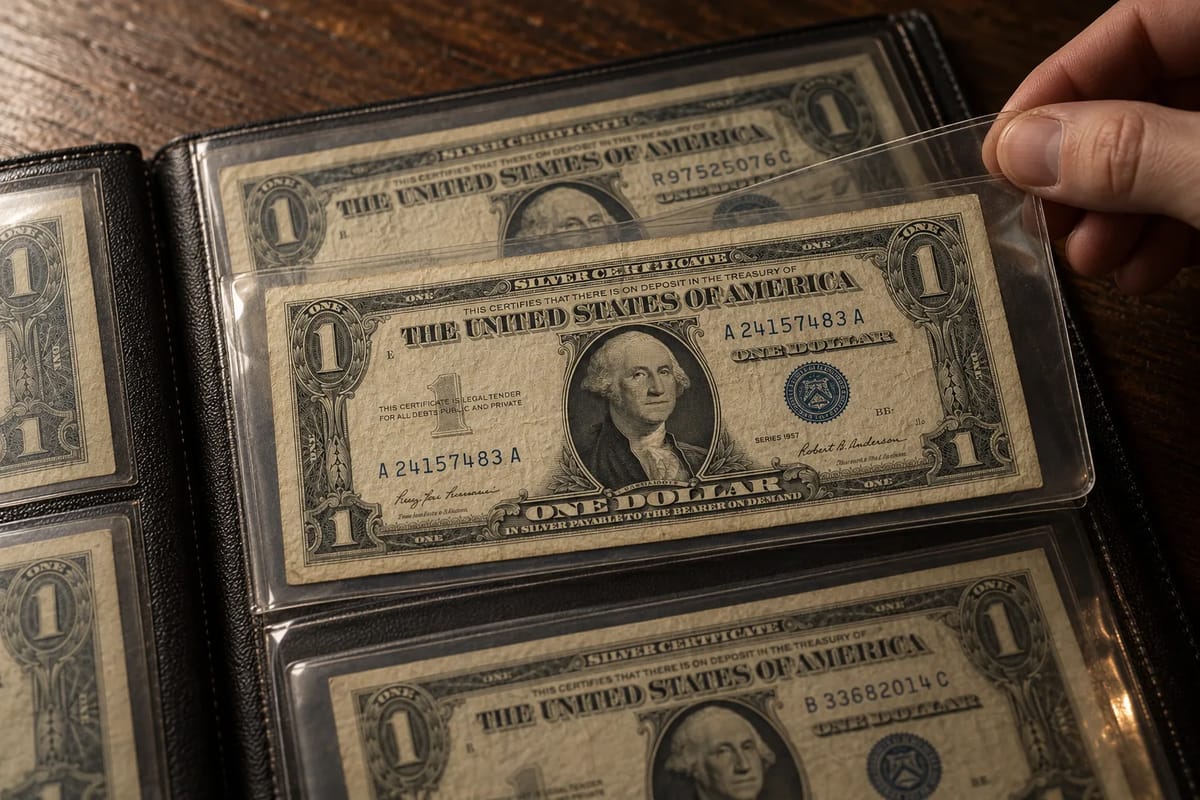
- Use inert currency sleeves made of Mylar (polyester) or polypropylene. Avoid soft PVC sleeves, which off-gas plasticizers that turn paper yellow and tacky over years.
- Store sleeved notes flat in a binder with archival pages or in a rigid currency box, never rolled or paper-clipped.
- Keep humidity moderate. Damp basements cause foxing (brown spots) and mold; attics cook the paper brittle.
- Keep notes out of direct sunlight. The blue seal and serial inks fade, and a faded seal costs more in value than a light fold.
- Handle by the edges with clean, dry hands. Never try to erase pencil marks or clean a note; cleaning reduces grade and removes any chance of an EPQ or PPQ designation.
- For graded notes, keep the holder. A PMG or PCGS Banknote slab protects the note and is the proof of grade a buyer pays for.
Buying silver certificates
If you are buying rather than selling, the cheapest way into the series is a circulated 1935 or 1957 $1 for $2 to $3, then a 1957 star, a 1935-A Hawaii, and a 1928 Funnyback as budget allows. Compare any price against the Greysheet ranges above and the sold-auction figures, and pay for certification only on notes where the grade is doing the work. On PeerMetals, sellers list coins, bullion and currency, and every listing shows the seller's price against live spot, which makes it easy to see when a paper note is priced on collector value alone. Sellers can list silver certificates alongside their silver. Our coin values hub covers the silver coins these notes once redeemed.
Frequently asked questions
How much is a 1957 silver certificate worth?
About $1.50 to $2 if worn but undamaged, $5 in XF-40, and $10 to $18 in Choice Uncirculated according to PCGS. Greysheet's range for a plain 1957 $1 runs from $1.50 to $210, with the top figure reserved for superb gem graded examples. Star notes add a few dollars: $12 in XF-40 and $20 to $24 in CU-63.
How much is a 1935 silver certificate worth?
Most 1935-series $1 notes are worth $1.50 to $3 heavily circulated, $3 to $6 in Very Fine, $6 to $12 in Extremely Fine and $10 to $25 uncirculated (Great American Coin Company). The scarcer letters (B, C, F, G, H) run 1.5 to 3 times those figures. A 1935-A with a brown Hawaii seal, a yellow North Africa seal, or a red R or S overprint is worth $22 to $300 and up.
Can I still redeem a silver certificate for silver?
No. Redemption for silver dollars ended in March 1964 and redemption for bullion ended June 24, 1968. A Treasury release from May 1968 states that after that date the notes "will continue to be usable as legal currency, but may not be redeemed for silver." A bank will exchange one only for a Federal Reserve Note of the same face value.
What is the rarest silver certificate?
Among small-size notes, the 1933 $10 is the rarest type; Greysheet's range is $2,000 to $95,000 and Serial Worth records a $50,400 sale in January 2022. The single highest guide value belongs to the 1928-D $1 star note at $100,000. Among large-size notes, the 1896 Educational and 1899 Black Eagle are the most valuable widely collected types, with records of $21,850 and $90,000 respectively.
Is a silver certificate with a star worth more?
Yes, but on common series the premium is small: roughly $5 to $20 over a regular note, per Great American Coin Company. The premium becomes large on scarce series. Greysheet starts 1928-C, D and E stars at $1,800, $1,000 and $5,500, and the 1953-B $5 star at $400.
Should I get my silver certificate graded?
Only if the note is scarce or truly uncirculated. PMG and PCGS Banknote fees exceed the value of a common circulated $1, so grading makes sense for 1928-series notes, large-size notes, WWII Hawaii and North Africa issues in high grade, scarce stars, the 1933 $10, and flawless common notes that could reach Gem 66 or better.
How do I tell a silver certificate from a regular dollar bill?
Look at the seal and serial numbers: blue means silver certificate, green means Federal Reserve Note, red means United States Note. The words "Silver Certificate" appear across the top, and the obligation promises silver "payable to the bearer on demand." WWII Hawaii notes have brown seals and North Africa notes have yellow seals, but both still read "Silver Certificate."