How Much Is a Dime Worth? Silver Dime Values by Year, Plus the 2026 Dime

A dime is worth 10 cents if it is dated 1965 or later, and about $3.91 at today's silver price if it is dated 1964 or earlier. That second figure is silver melt value: every U.S. dime struck through 1964 is 90 percent silver and contains 0.0723 troy ounces of the metal (at the $65.39/oz spot of 3 September 2026 used in the tables below, that came to $4.73). Collector value sits on top of that floor. A worn common-date Mercury dime lists at $5.89 to $7.62 in the USA Coin Book price chart, a worn common Barber dime at $10.50 to $16, and a short list of key dates runs from a few hundred dollars to more than $30,000. The rest of this guide gives you the numbers by series, by grade and by date, then covers how to test a dime for silver and what dealers pay when you go to sell.
The live spot price moves every minute, so treat $65.39 as a snapshot. You can pull the current figure and rerun the math on the junk silver calculator or the live silver price page.
The quick answer: which dimes are worth more than 10 cents
| Dime | Years | Composition | What it is worth today |
|---|---|---|---|
| Barber dime | 1892-1916 | 90% silver, 10% copper, 2.5 g | $10.50 to $16 for a worn common date (G-4 to F-12); $95 to $253 in AU-50 to MS-63; key dates $126 to $15,254 |
| Mercury (Winged Liberty) dime | 1916-1945 | 90% silver, 10% copper, 2.5 g | $5.89 to $7.62 for worn 1934-1945 dates; $7.32 to $14 for worn pre-1934 dates; $34 to $316 in MS-65; key dates $64 to $32,661 |
| Roosevelt silver dime | 1946-1964 | 90% silver, 10% copper, 2.5 g | $5.89 to $7.62 worn (silver value drives it); $10.99 to $73 in MS-65 |
| Roosevelt clad dime | 1965-present | Copper-nickel clad, 2.268 g | Face value; $2.50 to $3.08 in MS-65; the 1996-W $25, the 1982 no-P $249, No-S proofs $500 and up |
Grade-based figures come from the USA Coin Book price charts, whose numismatic values were last updated February 2026 with the silver portion updated live (retrieved September 2026). The clad weight is from the U.S. Mint's dime specifications, and the silver weight from NGC's melt value table.
Which dimes are silver and which are clad
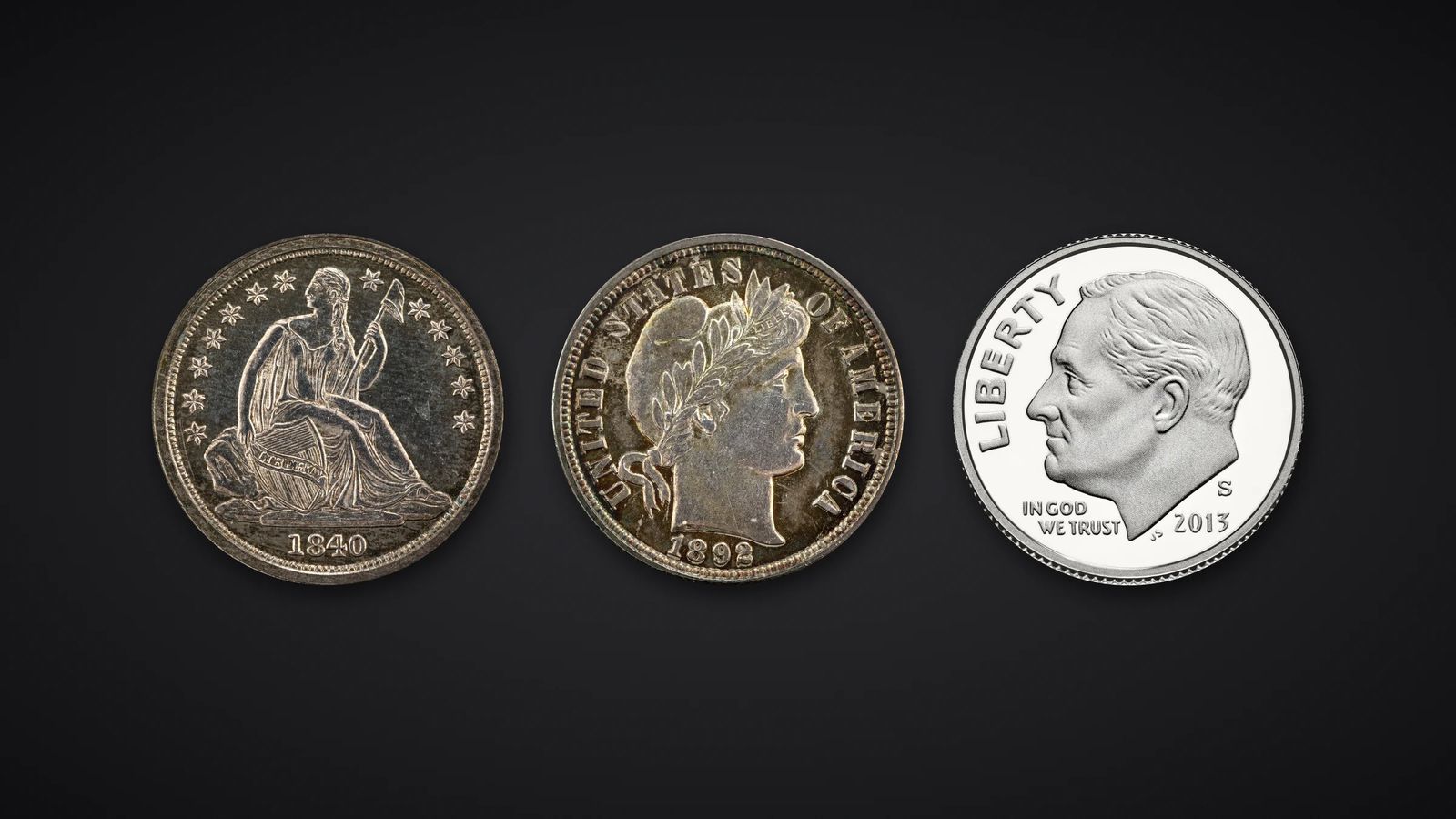
The U.S. Mint struck its first dimes in 1796 as small silver coins. Liberty in one form or another stayed on the dime until 1946. The Mint removed silver from the dime in 1965 and switched to a copper-nickel clad composition, and it has stayed clad ever since. The cut-off is a date, not a design: any dime dated 1964 or earlier is silver, any dime dated 1965 or later is clad. Hero Bullion ties the change to the Coinage Act of 1965.
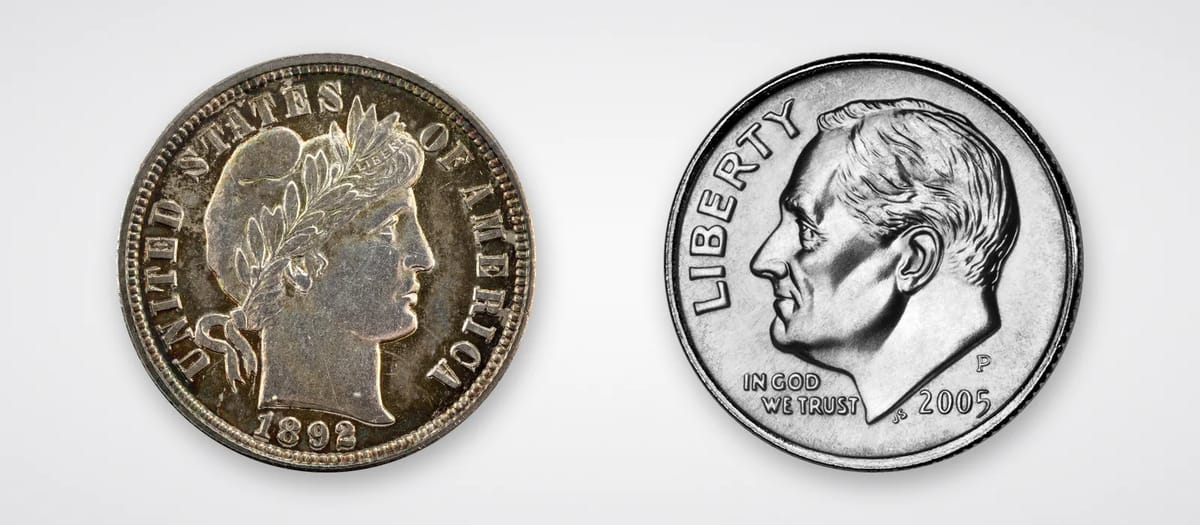
Three silver series turn up in change jars and inherited collections.
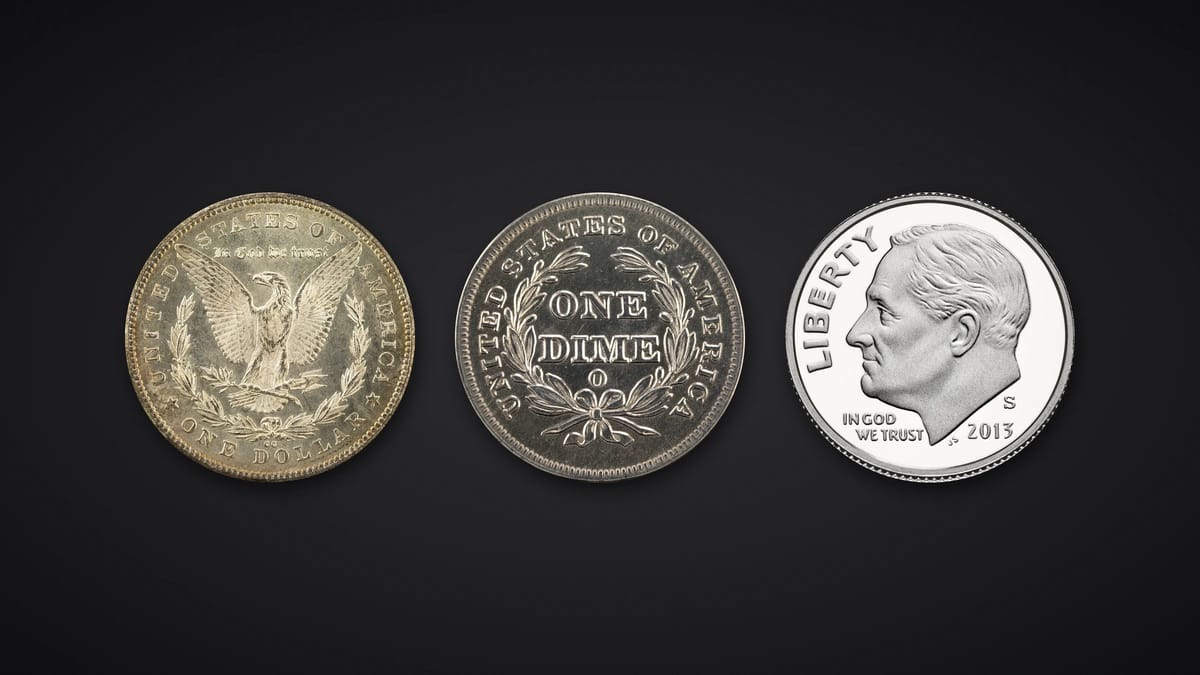
- Barber dime, 1892-1916. Designed by Chief Engraver Charles E. Barber, with Liberty in a cap and laurel wreath on the front and ONE DIME inside a wreath on the back. Mint marks P (none), D, O and S. Read the full series in our Barber dime value guide.
- Mercury dime, 1916-1945. Adolph A. Weinman's Winged Liberty Head. The Mint's own dime page says the design got its name because the winged cap reminded people of the Roman god Mercury, and calls it one of the most beautiful coins in the country's history. The reverse shows a fasces and olive branch. Full series coverage is in the Mercury dime value guide.
- Roosevelt dime, 1946-present. Released 30 January 1946 to honor Franklin D. Roosevelt and his support of the March of Dimes. Silver through 1964, clad from 1965. See the Roosevelt dime value guide.
Two details trip people up. First, 1916 exists in both the Barber and Mercury designs. USA Coin Book lists 18,490,000 Barber dimes from Philadelphia and 5,820,000 from San Francisco that year, alongside 22,180,080 Philadelphia Mercury dimes, 10,450,000 from San Francisco and only 264,000 from Denver. Second, the Mint is replacing the Roosevelt design for 2026 only with an Emerging Liberty design for the 250th anniversary, then returning to Roosevelt in 2027. Those 2026 dimes are clad and worth face value in circulation.
Older silver dimes exist too. Gainesville Coins gives circulated ranges of $35 to $500 and up for Bust dimes (1796-1837) and $15 to $200 and up for Liberty Seated dimes (1837-1891), but notes that finding either in circulation is extraordinarily rare.
The two compositions side by side
| Specification | Silver dime (through 1964) | Clad dime (1965 on) |
|---|---|---|
| Alloy | 90% silver, 10% copper | 8.33% nickel, balance copper (pure copper core) |
| Weight | 2.5 g | 2.268 g (U.S. Mint); USA Coin Book rounds it to 2.27 g |
| Pure silver | 0.0723 troy oz | None |
| Diameter | 17.9 mm | 17.91 mm |
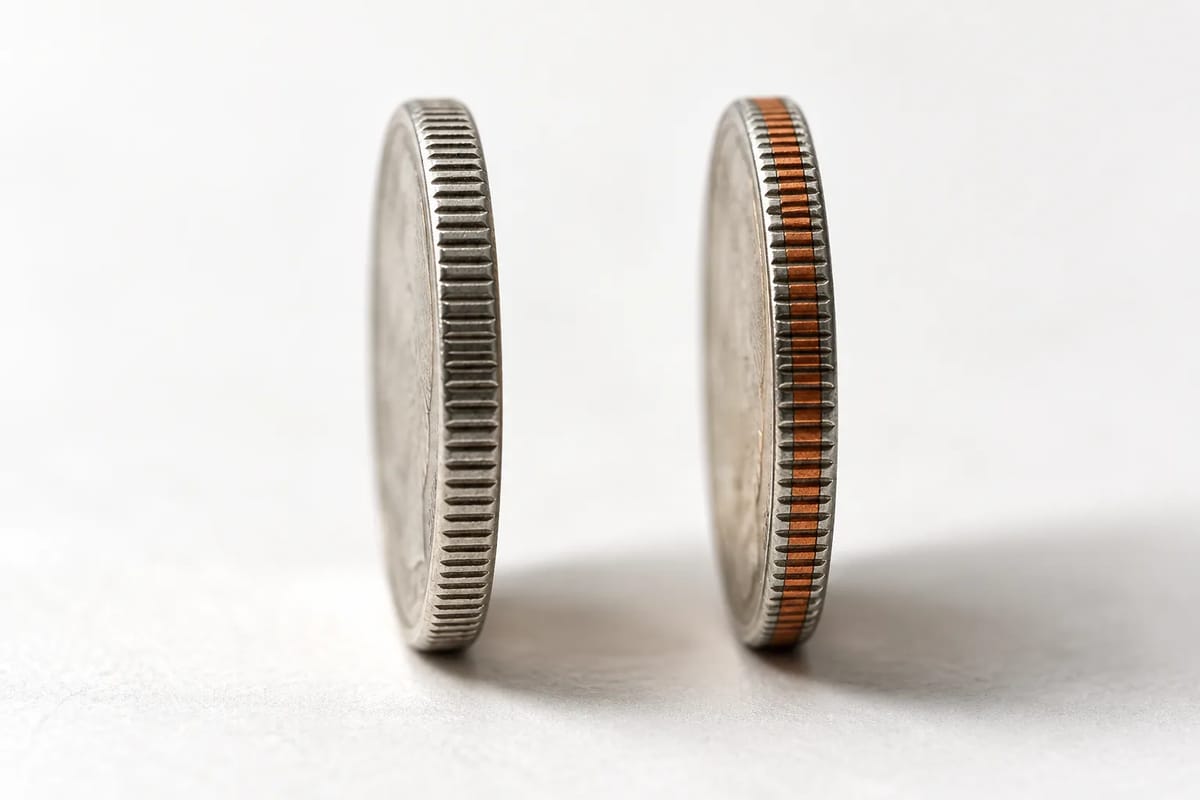
| Edge | Reeded, solid silver-gray | Reeded, 118 reeds, visible copper stripe |
Silver dime melt value: the math, with a worked example
A silver dime weighs 2.5 grams. Ninety percent of that is silver, which is 2.25 grams, or 0.0723 troy ounces. NGC lists that actual silver weight for the Barber, Mercury and Roosevelt dimes alike. Multiply it by the spot price and you have melt value.
At $65.39/oz: 0.0723 x 65.39 = $4.73. NGC's melt table showed $4.74 for each of the three series at its ask price of $65.51 on the evening of 2 September 2026, so the two sources agree to within a cent. American Hartford Gold walks through the same formula at a $30 silver price, which gave $2.17 per dime; the coin has not changed, the metal has more than doubled.
| Quantity | Face value | Silver content (troy oz) | Melt value at $65.39/oz |
|---|---|---|---|
| 1 dime | $0.10 | 0.0723 | $4.73 |
| 10 dimes | $1.00 | 0.723 | $47.28 |
| 14 dimes | $1.40 | 1.012 | $66.19 |
| Roll of 50 | $5.00 | 3.615 | $236.38 |
| $100 face bag (1,000 dimes) | $100 | 72.3 | $4,727.70 |
| $1,000 face bag (10,000 dimes) | $1,000 | 723 | $47,277 |
The 14-dime line explains a phrase you will hear at coin shops. American Hartford Gold notes that dealers say "$1.40 face equals one ounce of silver" so they can trade bags of dimes without a calculator. Strictly, 14 dimes hold 1.012 ounces. The rounding is deliberate: circulated coins have lost a little metal to wear, and the $1.40 rule builds in that allowance. AHG also gives the standard bag sizes as $100, $500 and $1,000 face, with a $1,000 bag of dimes holding 10,000 coins and about 723 troy ounces.
The silver melt calculator does this for any weight and purity, and the junk silver calculator takes a face-value total in dimes, quarters or halves and returns melt at the live spot. If you are new to 90 percent coinage as a way to hold silver, start with our junk silver guide.
Silver dime values by grade: common dates
Price guides value coins on the 70-point Sheldon scale. The columns below use G-4 (Good), VG-8 (Very Good), F-12 (Fine), VF-20 (Very Fine), EF-40 (Extremely Fine), AU-50 (About Uncirculated), MS-60 (Mint State, lowest uncirculated) and MS-65 (gem uncirculated). USA Coin Book publishes its Barber chart to MS-63 rather than MS-65, so the last column reads MS-63 for the two Barber rows. If those abbreviations are new, read our guide to PCGS, NGC and ANA grading standards first.
| Coin (common date) | G-4 | VG-8 | F-12 | VF-20 | EF-40 | AU-50 | MS-60 | MS-65 (MS-63 for Barber) |
|---|---|---|---|---|---|---|---|---|
| 1892 Barber (P), first year | $14 | $20 | $25 | $36 | $53 | $95 | $158 | $229 |
| 1912 Barber (P) | $10.50 | $14 | $16 | $22 | $41 | $95 | $166 | $253 |
| 1920 Mercury (P), early date | $7.32 | $7.62 | $7.96 | $9.95 | $14 | $22 | $46 | $316 |
| 1944 Mercury (P), late date | $5.89 | $6.49 | $7.06 | $7.32 | $7.62 | $8.66 | $10.99 | $34 |
| 1946 Roosevelt (P), first year | $5.89 | $6.49 | $7.06 | $7.32 | $7.62 | $8.31 | $9.95 | $18 |
| 1964 Roosevelt (P), last silver year | $5.89 | $6.49 | $7.06 | $7.32 | $7.62 | $7.97 | $8.31 | $10.99 |
Source: USA Coin Book Barber, Mercury and Roosevelt dime price charts, numismatic values updated February 2026 with the silver portion live, retrieved 3 September 2026.
Three things stand out. For any Mercury dime from 1934 on and any silver Roosevelt dime, every grade from G-4 through EF-40 sits within about $3 of melt. Condition does not matter until the coin is uncirculated, and even then a 1964 dime in MS-65 lists at $10.99. Early Mercury dimes (1916-1931) carry a couple of dollars more in worn grades and real money in gem grades: a 1920 Philadelphia coin jumps from $46 in MS-60 to $316 in MS-65. Barber dimes start at roughly twice melt even in G-4, because far fewer survived, and a common date in AU-50 is $95.
Key-date dimes and what they actually bring
Key dates are the coins with low mintages or a recognized variety, where demand outruns supply in every grade. These are the ones worth pulling from a jar and, in most cases, sending to PCGS or NGC before you sell.
| Coin | Mintage | G-4 | F-12 | EF-40 | MS-60 | MS-65 (MS-63 for Barber) |
|---|---|---|---|---|---|---|
| 1894-S Barber | 24 | n/a | n/a | n/a | n/a | PR-63 $1,714,917 (USA Coin Book); PCGS auction record $2,160,000 for the PR-66 finest known, Heritage, January 2025 |
| 1895-O Barber | 440,000 | $588 | $1,348 | $3,089 | $7,337 | $15,254 |
| 1896-S Barber | 575,056 | $147 | $379 | $502 | $933 | $1,678 |
| 1901-S Barber | 593,022 | $126 | $486 | $725 | $1,603 | $2,632 |
| 1916-D Mercury | 264,000 | $1,247 | $3,089 | $7,338 | $15,256 | $32,661 |
| 1921 Mercury | 1,230,000 | $64 | $158 | $670 | $1,603 | $4,074 |
| 1921-D Mercury | 1,080,000 | $85 | $253 | $829 | $1,819 | $4,251 |
| 1926-S Mercury | 1,520,000 | $22 | $36 | $316 | $1,449 | $4,252 |
| 1942/1 Mercury overdate | not recorded | $380 | $560 | $794 | $3,089 | $18,710 |
| 1942/1-D Mercury overdate | not recorded | $380 | $531 | $725 | $3,089 | $12,164 |
| 1949-S Roosevelt | 13,510,000 | $5.89 | $7.06 | $9.95 | $34 | $73 |
| 1982 no-P Roosevelt (clad) | not recorded | n/a | n/a | n/a | n/a | $249 (Gainesville Coins gives $50 to $100 and up for typical examples) |
Source: USA Coin Book price charts, numismatic values updated February 2026, retrieved 3 September 2026. Mintages as listed on the same charts. The 1894-S and 1982 no-P are not priced by USA Coin Book in circulated grades.
1916-D Mercury dime
Only 264,000 were struck at Denver, against 22 million at Philadelphia. USA Coin Book lists $1,247 in G-4, $4,947 in VF-20 and $32,661 in MS-65. Other guides cluster lower for worn coins: Gainesville Coins gives $800 to $2,000 and up circulated, Bullion Exchanges $700 to $1,500 and up for well-worn examples, and howmuchisadimeworth.com $1,095 in Good. The spread is normal for a coin that trades on eye appeal and certification. Buy or sell this date only in a PCGS or NGC holder. Our 1916-D Mercury dime value page goes deeper.
1894-S Barber dime
Twenty-four were struck and the coin is one of the most famous U.S. rarities. PCGS CoinFacts lists the auction record as $2,160,000 for the PR-66 finest known, sold by Heritage in January 2025 (it brought $1,997,500 in 2016), and USA Coin Book carries a single PR-63 value of $1,714,917. For context, the same Hero Bullion table lists the 1873-CC No Arrows Seated Liberty dime at $3,600,000 in 2023 and a 1796 Draped Bust dime in MS-66+ at $372,000. Full detail is on the 1894-S Barber dime value page.
1921 and 1921-D Mercury dimes
Dime production fell to 1,230,000 in Philadelphia and 1,080,000 in Denver in 1921, and USA Coin Book's chart shows no dimes at all for 1922. It lists the 1921 at $64 in G-4, $348 in VF-20 and $4,074 in MS-65, and the 1921-D at $85, $441 and $4,251 in the same grades. Gainesville Coins gives $50 to $150 and up for a circulated 1921 and $65 to $200 and up for a 1921-D; Bullion Exchanges quotes $150 to $600 and up for the pair depending on condition. See the 1921 Mercury dime value page.
1942/1 overdates
Gainesville Coins explains the variety: 1941 dies were reused in 1942 with the 2 punched over the 1, so a trace of the 1 shows below the 2. USA Coin Book lists both the Philadelphia and Denver overdates at $380 in G-4 and $3,089 in MS-60, with MS-65 at $18,710 for the P and $12,164 for the D. Gainesville gives $300 to $800 and up for the 1942/1 and $350 to $900 and up for the 1942/1-D. It is the most valuable Mercury variety you could realistically find in an old roll.
1949-S Roosevelt dime
This is the lesson in how a "key date" can be worth melt. The 1949-S had the lowest mintage of the early Roosevelts at 13,510,000, but USA Coin Book prices it at $5.89 to $7.32 from G-4 to VF-20, exactly the same as a 1964. The premium appears only in high grade: $9.95 in EF-40, $34 in MS-60 and $73 in MS-65. The 1949 Philadelphia coin runs $25 and $50 in MS-60 and MS-65, and the 1950-S matches the 1949-S at $34 and $73. Gainesville Coins gives the 1949 trio $5 to $15 and up. Details are on the 1949-S Roosevelt dime page.
1982 no-P Roosevelt dime
Some 1982 Philadelphia dimes were struck from a die that never received its P mint mark. Gainesville Coins calls it the most realistic modern variety to find in circulation and gives a typical value of $50 to $100 and up, with strong-strike uncirculated coins highest. USA Coin Book lists $249 in MS-65 against $9.37 for a normal 1982-P. Check any 1982 dime with no letter beside the date; a D means Denver, not the variety. Our 1982 no-P Roosevelt dime page has the diagnostics.
Modern Roosevelt dimes (1965 to now) worth more than face
Most clad dimes are worth 10 cents. The exceptions fall into a few groups.
| Modern dime | Value | Source |
|---|---|---|
| Any clad dime, gem uncirculated (MS-65) | $2.50 to $3.08 (1965: $3.08; 1996-P, 2024-P, 2025-P: $2.50) | USA Coin Book |
| 1996-W, 50th anniversary, mint sets only, 1,457,000 struck | $25 in MS-65; $15 uncirculated and $5 to $10 circulated | USA Coin Book; Gainesville Coins |
| 1982 no-P | $50 to $100 and up; $249 in MS-65 | Gainesville Coins; USA Coin Book |
| No-S proof dimes (1968, 1970, 1975, 1983) | $500 to $100,000 and up; the 1975 no-S, with two confirmed, $250,000 to $350,000 | Gainesville Coins; howmuchisadimeworth.com |
| Regular proofs | 1968-S and 1970-S $2.50 in PR-65; 1983-S and 1992-S clad $3.62; 1992-S silver proof $10.99 | USA Coin Book |
| 1964-D doubled die reverse (silver) | $15 in G-4 to $198 in MS-65 | USA Coin Book |
Two strike designations add value on the silver side. Mercury dimes with fully separated horizontal bands on the fasces earn a Full Bands label, and Roosevelt dimes with a fully split torch earn Full Torch. Gainesville Coins describes the Full Bands premium as significant without putting a number on it, so check a certified-coin price guide for the specific date before paying up.
Silver did return to the dime in one place. From 1992 the Mint sold silver proof sets, and USA Coin Book lists the 1992-S silver proof at 1,317,579 struck and $10.99 in PR-65. These were never released for circulation, but Bullion Exchanges notes that proof dimes do escape sets and turn up in change, where their mirror fields give them away; it gives $20 to $100 and up for circulating proof dimes.
Error dimes
Genuine mint errors are worth money; post-mint damage is not. Gainesville Coins draws the line: true errors happen during striking, off-center strikes keep a proper rim, and hub doubling looks nothing like the flat shelf of machine doubling. Its ranges, with Bullion Exchanges' figures where they differ:
- Doubled die: $25 to $50 light, $75 to $200 moderate, $300 to $500 and up when visible without magnification. Bullion Exchanges gives $100 to $1,000 and up for doubled-die Mercury dimes.
- Off-center strike: $15 to $35 at 5 to 10 percent, $35 to $75 at 10 to 25 percent, $75 to $200 and up at 25 to 50 percent, with a premium for a complete date. Bullion Exchanges quotes $50 to $300 and up for off-center dimes showing the date.
- Missing clad layer, exposing the copper core: $75 to $400 and up (Bullion Exchanges).
- Wrong planchet, such as a dime struck on a cent blank: $200 to $1,000 and up; transitional strikes on a silver planchet $300 to $2,000 and up (Bullion Exchanges).
- Die clash $5 to $50, strike-through $15 to $100, brockage $100 to $500 and up, die cap $200 to $1,000 and up (Gainesville Coins).
Every dealer page we reviewed says the same thing about errors: have the coin examined in person before assigning a value, because most "errors" that reach a counter are damage.
How to check whether a dime is silver
- Read the date. 1964 or earlier is silver. 1965 or later is clad, apart from proof-set coins that should not be in circulation.
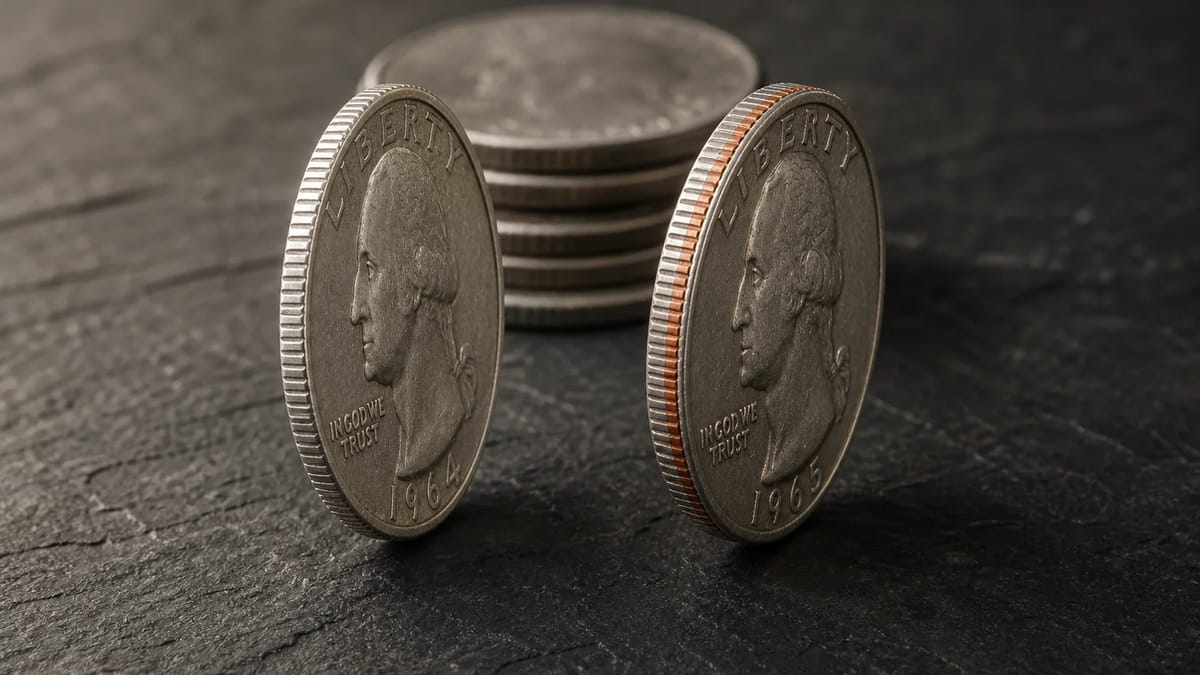
- Look at the edge. A silver dime has a solid silver-gray edge. A clad dime shows a copper-colored stripe sandwiched between two nickel-colored layers. Bullion Exchanges, Gainesville Coins and American Hartford Gold all put this first because it works through dirt and in bad light. Coin-roll hunters check the edges of a whole roll at once.
- Weigh it. A silver dime weighs 2.5 g. The U.S. Mint gives the clad dime at 2.268 g, and USA Coin Book rounds that to 2.27 g. A pocket scale that reads to 0.01 g separates them cleanly. Weight also catches a plated fake, which will not hit 2.5 g.
- Try a magnet. Neither silver nor copper-nickel is magnetic. If a magnet grabs the coin, it is not a U.S. dime.
- Listen. Gainesville Coins lists the different sound when dropped as a quick tell. Silver rings higher and longer than clad on a hard surface.
- Find the mint mark. P is Philadelphia (usually no mark on older coins), D is Denver, S is San Francisco and O is New Orleans, which appears only on Barber dimes among these three series. American Hartford Gold notes the Barber mark sits under the bow on the reverse and is easy to miss under grime. On modern Roosevelts the letter is on the front beside the date, which is where you spot a 1996-W or a missing P. Our field guide to mint marks shows each position.
- Do not clean it. Cleaning strips the original surface and cuts collector value, sometimes to melt. Every source in this guide says the same.
A gold-colored dime is not gold. There are no U.S. gold dimes; a yellow tint is toning or plating, and a plated dime is still worth 10 cents or melt.
What dealers actually pay vs price-guide numbers
Price guides show retail. NGC's own disclaimer says its prices are averages compiled from third-party sources, not prices for individual coins, and that they lag short-term moves. USA Coin Book's $5.89 for a G-4 1964 dime is what a dealer might ask for one coin, not what a dealer hands you for a jar of them. The buy side works differently for bulk silver and for key dates.
Bulk silver dimes trade as a multiple of face
Dealers quote junk silver as "times face." At $65.39 spot a dollar of face in dimes contains 0.723 oz, so melt is $47.28 per dollar, or 47.3 times face. A buy price lands under that and a sell price over it. The gap is the dealer's margin, and it is smaller when you sell more. American Hartford Gold puts it plainly: local coin shops offer quick cash but subtract overhead via low bids, so get at least two offers; online dealers post live buy prices and send prepaid labels, which suits larger lots.
Real asks give a sense of the sell side on the day. On PeerMetals on 3 September 2026, one seller listed circulated 90 percent silver Mercury dimes at $5.15 each, marked down from $5.77, which is about 9 percent over the $4.73 melt, and another listed a Mercury dime at $5.83. On USA Coin Book's own marketplace, common-date circulated Mercury dimes were listed at $5.85 to $6.95 and common circulated Barber dimes at $5.67, well under the $10.50 G-4 figure in the same site's price chart. The chart is a reference; the listing is the market.
Key dates sell on the holder, not the guide
For a 1916-D, a 1921-D or an overdate, the price-guide column you land in depends on the grade a third party assigns, and raw coins sell at a discount to certified ones because the buyer takes on the grading risk. Hero Bullion's advice is to have rare silver dimes professionally graded before selling. The same applies to any error coin worth more than about $100: Bullion Exchanges answers every reader who writes in with a possible error by sending them to a dealer or coin show for an in-person look, then to PCGS or NGC if the coin holds up.
Cleaned, holed and damaged coins
A cleaned, bent, holed or corroded silver dime is a melt coin regardless of date, with the rare exception of a key date that still has value as a filler. Sort these out before you ask for a quote, because a dealer will price the whole lot as culls if they are mixed in.
How to sell dimes
- Sort by date. Pull everything dated 1964 or earlier. Check the edges of the rest for a missing copper stripe, and set aside any 1982 with no mint mark, any 1996-W and anything that looks struck wrong.
- Pull the key dates. Compare your silver coins against the key-date table above. Everything else is bulk.
- Weigh and count the bulk. Ten dimes is $1 face. Run the face total through the junk silver calculator to get today's melt, then expect buy offers a little under it.
- Grade the keys. Send a 1916-D, a 1921 or 1921-D, an overdate or any Barber key to PCGS or NGC before you sell. For a 1949-S or a common Mercury in gem condition, grading only pays if the coin is truly uncirculated.
- Get two quotes. A local shop, an online dealer's buy price and a peer-to-peer listing will rarely agree. American Hartford Gold notes that selling to other collectors online can return more but adds fees, shipping and scam risk; photograph everything, describe any damage and insure the package.
- List it yourself if the spread is wide. On PeerMetals, sellers list bulk silver dimes and graded key dates side by side, and every listing shows the seller's price against live spot so a buyer can see the premium at a glance. The platform charges a flat 2.75 percent seller fee with no listing fees and pays out in one to three days. Browse the marketplace to see current asks, or read how selling works.
If you are holding rather than selling, American Hartford Gold suggests 2x2 Mylar flips or archival tubes sorted by date and mint mark, with an inventory spreadsheet noting condition and estimated value for insurance. Keep silver away from humidity and sulfur, which speed up tarnish on any silver surface.
Frequently asked questions
How much is a 1964 dime worth?
A 1964 dime is 90 percent silver and worth $4.73 in melt at $65.39/oz silver. USA Coin Book lists $5.89 in G-4 through $7.62 in EF-40 and $10.99 in MS-65. With 933,310,762 struck at Philadelphia and 1,357,517,180 at Denver it is the most common silver dime, so there is no date premium. The 1964-D doubled die reverse is the exception at $15 to $198. See the 1964 Roosevelt dime value page.
How much is a Mercury dime worth?
A common Mercury dime from 1934 to 1945 lists at $5.89 to $7.62 in circulated grades and $34 to $46 in MS-65 on USA Coin Book, against a $4.73 melt value. Dates from 1916 to 1931 run $7.32 and up worn and $95 to $2,078 in MS-65. The key dates are the 1916-D ($1,247 in G-4), the 1921 and 1921-D ($64 and $85 in G-4), the 1926-S ($22 in G-4, $4,252 in MS-65) and the 1942/1 overdates ($380 in G-4).
How much is a 1965 dime worth?
Ten cents in circulated condition. USA Coin Book lists a 1965 at $3.08 in MS-65, with 1,652,140,570 struck. The one thing worth checking is weight: a 1965 dime that weighs 2.5 g instead of 2.27 g could be a transitional strike on a leftover silver planchet, which Bullion Exchanges values at $300 to $2,000 and up once authenticated.
Are any dimes after 1964 silver?
Only the silver proof dimes the Mint has sold in collector sets since 1992, such as the 1992-S silver proof that USA Coin Book lists at 1,317,579 struck and $10.99 in PR-65. They were never released for circulation. Any other 1965-or-later dime you find in change is copper-nickel clad, unless it fails the edge and weight tests above.
How many silver dimes make one ounce of silver?
Fourteen dimes hold 1.012 troy ounces (14 x 0.0723), and the exact break-even is 13.8 coins. Dealers round to 14 and quote "$1.40 face equals one ounce," as American Hartford Gold describes, which also builds in a small allowance for wear.
Is it legal to melt silver dimes?
Yes. American Hartford Gold notes that, unlike cents and nickels, U.S. silver coins carry no melting restriction. It is still poor practice to melt anything that carries a collector premium over melt, and in most cases selling as junk silver pays more than a refiner would.
What is the most valuable dime ever sold?
Hero Bullion records the 1873-CC No Arrows Seated Liberty dime at $3,600,000 at auction in 2023 as the top sale, followed by the 1894-S Barber dime graded PR-66, which sold for $2,160,000 in January 2025. Among coins you could plausibly find, the 1916-D Mercury tops the list at $32,661 in MS-65 on USA Coin Book, and the 1975 no-S proof, with two confirmed, is quoted at $250,000 to $350,000 by howmuchisadimeworth.com.
The 1776–2026 dime and other 2026 coins
Coins dated 2026 carry the dual date 1776–2026 for the 250th anniversary of American independence, which is why the search for a "1776 to 2026 dime value" has taken off. The 2026 dime is the same copper-nickel clad coin as every dime since 1965: it contains no silver and is worth 10 cents in circulation. Uncirculated examples from rolls and mint sets sell for a dollar or two, proofs for a few dollars, and the semiquincentennial designs will likely hold a small collector premium the way the 1976 Bicentennial coins did, which is to say not much. The coins worth money in 2026 change are the same ones as always: pre-1965 silver dimes, worth $3.91 each at today's spot, and genuine errors such as off-center strikes or missing clad layers. Check anything unusual against the coin value guides before spending it.