How Many Quarters in a Roll? Count, Weight, Box Size and Silver Value

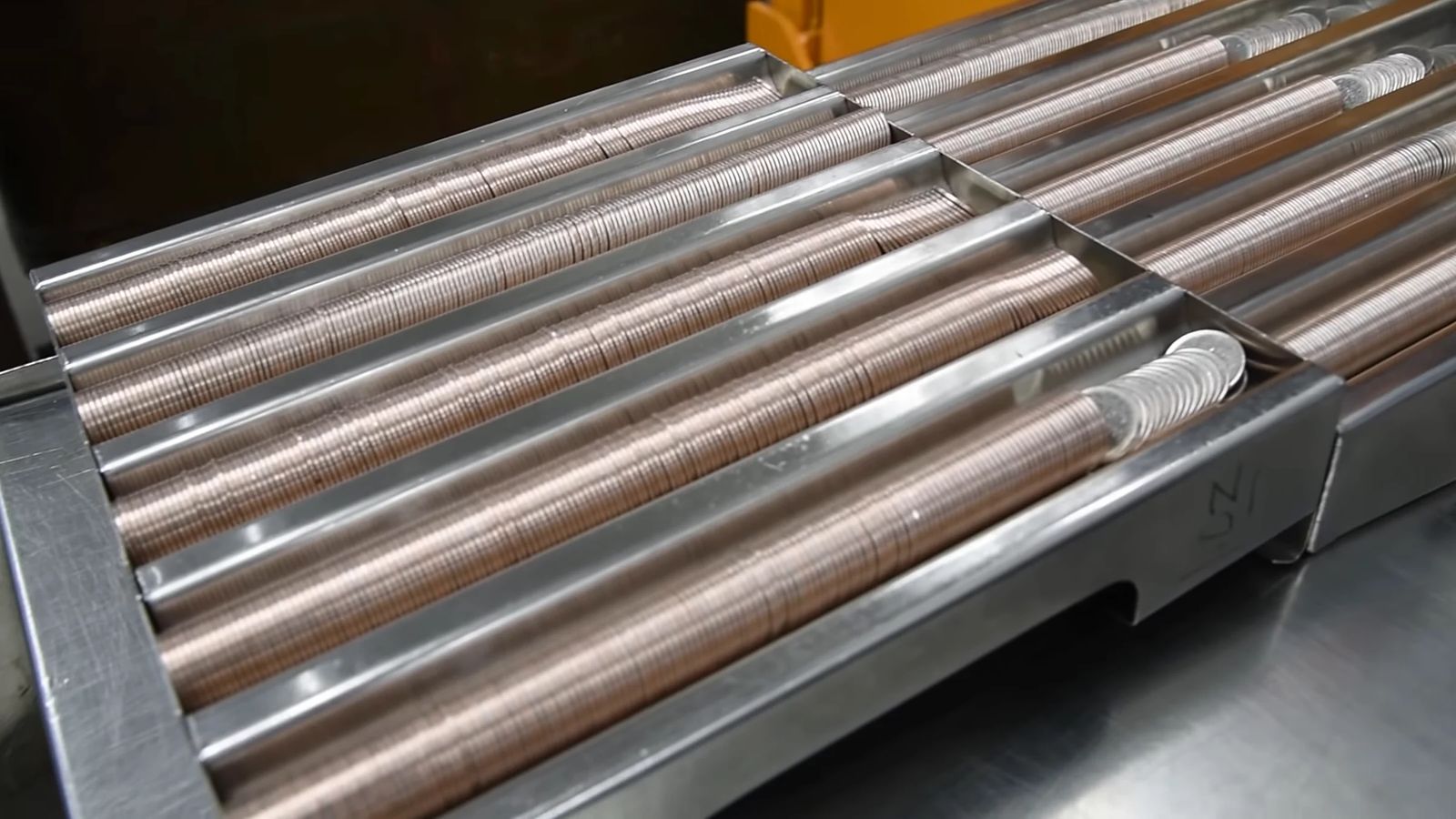
There are 40 quarters in a roll, and a roll of quarters is worth $10 in face value. That count is the standard used by every U.S. bank, by the Federal Reserve, and by the U.S. Mint's own Coin Classroom, so the answer is the same whether the roll came from a teller, a coin-counting machine, or your own kitchen table.
The rest of this guide covers what the search results usually leave out: the roll count and weight for every U.S. denomination, what a box and a bag of quarters hold, how the weight of a roll tells you whether silver is inside, which quarters are worth pulling out of a bank roll, what it costs to dump coins back, and what a roll of pre-1965 silver quarters is worth at today's silver price.
Quick answer: a roll of quarters by the numbers
| Question | Answer | Source |
|---|---|---|
| Quarters per roll | 40 | U.S. Mint Coin Classroom, JM Bullion |
| Face value of a roll | $10.00 | U.S. Mint Coin Classroom |
| Weight of a roll (clad, 1965 to date) | 226.8 g (about 8 oz, half a pound) | 40 x 5.67 g, U.S. Mint coin specifications |
| Weight of a roll (90% silver, 1932 to 1964) | 250 g | 40 x 6.25 g |
| Rolls per bank box | 50 rolls, 2,000 quarters, $500 | U.S. Gold Bureau |
| Federal Reserve bag | $1,000, 4,000 quarters, orange tag | Federal Reserve Financial Services |
| Wrapper color | Orange | ABA color code, Federal Reserve |
| Silver in a roll of pre-1965 quarters | 7.23 troy oz | 40 x 0.18084 oz, Money Metals, SD Bullion |
| Melt value of a silver roll at $65.34/oz (3 Sept 2026) | about $472.64 | PeerMetals live silver price |
How many coins are in a roll of every U.S. denomination
Roll sizes are not random. The U.S. banking system fixed each roll at a round dollar figure that stays a manageable size and weight, and the Federal Reserve, armored carriers, and counting machines are all built around those units. Pennies and dimes are thin, so they roll in 50s. Nickels and quarters roll in 40s. Half dollars roll in 20s. Small dollar coins (Sacagawea, Native American, Presidential) roll in 25s, while the large Eisenhower dollar rolls in 20s, according to JM Bullion's coin roll guide.
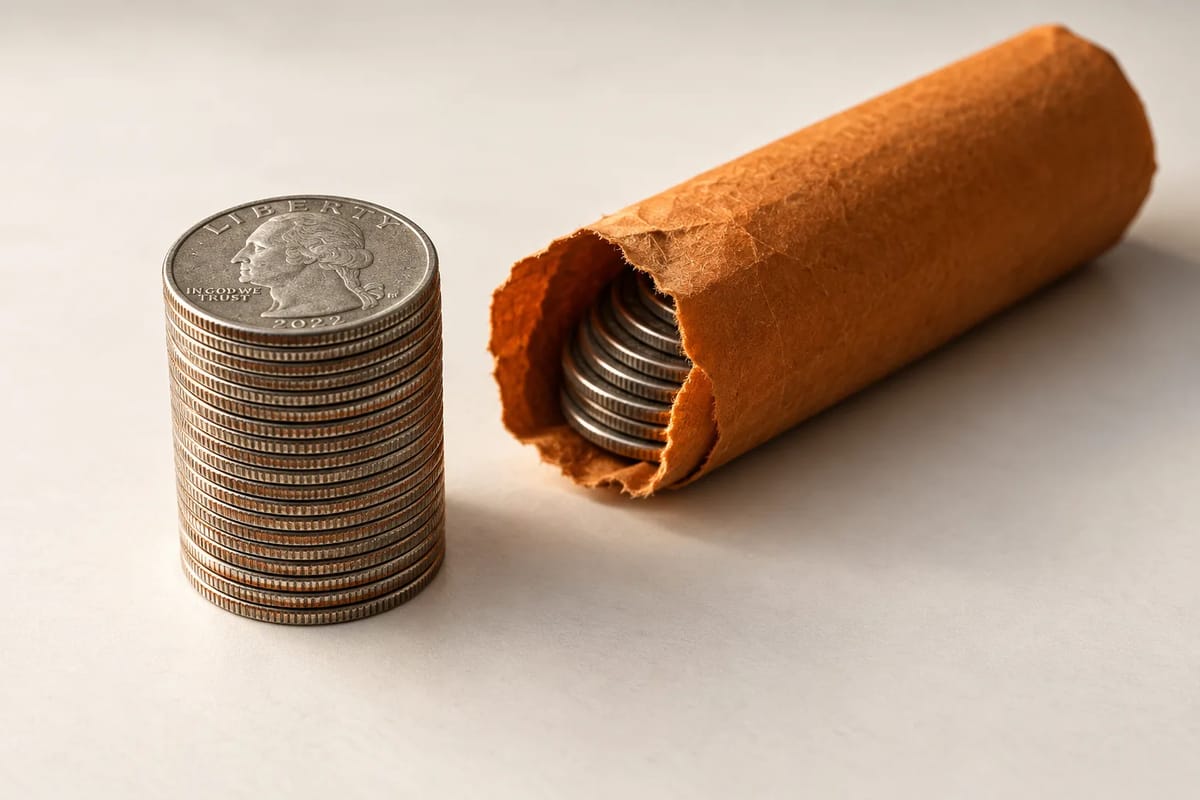
The roll weights below are calculated from the per-coin weights published in the U.S. Mint's coin specifications: 2.50 g for the penny, 5.00 g for the nickel, 2.268 g for the dime, 5.67 g for the quarter, 11.34 g for the half dollar, and 8.10 g for the dollar coin.
| Coin | Coins per roll | Face value of roll | Weight per coin (U.S. Mint) | Weight of a full roll |
|---|---|---|---|---|
| Penny (1 cent) | 50 | $0.50 | 2.50 g | 125 g |
| Nickel (5 cents) | 40 | $2.00 | 5.00 g | 200 g |
| Dime (10 cents) | 50 | $5.00 | 2.268 g | 113.4 g |
| Quarter (25 cents) | 40 | $10.00 | 5.67 g | 226.8 g |
| Half dollar (50 cents) | 20 | $10.00 | 11.34 g | 226.8 g |
| Dollar coin, small (Sacagawea, Presidential) | 25 | $25.00 | 8.10 g | 202.5 g |
| Eisenhower dollar (1971 to 1978) | 20 | $20.00 | 22.68 g (clad) | 453.6 g |
Two notes on the weights. Coin weights are struck to a tolerance, so a roll of worn circulated coins will come in a gram or two under the figure above. Dealer guides also round differently: JM Bullion lists a dime roll at 113.5 g, and Bullion Exchanges lists a clad half dollar roll at about 225 g and a small dollar roll at about 218.75 g, versus the 202.5 g you get from the Mint's 8.10 g dollar coin. The Mint figure is the one to trust for a coin in fresh condition.
A quick sanity check on any roll: a roll of quarters and a roll of half dollars weigh the same (226.8 g), and a roll of dimes weighs almost exactly half that. If a "roll of quarters" on a kitchen scale reads far from 227 g, either it is short, it is padded with something else, or it contains silver, which is covered below.
How many quarters are in a box, and in a bag
Banks do not handle single rolls when they order coin. They handle boxes and bags, and knowing those units helps when you ask a teller for quantity.
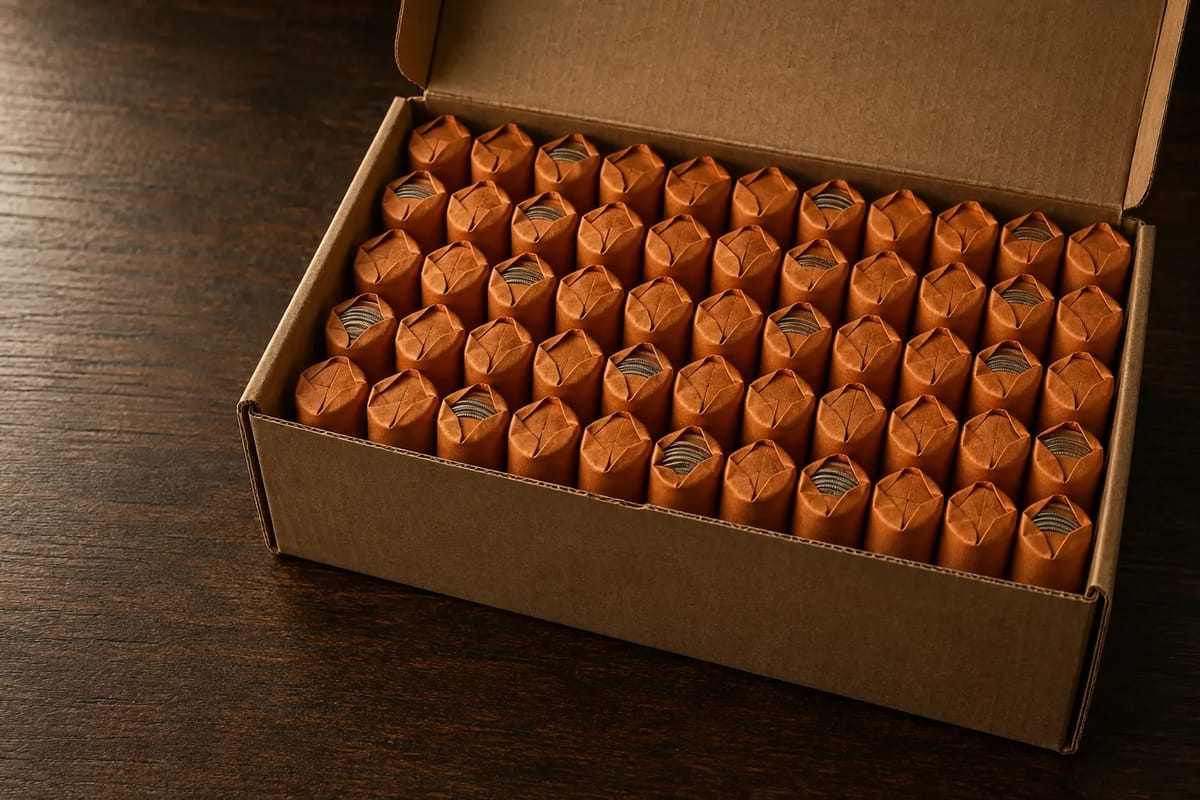
A box of quarters is 50 rolls, or $500
A standard bank box holds 50 rolls regardless of denomination, so a box of quarters is 50 rolls x 40 quarters = 2,000 quarters, or $500 in face value, per the U.S. Gold Bureau's guide. That same 50-roll box works out to $25 of pennies, $100 of nickels, $250 of dimes, $500 of quarters, $500 of half dollars, and $1,250 of small dollar coins. Using the Mint's 5.67 g quarter, a full box of clad quarters weighs 50 x 226.8 g = 11.34 kg, almost exactly 25 pounds, before the weight of the wrappers and cardboard. Coin roll hunters call these "customer wrapped" or "bank wrapped" boxes depending on where the rolls were made, and a sealed box straight from the Federal Reserve's armored carrier is what most hunters want.
A Federal Reserve bag of quarters is $1,000, or 4,000 coins
Federal Reserve Financial Services publishes the standard depositing and ordering units that banks use with the Fed. A bag of quarters is $1,000, which is 4,000 loose quarters, the equivalent of 100 rolls. At 5.67 g each that is about 22.7 kg, or 50 pounds, per bag. The Fed's full table:
| Denomination | Federal Reserve bag amount | Coins per bag | Bag tag color (ABA standard) |
|---|---|---|---|
| Pennies | $50 | 5,000 | Red |
| Nickels | $200 | 4,000 | Blue |
| Dimes | $1,000 | 10,000 | Green |
| Quarters | $1,000 | 4,000 | Orange |
| Half dollars | $1,000 | 2,000 | Buff |
| Eisenhower dollars (deposit only) | $1,000 | 1,000 | Gray |
| Presidential, Native American, Susan B. Anthony dollars | $2,000 | 2,000 | Gray |
The Fed page also states that it does not provide coin directly to consumers or retail businesses. Everything goes through a bank or credit union, which is why coin roll hunting starts at a teller window and not at a Reserve Bank.
How much does a roll of quarters weigh, and how weight reveals silver
The U.S. Mint's specifications put the current cupro-nickel clad quarter at 5.67 g (0.20 oz), 24.26 mm across, and 1.75 mm thick. Forty of them weigh 226.8 g, which is 8.0 avoirdupois ounces, right at half a pound. The U.S. Gold Bureau and JM Bullion both publish the same 226.8 g figure for a roll.
Quarters struck from 1932 through 1964 are 90% silver, and they are heavier: 6.25 g each, per the Washington quarter's published specifications (Wikipedia's coinage table, which matches the Mint's historical standard). Forty silver quarters weigh 250 g. That 23.2 g gap between a silver roll and a clad roll is the trick experienced coin roll hunters use before they open a single wrapper.
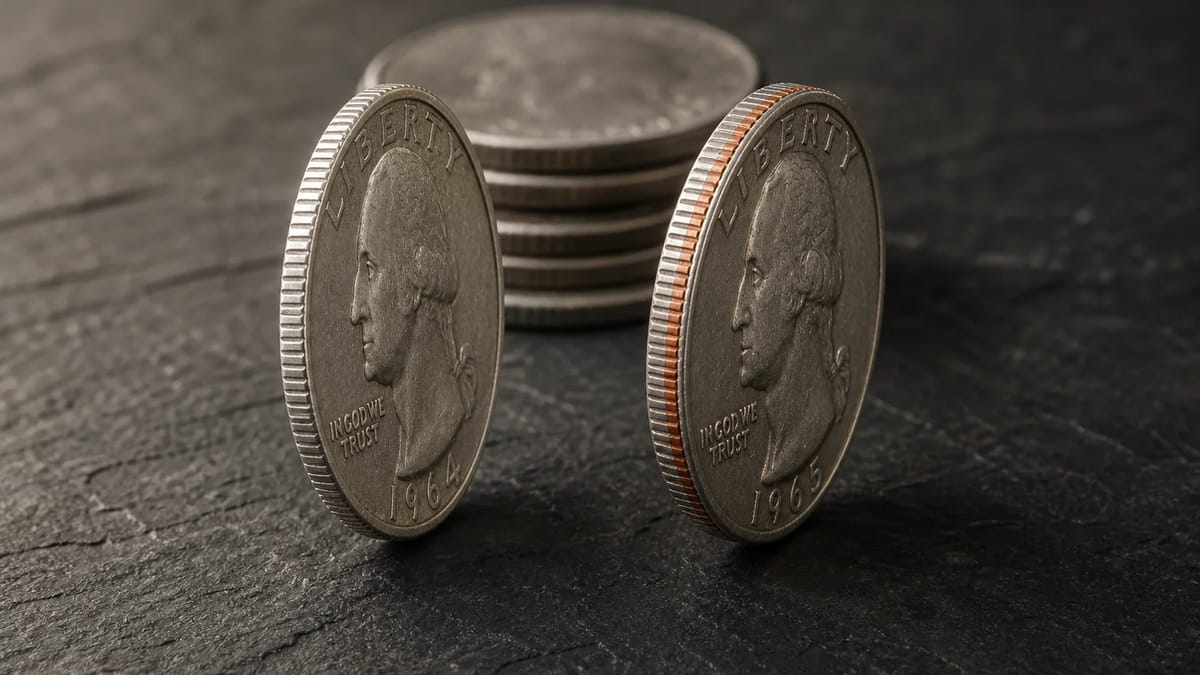
The math for a mixed roll: every silver quarter adds 0.58 g over a clad coin. A roll weighing 228 g is likely to hold two silver coins. A roll at 232 g suggests nine. A scale that reads to 0.1 g will flag a single silver quarter in a roll of clad; a cheap 1 g kitchen scale will catch two or more. Wear cuts both ways, since a heavily circulated silver quarter can lose a tenth of a gram or more, so treat the scale as a screening tool and confirm by edge. A silver quarter has a solid silver-colored edge, while a clad quarter shows a visible copper stripe. You can check any U.S. coin's weight, diameter, and metal content in the coin weight and purity lookup.
Wrapper colors: why quarter rolls are orange
Coin wrappers in the United States follow a color code by denomination, and the Federal Reserve requires the same colors on the tags of canvas coin bags, which it describes as being "color-coded in accordance with ABA standards based on denomination." The American Bankers Association code is: red for pennies, blue for nickels, green for dimes, orange for quarters, buff or yellow for half dollars, and gray for dollar coins. Wikipedia's coin wrapper article lists the same colors for wrappers, with yellow for halves.
Wrappers come in two forms. Flat paper wrappers are the kind banks hand out free to customers and are rolled by hand around a stack of coins. Preformed tubes, sometimes called "shotgun" rolls, are crimped at one end and filled by machine, which is how the rolls in a Federal Reserve box arrive. Coin wrapping machines date to the early 20th century; Wikipedia records banks using coin rolling machines by 1911, and the U.S. Gold Bureau credits the first coin wrapping machine to 1908. The biggest wrapper brand today is Coin-Tainer, whose maker states it has been "the #1 coin wrapper sold in North America since 1976." Other office-supply brands sell the same ABA colors, and the U.S. Mint's Coin Classroom notes that each wrapper is printed with the denomination and the value of a full roll ($10 for quarters).
One warning from the U.S. Gold Bureau: private sellers sometimes package "half rolls," "double rolls," or oddly counted rolls in fancy wrappers with a "bank value certificate." Nonstandard packaging does not add value. A standard roll is 40 quarters, and anything else is a marketing wrapper.
Coin roll hunting: what to look for in a roll of quarters
Coin roll hunting is buying rolls at face value, searching them, and returning the ordinary coins. Quarters are the most popular denomination to hunt because the upside is real: a single pre-1965 quarter carries about $11.82 of silver at the 3 September 2026 spot price, 47 times its face value, and modern rolls still turn up W mint marks and die varieties. Here is what to pull from a roll, with the value ranges Bullion Exchanges publishes in its rare quarters guide (retrieved 3 September 2026). The ranges run from circulated examples at the low end to high-grade certified coins at the top, on the standard Sheldon scale (G-4 through MS-70).
| What to look for | How to spot it | Published value range (Bullion Exchanges, circulated to high grade) |
|---|---|---|
| Any 1932 to 1964 Washington quarter | Date, plus a solid silver edge with no copper stripe; 6.25 g on a scale | Silver melt: about $11.82 per coin at $65.34/oz; common dates trade near melt |
| 1932-D Washington quarter | D mint mark on the reverse (see the mint marks guide) | $100 to over $10,000 |
| 1965 quarter on a silver planchet | A 1965 quarter with a silver edge that weighs 6.25 g instead of 5.67 g | $4,000 to $7,000 |
| 1976 Bicentennial quarter, 40% silver | Dual date 1776-1976, drummer reverse, S mint mark, no copper edge | $5 to over $100; the clad P and D versions are common in change |
| 1999-P Delaware "Spitting Horse" | Die crack running from the horse's mouth | $10 to $500 |
| 2004-D Wisconsin extra leaf (high or low) | Extra leaf on the left side of the corn husk | $100 to $1,200 |
| 2005 Minnesota doubled die reverse | Doubling in the trees to the right of the lake | $5 to $300 |
| 2015 Homestead "snow on the roof" | Die breaks across the cabin roof | $5 to $300 |
| 2019-W America the Beautiful quarters (Lowell and the other four 2019 designs) | W mint mark below "IN GOD WE TRUST" on the obverse | $20 to $100 (Lowell) |
| 2020-W America the Beautiful quarters with privy mark | W mint mark plus a small World War II privy mark on the obverse | $10 to over $100 |
Silver quarters (1932 to 1964)
This is the main prize. Bank rolls today rarely hold silver because hunters have pulled most of it over sixty years, but silver still turns up, especially in customer-wrapped rolls that came out of a jar someone had kept since the 1960s. Every pre-1965 Washington quarter is 90% silver with 0.18084 troy oz of pure silver, according to Money Metals. Check the date first, then the edge. The junk silver guide covers the dimes and halves you will find alongside them, and the Washington quarter hub lists the key dates worth more than melt.
1976 Bicentennial quarters
The dual-dated drummer boy quarter is the one everyone asks about. The circulating P and D coins are clad and common, so a worn one is worth a quarter. The 40% silver version carries an S mint mark and was sold in collector sets rather than released into circulation, so an S mint mark with a silver edge is what you want. Bullion Exchanges lists the silver version at $5 to over $100 depending on grade. The Bicentennial quarter hub breaks down the varieties, and the 1976-S 40% silver quarter guide gives values by grade.
W mint mark quarters (2019 and 2020)
In 2019 the West Point Mint struck two million of each of the five America the Beautiful designs with a W mint mark and released them straight into circulation, the first W quarters ever, and repeated it in 2020 (Wikipedia). Ten million coins a year sounds like a lot until you compare it with the hundreds of millions struck at Philadelphia and Denver for each design. Bullion Exchanges lists the 2019-W Lowell at $20 to $100 and the 2020-W issues at $10 to over $100. Look on the obverse, to the right of Washington's ponytail, for the W. Bullion Exchanges notes the 2020 coins also carry a small privy mark commemorating World War II.
America the Beautiful and American Women quarters
The 2010 to 2021 America the Beautiful series and the 2022 to 2025 American Women series are still in rolls everywhere, and most are worth face value. Their value to a roll hunter is in filling a set from circulation and in watching for the die varieties listed above. Bullion Exchanges' guide notes that the U.S. Mint sells these designs in its own rolls and bags, so a roll of a single new design is not rare in itself.
Errors and varieties
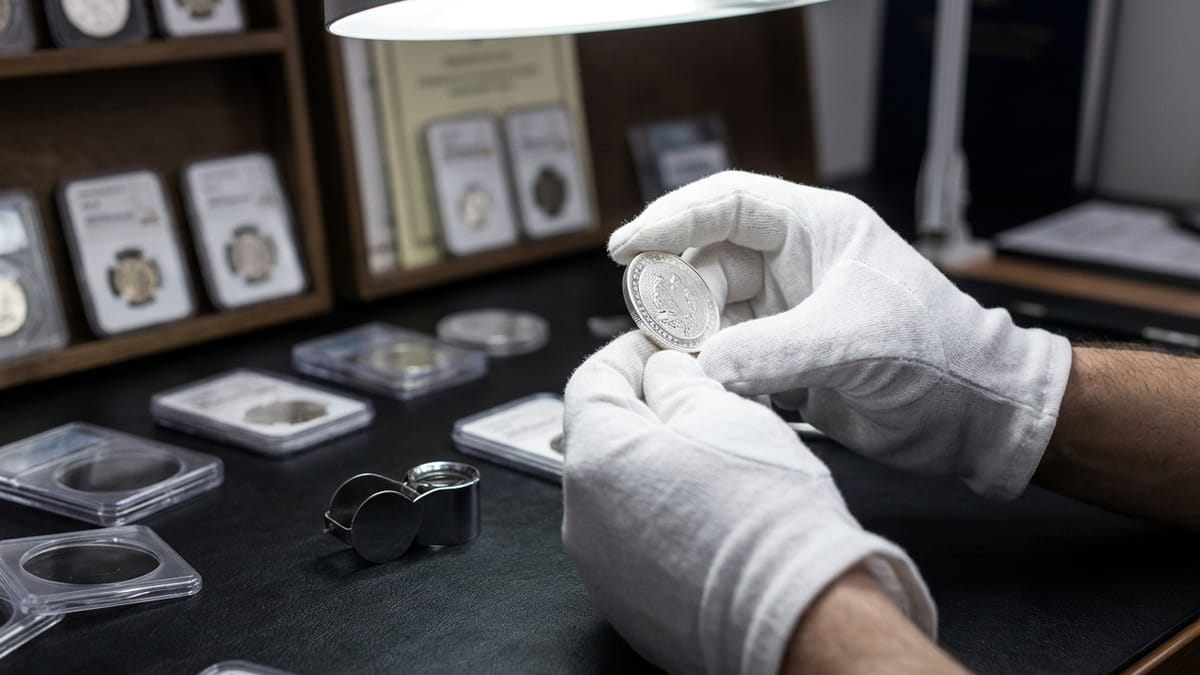
Bullion Exchanges groups the errors worth money into doubled dies (overlapping lettering or design), wrong planchet strikes (the 1965 silver quarter is the famous one), off-center strikes, and overdates. Use a loupe and good light. Most "errors" people find are post-mint damage, which adds nothing, so compare against reference photos before you set a coin aside. If you think you have a genuine variety, the grading standards guide explains when certification is worth the fee.
How to get rolls of quarters from a bank, and how to dump them back
Any bank will sell rolled coin at face value, but the practical limits vary. Hero Bullion's guide notes that some banks require you to hold an account before they will sell coin rolls, and that many limit how many rolls one customer can buy so they keep enough on hand for change. The U.S. Gold Bureau adds that tellers may resist large orders when their coin supply is short. A few steps that work:
- Open an account at a bank with a branch near you and ask the teller, not the drive-through, whether they can order a $500 box of quarters for you. Most branches order coin weekly, matching the Federal Reserve's basic service level of one coin order per week per endpoint.
- Ask for "customer wrapped" rolls if the branch has them. These came from other customers' jars and have not been machine-searched.
- Pay with cash or a withdrawal. Coin is sold at face value, so a box of quarters costs exactly $500.
- Search at home with a scale, a loupe, and a date list. Set aside silver, W quarters, and anything with an unusual edge or doubling.
- Re-roll the rejects in the free flat wrappers your bank provides, or take them loose to a branch with a customer coin counter.
What it costs to dump coins
Dumping is where the fees hide. The U.S. Gold Bureau notes that bank coin-counting machines are free at some branches and charge up to 10% of the coin total at others, so ask before you pour. Coinstar's own site states that coin transactions "may be subject to a service fee of up to 15.9% plus a transaction fee of up to $0.99," with the exact fee shown on the kiosk before you start. On a $500 box of quarters the worst case is $79.50 plus $0.99 in fees, which wipes out any find short of a silver coin or two. Coinstar's eGift card option has no-fee choices with some retailers, and Wikipedia records the historic U.S. cash fee at 12.5%. The cheapest dump is always a bank that accepts rolled coin from account holders at no charge. Etiquette matters too: do not dump at the same branch you buy from, or the teller will stop ordering for you.
How much is a roll of silver quarters worth
A roll of 40 pre-1965 quarters holds 40 x 0.18084 = 7.2336 troy oz of silver. At a silver spot price of $65.34/oz on 3 September 2026 (PeerMetals live silver price), that silver is worth about $472.64, or $11.82 per coin, against a face value of $10. The live figure changes every minute; enter $10 of face value into the junk silver calculator and it does the math at the current spot. For a single coin or an odd weight, the silver melt value calculator takes grams and purity directly.
Dealers quote the silver in a $10 roll slightly differently because circulated coins have lost metal to wear. SD Bullion lists 7.23 troy oz for a $10 face roll of AU/UNC Washington quarters, while JM Bullion's product listing for a circulated $10 tube cites about 7.15 troy oz of actual silver, and its silver coin guide gives 5.625 g (0.18085 oz) of silver per coin when new. For a worn roll, budget about 1% less silver than the mint-state figure.
What dealers charge for a roll of silver quarters
Retail prices for a $10 face roll of 90% silver quarters, as listed on SD Bullion on 3 September 2026 with silver at $65.91 ask on its ticker (check or wire price):
| Product (SD Bullion, $10 face, 40 coins) | Price | Premium over melt at $65.34/oz |
|---|---|---|
| 90% silver quarters, random design, circulated | $476.22 | about 0.8% |
| 90% silver Washington quarters, circulated | $478.36 | about 1.2% |
| 90% silver Washington quarters, AU/UNC | $499.81 | about 5.7% |
| 90% silver Standing Liberty quarters, dateless | $485.51 | about 2.7% |
| 90% silver Barber quarters, circulated | $521.26 | about 10.3% |
| $100 face bag, 400 quarters, random design | $4,762.19 | about 0.8% |
Two things stand out. First, common-date circulated silver quarters sell within about 1% of melt, so the silver price is what you are paying for. Second, condition and series add a premium: uncirculated Washingtons cost about 5% more, and Barber quarters from 1892 to 1916 about 10% more. When you sell a roll, expect a dealer to pay a little under melt for circulated coins. SD Bullion's page notes its published buyback estimates assume 500 ounces or more, so a single roll will get a lower bid.
Buying or selling rolls of silver quarters on PeerMetals
Sellers on the PeerMetals marketplace list 90% silver quarters by the coin, by the roll, and by the bag, often priced at or just under melt because there is no dealer overhead in the middle. Every listing shows the seller's price against live spot, so you can see the premium before you click. On the live silver page on 3 September 2026, for example, one seller had circulated 90% silver Washington quarters listed at $11.46 each, below the $11.82 melt value at that moment. If you have searched enough rolls to build up a stack of silver quarters, you can also list them for sale yourself at a flat seller fee with no listing charge.
Frequently asked questions
How many quarters are in a roll?
Forty. The U.S. Mint's Coin Classroom, JM Bullion, Money Metals, and every bank in the country use 40 quarters per roll. Multiply 40 by $0.25 and you get the roll's face value of $10.
How much is a roll of quarters worth?
A roll of modern clad quarters is worth its face value of $10. A roll of 1932 to 1964 silver quarters was worth about $472.64 in silver alone at $65.34/oz on 3 September 2026, and more if it holds key dates such as the 1932-D. Use the junk silver calculator for the live number.
How many quarters are in a box?
A bank box holds 50 rolls, so a box of quarters is 2,000 quarters and $500 in face value, per the U.S. Gold Bureau. It weighs about 25 pounds. A Federal Reserve bag is larger: $1,000, or 4,000 quarters, with an orange tag.
How much does a roll of quarters weigh?
A roll of 40 clad quarters weighs 226.8 g, about half a pound, based on the U.S. Mint's 5.67 g per coin. A roll of 40 silver quarters weighs 250 g because each silver quarter is 6.25 g. Each silver coin in a mixed roll adds 0.58 g.
Why are quarter wrappers orange?
The American Bankers Association color code assigns orange to quarters, and the Federal Reserve requires the same ABA colors on coin bag tags: red for pennies, blue for nickels, green for dimes, orange for quarters, buff for halves, and gray for dollars. The colors let a teller identify a roll or bag from across the vault.
Can you still find silver quarters in bank rolls?
Yes, but not often. Most silver was pulled from circulation decades ago. Your best odds are customer-wrapped rolls from small branches. Weigh rolls first: a roll over 227 g is worth opening. Any quarter dated 1964 or earlier is 90% silver.
How many W quarters were made?
Two million of each of the five 2019 America the Beautiful designs, or ten million in total, were struck at West Point with a W mint mark and released into circulation, and the program repeated in 2020, according to Wikipedia. Bullion Exchanges lists 2019-W and 2020-W quarters at roughly $10 to $100 or more depending on grade.