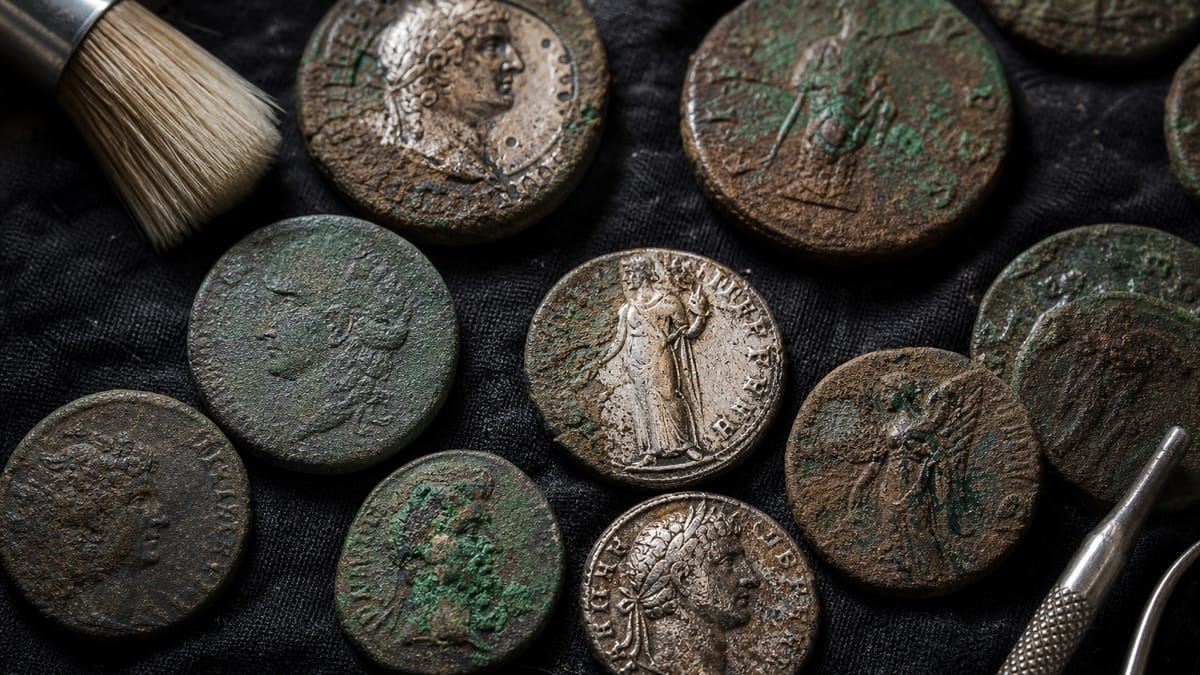
Silver Quarter Value: What Every 1932-1964 Quarter Is Worth Today

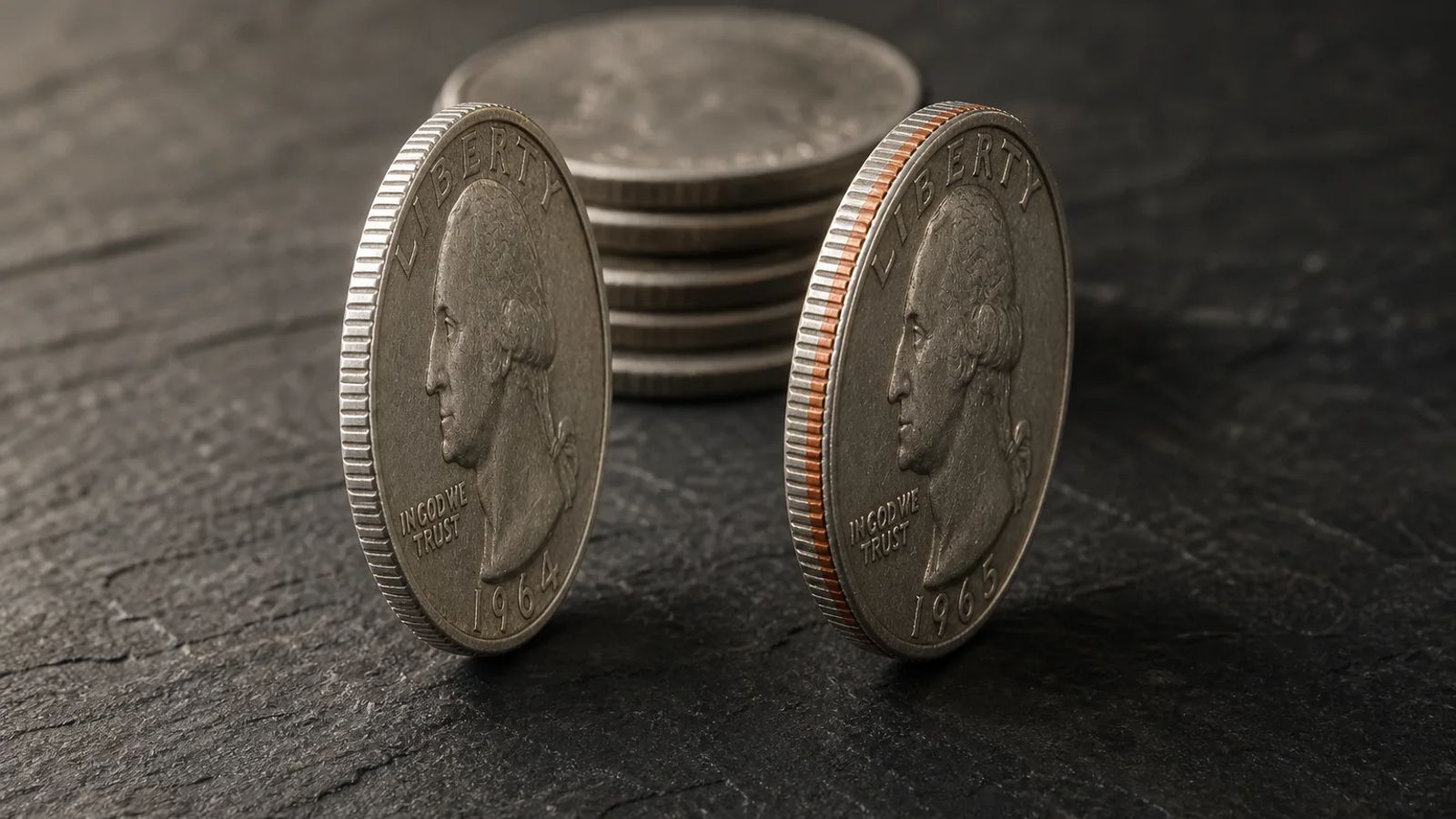
A common-date silver quarter is worth about $11.83 in silver alone at a silver spot price of $65.44/oz on 3 September 2026, and a worn one sells for a little over that. Every United States quarter dated 1964 or earlier is 90% silver and contains 0.1808 troy oz of pure silver, so the floor is the same whether the coin is a 1964 Washington, a 1928 Standing Liberty, or a 1908 Barber. The ceiling is set by date, mint mark, and condition: a 1932-D in MS-65 lists at $12,169 in USA Coin Book's price chart, and a 1916 Standing Liberty starts at $3,713 in Good condition on CoinStudy's chart (both retrieved September 2026).
Silver moves every day, so run your own coins through the junk silver calculator for the live number, and check the live silver price before you buy or sell. This guide covers which quarters are silver, how to tell in ten seconds, what each grade is worth, the key dates and doubled dies that are worth checking for, what a roll or a $1,000 face bag is worth, and, most usefully, what dealers actually pay versus what the price guides say.
Silver quarter value at a glance
| What you have | Value on 3 September 2026 (silver $65.44/oz) | Where the number comes from |
|---|---|---|
| Any 1892-1964 quarter, melt value | $11.83 | 0.1808 oz x $65.44 (NGC's melt table showed $11.84 the same day) |
| Worn common-date Washington (1934-1964), dealer bid | $8.92 to $10.20 | Gainesville Coins $35.66 and Money Metals $40.78 per $1 face, divided by 4 |
| Worn common-date Washington, dealer retail | $11.63 to $12.71 | Money Metals $46.50 and APMEX $50.84 per $1 face, divided by 4 |
| Worn common Standing Liberty (1925-1930) | $12.54 wholesale, $16.25 retail | CoinStudy Good grade; APMEX $64.99 per $1 face with dates |
| Worn common Barber (1900-1916) | $16.01 wholesale, $16.25 retail | CoinStudy Good grade; APMEX $64.99 per $1 face |
| Uncirculated common-date 1964 | $14.22 to $28 | CoinStudy Mint State (wholesale) to USA Coin Book MS-65 |
| Roll of 40 ($10 face) | $473 melt, $483.34 retail | 7.232 oz x $65.44; APMEX 40-coin roll, average circulated |
| $1,000 face bag (4,000 coins) | $46,790 melt at 0.715 oz per $1 face | 715 oz x $65.44 |
Which quarters are silver
Three circulating series and a handful of collector issues contain silver. Gold Silver Ledger's identification chart (retrieved September 2026) gives the specifications for each, and the U.S. Mint standardized the 6.25 g weight across all three circulating series.
| Series | Years | Composition | Gross weight | Pure silver | Notes |
|---|---|---|---|---|---|
| Barber quarter | 1892-1916 | 90% silver, 10% copper | 6.25 g | 0.1808 oz | Mint marks O, S, D on the reverse below the eagle |
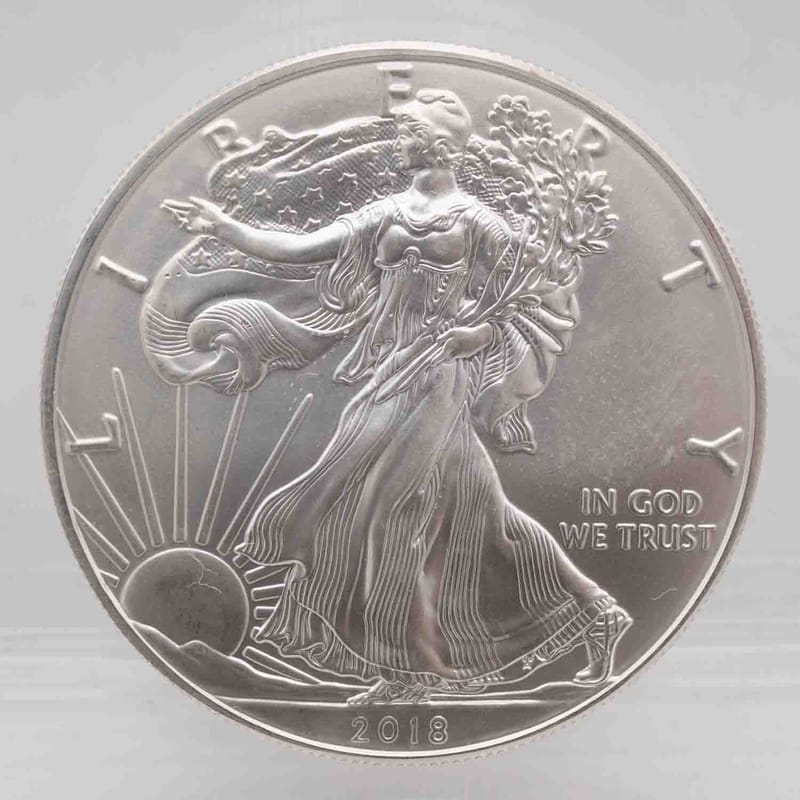
| Standing Liberty quarter | 1916-1930 | 90% silver | 6.25 g | 0.1808 oz | No 1922 issue; mint mark left of the date near the star |
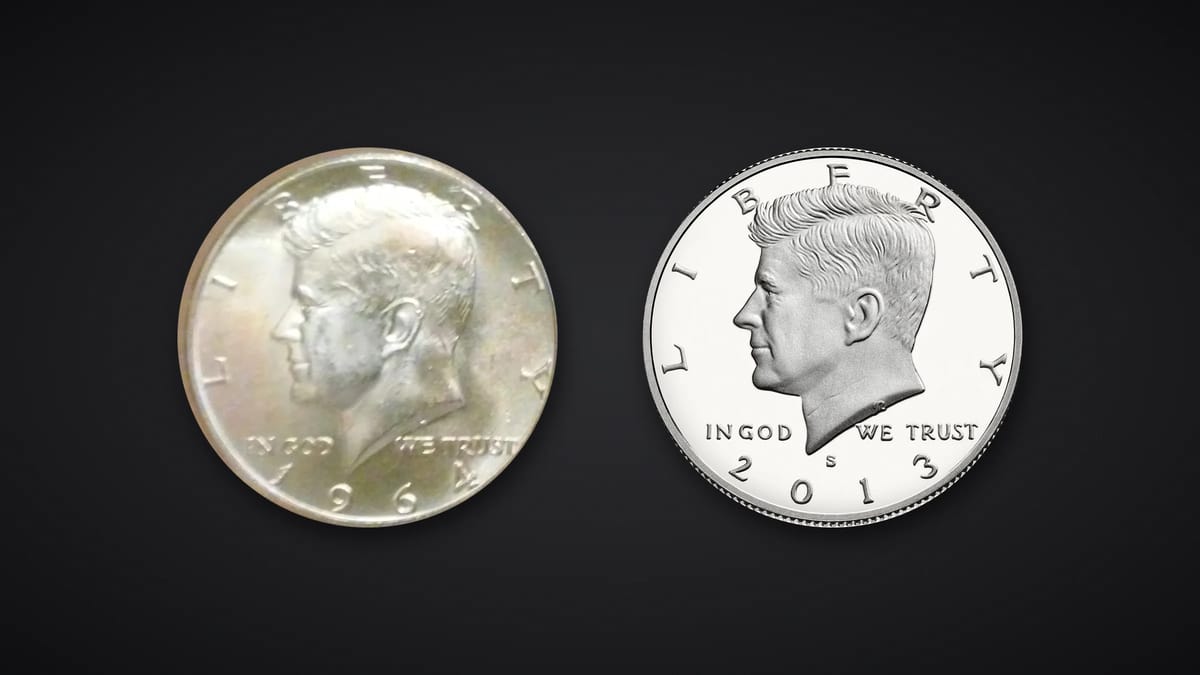
| Washington quarter, silver era | 1932-1964 | 90% silver | 6.25 g | 0.1808 oz | No 1933 issue; mint mark on the reverse below the wreath |
| Bicentennial, collector silver | 1976-S only | 40% silver | 5.75 g | 0.0739 oz | Sold only in Mint sets; never circulated |
| Silver proof quarters | 1992-2018 (S) | 90% silver | 6.25 g | 0.1808 oz | From annual silver proof sets |
| Silver proof quarters | 2019-present (S) | .999 fine silver | 6.343 g | about 0.2037 oz | Mint switched to .999 fine in 2019 |
| Washington quarter, clad | 1965-present (P, D, W) | Copper-nickel over copper | 5.67 g | 0 | Includes 1976 P and D, State, ATB, and 2019-W and 2020-W |
There is no such thing as a 1922, 1931, or 1933 silver quarter; the Mint struck none. Wartime 1941-1945 quarters are ordinary 90% silver, not a special alloy. The 35% silver wartime composition applies to nickels only, as our Jefferson nickel guide explains. Earlier Draped Bust, Capped Bust, and Seated Liberty quarters (1796-1891) are also silver, but they trade as collector coins at many multiples of melt and are outside the scope of this page.
How to tell a silver quarter from a clad one
- Read the date. 1964 or earlier is silver. 1965 or later is clad unless it is a 1976-S from a Mint set or an S-mint proof from a silver proof set.
- Look at the edge. A silver quarter has a solid silver-gray edge. A clad quarter shows a copper stripe through the middle of the reeding. Bullion Exchanges and Gold Silver Ledger both describe this as the fastest field test, and it works on coins with the date worn off.
- Weigh it. Silver is 6.25 g, clad is 5.67 g, and the 40% Bicentennial is 5.75 g. A kitchen scale reading to 0.1 g separates silver from clad; you need a 0.01 g jeweler's scale to separate the 40% coin from clad. The diameter is 24.3 mm for all of them, so measuring width tells you nothing.
- Drop it. On glass or stone, silver rings with a sustained high tone and clad gives a short clack. Skip this test on anything that might grade Mint State.
- Do not use a magnet. Neither silver nor clad is magnetic. A magnet only screens out steel-core fakes.
Our coin weight and purity lookup lists the official weight and fineness for every U.S. coin so you can check a scale reading against the standard.
Where the mint mark is
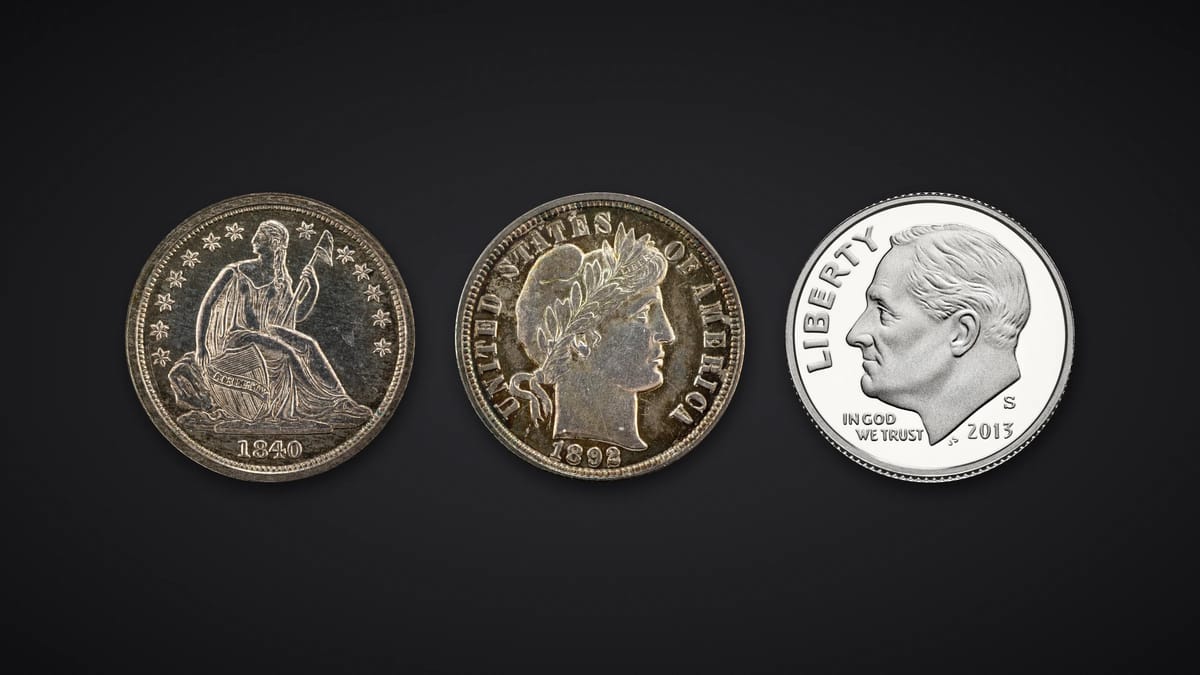
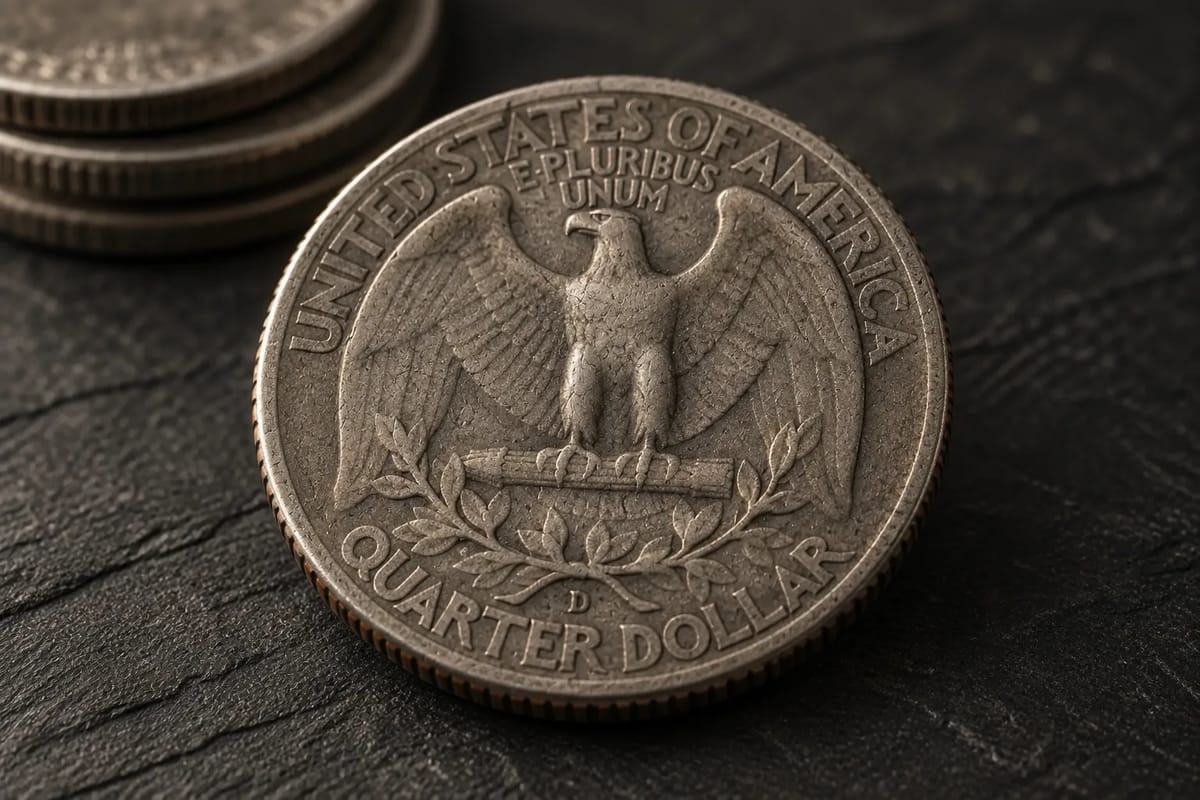
On 1932-1964 Washington quarters the mint mark sits on the reverse, just below the point where the two olive branches meet and above the letters ER of QUARTER. A D is Denver, an S is San Francisco, and no mark is Philadelphia. Standing Liberty quarters carry a tiny D or S on the obverse to the left of the date, next to the star; a magnifier helps. Barber quarters put the O, S, or D on the reverse under the eagle's tail feathers. Our mint mark field guide has photographs of each position.
Melt value math, worked example
The formula is weight in troy ounces times purity times spot. A quarter weighs 6.25 g, which is 0.2009 troy oz. At 90% fine that is 0.1808 troy oz of silver (5.625 g). Multiply by the spot price:
- 0.1808 oz x $65.44/oz = $11.83 per quarter on 3 September 2026.
- Four quarters make $1 face value, so $1 face holds 0.7232 oz of silver when the coins are unworn. Dealers quote 0.715 oz per $1 face to allow for wear, which gives 0.715 x $65.44 = $46.79 per $1 face, or $11.70 per quarter.
- A 40% silver 1976-S holds 0.0739 oz, worth $4.84 at the same spot.
- A 2019-or-later .999 silver proof (6.343 g) holds about 0.2037 oz, worth $13.33.
For comparison, SD Bullion published the same formula when silver was $17.61 and got $3.18 per quarter; Money Metals' product page still shows $5.37 at a $30 spot; Bullion Exchanges wrote $6.15 at $34 in March 2025; CBS News computed a $571 roll at $78.95 in February 2026. Those figures are all correct for their dates and all wrong today, which is why the silver melt calculator pulls the live price instead of a fixed one.
Silver Washington quarter values by grade
Two kinds of price exist for common silver quarters. Retail guides such as USA Coin Book quote what you would pay a dealer; CoinStudy publishes wholesale figures computed from dealer buy lists, which it says "reflect closely the value you would expect to receive when selling." The two disagree by about $6 on a worn coin, so both are shown. Grade scale: G-4 (Good), VG-8, F-12 (Fine), VF-20, EF-40 (Extremely Fine), AU-50, MS-60 (Mint State), MS-65 (Gem). USA Coin Book figures are its retail chart with the numismatic portion last updated February 2026 and the metal portion updated live; CoinStudy figures are dated 31 August 2026 at $66.33 silver.
| Date (Philadelphia unless noted) | G-4 | VG-8 | F-12 | VF-20 | EF-40 | AU-50 | MS-60 | MS-65 | CoinStudy wholesale G / EF / MS |
|---|---|---|---|---|---|---|---|---|---|
| 1932 | $17.87 | $19 | $22 | $25 | $28 | $29 | $39 | $354 | $11.14 / $14.42 / $39 |
| 1935 | $17.10 | $18.60 | $19 | $20 | $23 | $27 | $36 | $96 | $11.14 / $13.32 / $28 |
| 1940 | $17.10 | $17.10 | $17.10 | $19 | $22 | $24 | $30 | $70 | $11.14 / $12.51 / $28 |
| 1945 | $17.10 | $17.10 | $17.10 | $17.10 | $17.10 | $18.60 | $20 | $51 | $11.14 / $11.83 / $14.81 |
| 1950 | $17.10 | $17.10 | $17.10 | $17.10 | $17.10 | $18.60 | $22 | $49 | $11.14 / $11.14 / $17.65 |
| 1955 | $17.10 | $17.10 | $17.10 | $17.10 | $17.10 | $18.60 | $20 | $39 | $11.14 / $11.14 / $14.22 |
| 1960 | $17.10 | $17.10 | $17.10 | $17.10 | $17.10 | $18.60 | $20 | $29 | $11.14 / $11.14 / $14.22 |
| 1964 and 1964-D | $17.10 | $17.10 | $17.10 | $17.10 | $17.10 | $18.60 | $20 | $28 | $11.14 / $11.14 / $14.22 |
The pattern is clear. From 1941 onward, a Washington quarter is a bullion coin in every grade below MS-63, and even a gem 1964 is worth $28 retail. The money is in the 1930s: 1936-D is $36 in Good and $1,253 in MS-65 on USA Coin Book's chart, 1935-D reaches $210 in Mint State on CoinStudy's wholesale list, and every D or S coin from 1932 to 1940 deserves a second look in EF or better. Our Washington quarter hub has a date-by-date table, and the 1964 quarter guide covers the most common silver quarter of all, with a combined Philadelphia and Denver mintage above 1.26 billion.
Standing Liberty quarter values, common dates
Standing Liberty quarters carry a premium over Washington quarters in every grade because the design is popular and the series is short. CoinStudy's wholesale chart dated 31 August 2026 (grade scale: Good, Fine, Extremely Fine, Mint State) gives these figures for the dates you are most likely to find:
| Date | G-4 | F-12 | EF-40 | MS-60 |
|---|---|---|---|---|
| 1917 Type I (no stars below eagle) | $21 | $56 | $126 | $305 |
| 1918 | $19 | $33 | $57 | $211 |
| 1920 | $25.24 | $34 | $40 | $209 |
| 1924 | $25.24 | $38 | $39 | $215 |
| 1925 | $12.54 | $17.03 | $44 | $199 |
| 1926 | $12.54 | $15.95 | $34 | $175 |
| 1928 | $12.54 | $15.95 | $35 | $224 |
| 1929 | $12.54 | $15.95 | $34 | $175 |
| 1930 | $12.54 | $15.95 | $33 | $202 |
Two practical points. Before 1925 the date sat high on the pedestal and wore off quickly, so most 1917-1924 coins found in bulk are dateless; APMEX sells a 40-coin roll of dateless Standing Liberty quarters for $462.77, about $11.57 a coin, which is melt plus pennies. A coin with a full readable date trades at $64.99 per $1 face on the same site, or $16.25 each. More on grading and varieties in the Standing Liberty quarter hub.
Barber quarter values, common dates
CoinStudy's chart (31 August 2026) starts common Barber quarters at $16.01 in Good and notes that dealers pay $16.01 to $18.44 for worn examples, a built-in premium over the $11.14 they pay for a worn Washington. Same grade scale:
| Date | G-4 | F-12 | EF-40 | MS-60 |
|---|---|---|---|---|
| 1892 | $18.44 | $26 | $71 | $209 |
| 1899 | $18.44 | $25 | $60 | $222 |
| 1900 | $16.01 | $24 | $74 | $237 |
| 1907 | $16.01 | $25 | $65 | $273 |
| 1908 | $16.01 | $25 | $65 | $237 |
| 1912 | $16.01 | $24 | $59 | $239 |
| 1914 | $16.01 | $24 | $58 | $237 |
| 1916 | $16.01 | $24 | $65 | $240 |
The step from Good to Fine roughly doubles the value on Barber quarters, and the tell is the headband: a coin showing all seven letters of LIBERTY, including the final Y, is Fine or better. APMEX was retailing average-circulated Barber quarters at $64.99 per $1 face on 3 September 2026, marked down from $89.99. See the Barber quarter hub for every date and mint.
Key dates, overdates, and doubled dies worth checking for
These are the silver quarters that are worth far more than their metal in any grade. Mintages are from USA Coin Book, CoinStudy, and Hero Bullion; values are USA Coin Book retail unless noted, with APMEX's key-date guide and CoinStudy's wholesale figures for comparison.
| Coin | Mintage | What to look for | G-4 | VF-20 | EF-40 | MS-60 | MS-65 |
|---|---|---|---|---|---|---|---|
| 1932-D Washington | 436,800 | D below the wreath on the reverse | $121 | $202 | $258 | $1,253 | $12,169 |
| 1932-S Washington | 408,000 | S below the wreath; lowest mintage of the series | $112 | $157 | $195 | $537 | $3,095 |
| 1934 Doubled Die Obverse | Unknown | Strong doubling on IN GOD WE TRUST | $70 | $195 | $290 | $1,253 | $4,080 |
| 1937 Doubled Die Obverse | Unknown | Doubling around the date | $290 | $594 | $800 | $2,778 | $11,101 |
| 1942-D Doubled Die Obverse | Unknown | Doubling on LIBERTY | $141 | $298 | $459 | $2,121 | $8,596 |
| 1943-S Doubled Die Obverse | Unknown | Doubling around the date | $78 | $163 | $258 | $676 | $2,043 |
| 1916 Standing Liberty | 52,000 | Date on the pedestal, no stars under eagle | $3,713 (CoinStudy) | Rare (CoinStudy) | Rare (CoinStudy) | Rare (CoinStudy) | Hero Bullion range $2,000 to $25,000; auction record about $207,400 |
| 1918/7-S Standing Liberty | Unknown | A 7 visible under the 8; easily mistaken for a plain 1918-S | $1,425 (CoinStudy) | F-12 $2,123 (CoinStudy) | Rare (CoinStudy) | Rare (CoinStudy) | Hero Bullion range $1,500 to $35,000; auction record $336,000 |
| 1927-S Standing Liberty | 396,000 | S left of the date | $44 (CoinStudy) | F-12 $126 (CoinStudy) | $998 (CoinStudy) | Rare (CoinStudy) | Hero Bullion range $50 to $46,000 |
| 1896-S Barber | about 188,000 | S under the eagle | $723 (CoinStudy) | F-12 $1,925 (CoinStudy) | Rare (CoinStudy) | Rare (CoinStudy) | Hero Bullion range $700 to $26,000 |
| 1901-S Barber | about 72,600 | S under the eagle; the series key | Rare (CoinStudy) | Rare (CoinStudy) | Rare (CoinStudy) | Rare (CoinStudy) | Hero Bullion range $4,000 to $60,000 |
| 1913-S Barber | 40,000 | S under the eagle; lowest Barber mintage | $1,033 (CoinStudy) | Rare (CoinStudy) | Rare (CoinStudy) | Rare (CoinStudy) | Hero Bullion range $1,400 to $40,000 |
A few notes on this table. APMEX's key-date guide (updated July 2026) prices the 1932-D at $175 Very Fine, $600 About Uncirculated, and $1,600 Choice Uncirculated, and the 1932-S at $125, $300, and $600, which sits between USA Coin Book's retail and CoinStudy's wholesale ($54 Good and $806 Mint State for the D; $48 and $315 for the S). Read our dedicated 1932-D quarter guide and 1932-S quarter guide before you buy either one raw: Hero Bullion calls them the most counterfeited coins on its list, and added mint marks are common. The 1943 Philadelphia doubled die is a different and much rarer coin than the 1943-S; APMEX notes only 13 have been graded by PCGS, and USA Coin Book lists it at $1,007 in Good. Two later varieties are also worth knowing: the 1950-D over S ($125 VF, $775 Choice Unc per APMEX) and the 1950-S over D ($185 VF, $450 Choice Unc).
Modern silver quarters, and the modern quarters that are not silver
1976-S 40% silver Bicentennial
The dual-dated 1776-1976 quarter with the drummer boy reverse is clad if it came from Philadelphia (no mint mark) or Denver (D), and those are worth 25 cents in circulated condition. The San Francisco Mint also struck a 40% silver version for collector sets. PCGS CoinFacts lists it at 5.75 g, 40% silver and 60% copper, with a mintage of 11,000,000 for the uncirculated version; USA Coin Book gives 8,906,940 for the same issue, so the two references disagree on the count. Melt is $4.84 at today's spot. USA Coin Book prices the uncirculated coin at $12.41 in MS-65 and the proof at $14 in PR-65. The one outlier is condition: PCGS records an auction of $19,200 for an MS-69 example in June 2019, with fewer than a handful known at that grade. Our Bicentennial quarter hub and the 1976-S 40% silver guide cover the set packaging and how to tell the two apart by weight.
Silver proof quarters, 1992 to today
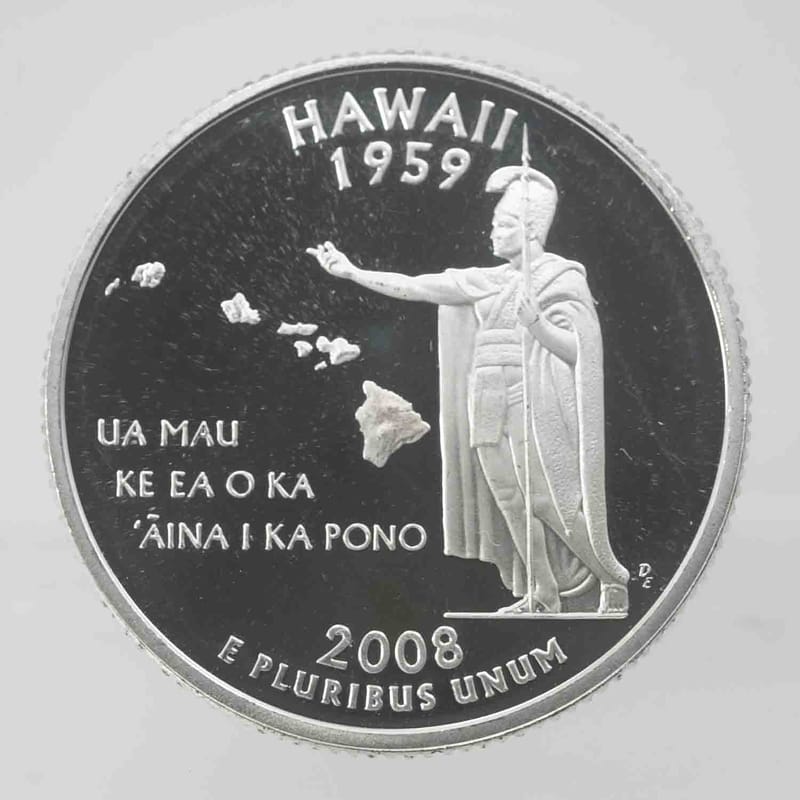
Since 1992 the Mint has sold an annual silver proof set with an S-mint quarter (five different quarters a year during the State and America the Beautiful programs). Gold Silver Ledger's chart gives 90% silver at 6.25 g and 0.1808 oz for 1992-2018, and .999 fine at 6.343 g, about 0.2037 oz, from 2019 onward. USA Coin Book prices the 1992-S through 1998-S silver proofs at $22 each in PR-65, against a 1992-S silver proof mintage of 1,317,579. Loose silver proof State and ATB quarters trade close to melt: APMEX sells them at $49.99 per $1 face, less than it charges for circulated 90% coins. A silver proof only ever reaches pocket change when someone breaks a set, so a 1992-or-later S-mint quarter in a capsule is worth weighing; one in a coin jar is almost always clad.
2019-W and 2020-W quarters: valuable, but not silver
These get mixed into silver searches constantly. In 2019 and 2020 the West Point Mint released 2 million quarters of each of five designs into circulation, 10 million per year, with a W mint mark on the obverse to the right of Washington's ponytail; the 2020 coins add a V75 privy mark. They are standard 5.67 g clad quarters with no silver. Coin ID Scanner's guide (updated May 2026) values a circulated 2019-W at $10 to $20 and a 2020-W at $15 to $30, uncirculated at $25 to $45 and $35 to $65, and MS-65 at $70 to $110 and $85 to $140. Keep them, but do not sell them as silver or expect a dealer to pay silver money for them.
What a roll or a bag of silver quarters is worth
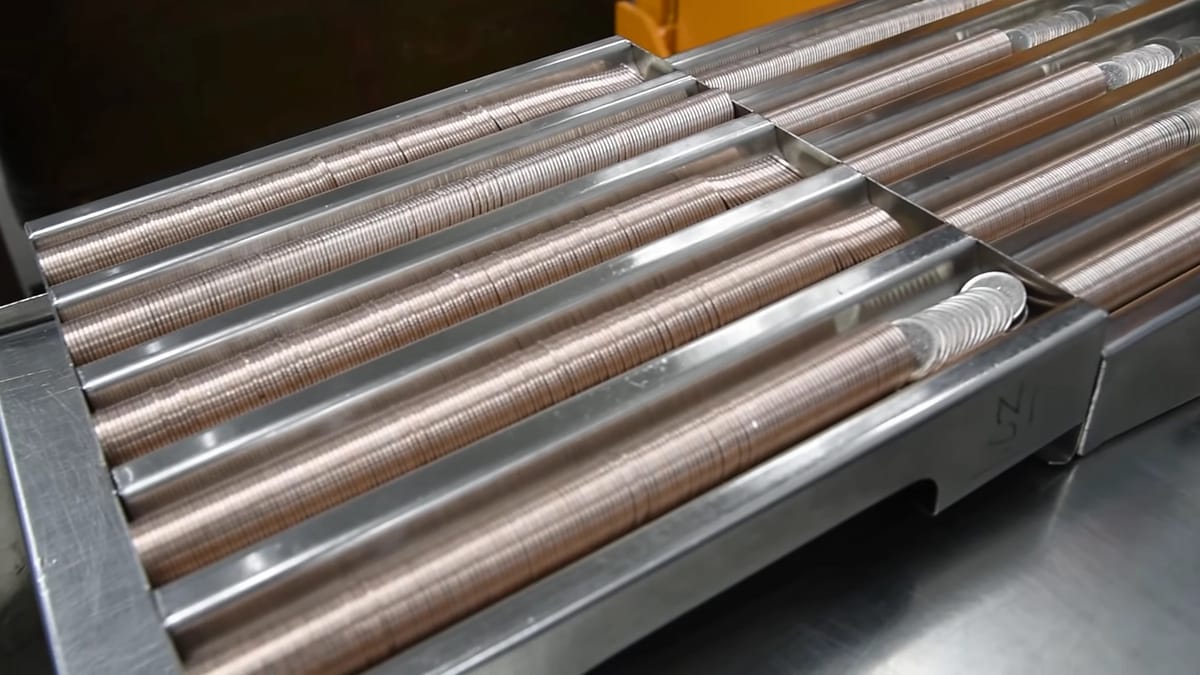
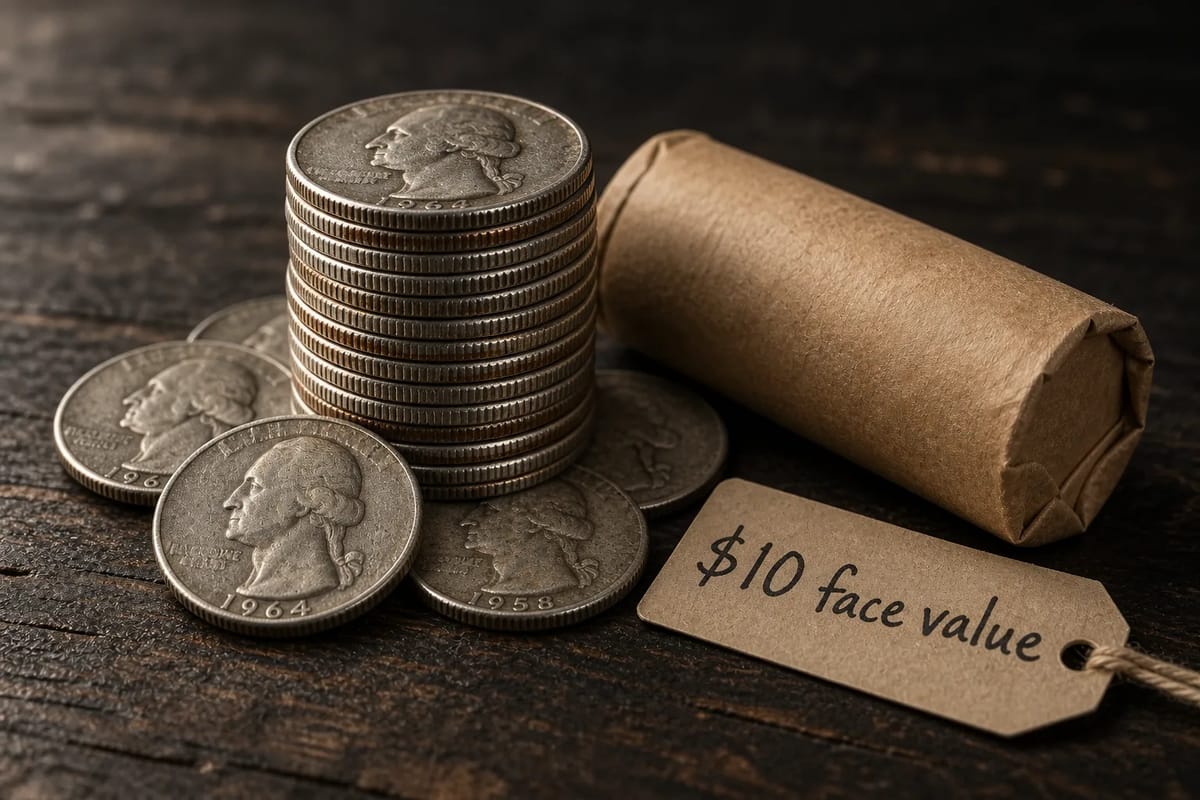
Bulk silver quarters are quoted per $1 of face value, and dealers use 0.715 oz of silver per $1 face to account for wear. A roll holds 40 coins ($10 face), a half bag is $500 face, and a full bag is $1,000 face (4,000 coins, about 55 pounds). At $65.44 silver:
| Lot | Coins | Silver at 0.715 oz per $1 face | Melt value | Dealer retail, 3 September 2026 | Dealer bid, 3 September 2026 |
|---|---|---|---|---|---|
| $1 face | 4 | 0.715 oz | $46.79 | $46.50 (Money Metals) to $50.84 (APMEX) | $35.66 (Gainesville) to $40.78 (Money Metals) |
| Roll, $10 face | 40 | 7.15 oz | $467.90 | $483.34 (APMEX average circulated roll) | $356.60 to $407.80 |
| $50 face bag | 200 | 35.75 oz | $2,339.48 | $2,416.70 (APMEX) | $1,783 to $2,039 |
| $100 face bag | 400 | 71.5 oz | $4,678.96 | $4,650 to $5,084 | $3,566 to $4,078 |
| $500 face | 2,000 | 357.5 oz | $23,394.80 | $23,250 (Money Metals) | $17,830 to $20,390 |
| $1,000 face bag | 4,000 | 715 oz | $46,789.60 | $46,500 to $50,840 | $35,660 to $40,780 |
If your coins are unworn the true silver content is 0.7232 oz per $1 face, which lifts a $1,000 bag to 723.2 oz and $47,326 in metal. Uncirculated rolls do carry a premium: APMEX prices a BU 40-coin roll at $494.06 and a bank-wrapped BU roll at $544.12, versus $483.34 for average circulated. CBS News' February 2026 article is the one most people find for this question; it used 0.18084 oz per coin, 7.2336 oz per roll, and a $78.95 spot for a $571 roll. Silver is 17% lower now, so plug your own count into the junk silver calculator rather than reusing that number.
What dealers actually pay versus the price guides
This is the part most value guides skip. There are three different prices for a common silver quarter, and only one of them is what you will be handed.
| Price type | Source and date | Per $1 face | Per quarter | Versus $46.79 melt |
|---|---|---|---|---|
| Retail guide, worn common date | USA Coin Book G-4, retrieved 3 September 2026 | $68.40 | $17.10 | 46% over melt |
| Dealer retail (what you pay) | APMEX 90% Silver Coins $1 Face Value Avg Circ, 3 September 2026 | $50.84 | $12.71 | 8.7% over melt |
| Dealer retail (what you pay) | Money Metals quarters-only bag, $5 face quantity, 3 September 2026 | $46.50 | $11.63 | 0.6% under melt |
| Wholesale guide | CoinStudy Good grade, 31 August 2026 | $44.56 | $11.14 | 4.8% under melt |
| Dealer bid (what you get) | Money Metals sell-to-us price, 3 September 2026 | $40.78 | $10.20 | 12.8% under melt |
| Dealer bid (what you get) | Gainesville Coins 90% US Silver Coins buy price, 3 September 2026 | $35.66 | $8.92 | 23.8% under melt |
Three things stand out. First, the bid-ask spread on junk silver is wide right now: a buyer at APMEX pays $50.84 and a seller at Gainesville gets $35.66, a 30% gap on the same $1 of coins. Second, dealers are bidding under melt, not over it. CBS News wrote in February 2026 that selling "might net you closer to the spot value or slightly below"; seven months later the two published bids are 13% and 24% below. Money Metals' own product reviews describe junk silver's "discounted price vs spot," which tells you dealers have more of it than they want. Third, printed guides lag. JM Bullion's Washington quarter table, sourced from the Red Book, still lists common dates at $7 to $8 in Extremely Fine, below the $11.83 melt, and the 1932-D at $190 in Fine against USA Coin Book's $141 and CoinStudy's $71. When a guide number is below melt, ignore it; when it is far above what dealers bid, treat it as a ceiling for a retail sale to a collector, not a floor.
Junk silver quarters are also priced per $1 face regardless of date, as Gainesville's buy page states outright, so a dealer buying a bag will pay the same for a 1934 as a 1964. Anything from the key-date table above should be pulled out and sold separately.
Grading pitfalls that cost real money
- Cleaning. A cleaned coin is worth melt no matter what the date. CoinStudy's Standing Liberty page shows a cleaned example and says any value as a collectible is "washed" away. Never polish, dip, or wipe a coin you think might be a key date.
- Grade inflation on the 1932-D and 1932-S. USA Coin Book's spread from EF-40 ($258) to MS-65 ($12,169) on the 1932-D means a one-grade mistake at the top is a four-figure mistake. Anything you believe is AU or better in these two dates should be graded by PCGS or NGC before it is sold. Our grading standards guide explains what each service charges and what the grades mean.
- The EF-40 line on 1930s Washingtons. CoinStudy calls Extremely Fine "a key grade separating bullion from collector quality." On a Washington quarter that means only the tops of the hair waves above the ear are flat and the eagle's chest still shows some feather lines. Below that, a 1930s coin is worth silver; above it, it starts to carry a date premium.
- Dateless Standing Liberty quarters. A worn-off date means bullion value, about $11.57 a coin at APMEX's dateless roll price, even though the coin might have started life as a 1927-S. Pre-1925 coins with a full date are worth setting aside on that basis alone.
- Counterfeits and altered mint marks. Weigh any 1932-D, 1932-S, 1916, 1918/7-S, 1901-S, or 1913-S. A genuine coin is 6.25 g; a cast fake is usually light and often has a soft, grainy edge. Hero Bullion's guide recommends authentication before buying or selling any of these, and that advice is right.
How to sell silver quarters
- Sort into two piles. Common dates (anything 1934 and later without a doubled die, plus worn common Standing Liberty and Barber coins) go in the bulk pile. Everything in the key-date table, every 1932-D or 1932-S, every 1930s D or S coin in EF or better, and every Barber or Standing Liberty coin in Fine or better goes in the collector pile.
- Weigh and count the bulk pile. Count face value, multiply by 0.715 oz, and check the result against the junk silver calculator. That is your melt figure. Expect a bulk buyer to bid 10% to 25% under it today, and get at least two quotes; the two published bids on 3 September 2026 differed by $5.12 per $1 face.
- Price the collector pile against a live guide, not a book. Use USA Coin Book or the PCGS price guide for retail, CoinStudy for wholesale, and treat a realistic private-sale price as somewhere between them.
- Sell peer to peer to close the spread. On PeerMetals, sellers list junk silver and collector coins directly to buyers, and every listing shows the seller's price against live spot, so a buyer can see a roll priced at 2% over melt and a seller can capture most of the retail-versus-bid gap instead of giving 30% of it to a middleman. The marketplace has 90% silver quarter listings priced under spot at the time of writing, and you can list your own with a flat 2.75% fee and no listing fee.
- Ship it properly. Money Metals' terms require USPS Registered Mail insured for full value and note that UPS and FedEx exclude precious metals from their insurance. Double-box anything over five pounds, which is any bag above about $90 face.
Store bulk quarters in tubes or the original canvas bag in a dry place; 90% silver tones but does not corrode in normal conditions. Put anything from the collector pile in an inert 2x2 flip or a graded holder so it cannot be scratched or fingerprinted. For a longer treatment of 90% coinage as a bullion product, including dimes and halves, read our junk silver guide.
Frequently asked questions
How much is a 1964 silver quarter worth?
About $11.83 in silver at a $65.44 spot on 3 September 2026, and a worn one sells for $11.63 to $12.71 at the large online dealers. USA Coin Book lists an MS-65 at $28 and CoinStudy's wholesale chart pays $14.22 for a Mint State coin. With more than 1.26 billion struck between Philadelphia and Denver, there is no date premium below gem grade.
How much silver is in a quarter?
A 1964-or-earlier quarter contains 0.1808 troy oz (5.625 g) of pure silver inside a 6.25 g coin. The 1976-S 40% Bicentennial contains 0.0739 oz. Silver proofs from 2019 onward are .999 fine, weigh 6.343 g and hold about 0.2037 oz. A clad quarter from 1965 onward holds none.
Are pre-1965 quarters worth more than melt?
Common dates, no. Dealers bid under melt for them in bulk right now ($35.66 to $40.78 per $1 face against $46.79 melt) and retail them at melt to 9% over. The exceptions are the 1932-D and 1932-S, the 1934, 1937, 1942-D, and 1943-S doubled dies, most Denver and San Francisco coins from the 1930s in EF or better, and any Barber or Standing Liberty coin with a readable date and a full LIBERTY.
Which silver quarters are worth the most?
Among coins you could plausibly find, the 1932-D ($121 in Good, $12,169 in MS-65 at USA Coin Book) and the 1937 doubled die ($290 to $11,101) lead the Washington series. The 1916 Standing Liberty (52,000 struck, $3,713 in Good) and 1918/7-S overdate ($1,425 in Good, auction record $336,000) lead that series. The 1901-S Barber (about 72,600 struck) is the key of its series and is worth $4,000 or more even heavily worn, according to Hero Bullion's 2026 guide.
How much is a roll of silver quarters worth?
A 40-coin roll ($10 face) holds 7.15 oz of silver at the dealer standard of 0.715 oz per $1 face, worth $467.90 at $65.44 silver, or 7.232 oz and $473.26 if the coins are unworn. APMEX was selling an average-circulated roll for $483.34 on 3 September 2026 and dealers were bidding $357 to $408 for the same roll.
Is a 1965 quarter silver?
No. 1965 was the first year of copper-nickel clad quarters under the Coinage Act of 1965, and a 1965 quarter weighs 5.67 g with no silver. A handful of 1965 quarters were struck on leftover silver planchets; if yours weighs 6.25 g and has a solid silver edge, have it authenticated, because Bullion Exchanges notes verified examples sell for thousands.
Are the W quarters silver?
No. The 2019-W and 2020-W America the Beautiful quarters are clad, 5.67 g, and were released into circulation at 2 million per design. They are collectible because of the low mintage, with circulated examples worth $10 to $30 and MS-65 coins $70 to $140 per Coin ID Scanner's May 2026 guide, but they contain no silver and should not be sold as such.